
Letter to the Representative
The Honorable Josh Harder
California House of Representatives
Stockton District Office
1776 W March Ln, Suite 360
Stockton, CA 95207
Dear Representative Harder:
My name is Elizabeth Adetayo, a social work professional and a constituent deeply engaged in the well-being of our community in Stockton. I would like to ask that you advocate for greater investment and organization of the National Housing Trust Fund (NHTF). As a frontline advocate, I witness the evils of housing insecurity on the lives of entire families and individuals in our area. Our most vulnerable require stronger federal solutions.
Stockton has expensive housing and a few affordable housing opportunities. Families are subjected to overcrowding, mobility, and homelessness. This housing insecurity endangers educational performance, mental health, and upward mobility. Whereas the SHIP program demonstrates the local potential of Florida, the NHTF is better suited as a national policy that can mitigate the disparities in the system. By increasing the NHTF, more of those with great need, such as our community, would be served and have access to long-term, stable housing opportunities.
The National Low Income Housing Coalition emphasizes that the U.S. lacks over seven million affordable rental homes for extremely low-income renters. The insecurity of housing is compounded by people such as Rachel Litchman, a homeless person, because of her disability. In Stockton, such stories are way too familiar. Federal funding under the NHTF could be long-term and aim at lifting residents by providing them with housing and wraparound resources.
I humbly request that you advocate for more investments and equal distribution of the National Housing Trust Fund. You can fully reconcile policy and justice through your leadership because all families in Stockton should have somewhere to call home. Let’s make housing stability a foundation, not a privilege. I appreciate your kind support and advocacy on this urgent matter.
I appreciate your consideration of my viewpoint on this matter. It is a crisis issue, and I hope the law can be tightened up to support the delivery of permanent housing solutions to our most vulnerable residents.
Sincerely,
Elizabeth Adetayo,
Address
Phone Number
Email Address
Part 2: Reflection on Advocacy Message Submission
Sending the letter to my representative was an empowering and complete act. Being a social work professional, I was happy to contribute to such a serious issue like housing insecurity with my voice. The underpinning that I had done a thorough job in researching the policy helped me feel at ease with the message, and it also contributed to my willingness to advocate. I have learned through this encounter that civic engagement is a critical part of being a professional in the field of social work.
I preferred to use a formal letter as opposed to an email. A physical letter is more personal, and it can be more respected by political representatives. Also, the format of the formal letter corresponded with the advocacy material in the materials offered this week. I wanted the message to be more professional with a feeling of urgency, which is outstanding.
I adhered to the guidelines that are offered in the Learning Resources for this week by starting with a formal salutation and defining the problem. I used studies, facts, and personal pleas to explain the impact of housing instability on constituents. I concluded by humbly urging an action and a professional closing in a straightforward and clear tone.
The advocacy skills that I employed include persuasive writing, issue framing, and a message tailored to the specific context of the representative. I also incorporated storytelling and facts to make the problem understandable and humane, and to show the big question on the community scale. These tactics succeeded in conveying urgency effectively and getting the interest of the legislators.
My next steps include following up with the representative office back and checking on any policy progress on the National Housing Trust Fund. I will also carry out community awareness programs and coalition building. A sustained campaign of advocacy and education needs to occur to support long-term structural change in housing policy.
ORDER A PLAGIARISM-FREE PAPER HERE
We’ll write everything from scratch
Question 
Letter to the Representative
Sample letter:
https://www.altaread.org/chapters/legislation/sample-letter-to-a-representative/
* Policy or Policy Alternative : #60896/60623
*Depending on the urgency of a social problem and policy timeline, you may not have the opportunity to attend a meeting with local, state, or federal representatives to vocalize your advocacy goals as they relate to the specific policies and agendas.
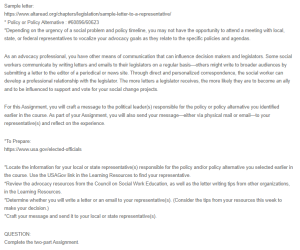
Letter to the Representative
As an advocacy professional, you have other means of communication that can influence decision makers and legislators. Some social workers communicate by writing letters and emails to their legislators on a regular basis—others might write to broader audiences by submitting a letter to the editor of a periodical or news site. Through direct and personalized correspondence, the social worker can develop a professional relationship with the legislator. The more letters a legislator receives, the more likely they are to become an ally and to be influenced to support and vote for your social change projects.
For this Assignment, you will craft a message to the political leader(s) responsible for the policy or policy alternative you identified earlier in the course. As part of your Assignment, you will also send your message—either via physical mail or email—to your representative(s) and reflect on the experience.
*To Prepare:
https://www.usa.gov/elected-officials
*Locate the information for your local or state representative(s) responsible for the policy and/or policy alternative you selected earlier in the course. Use the USAGov link in the Learning Resources to find your representative.
*Review the advocacy resources from the Council on Social Work Education, as well as the letter writing tips from other organizations, in the Learning Resources.
*Determine whether you will write a letter or an email to your representative(s). (Consider the tips from your resources this week to make your decision.)
*Craft your message and send it to your local or state representative(s).
QUESTION:
Complete the two-part Assignment.
Part 1:
Submit a 1- to 2-page message to your political representative(s). Address the following in your message:
*Use the appropriate structure for the delivery format (letter or email).
*Introduce yourself and your intent or request.
*Describe the social problem and impacts of the policy in question.
*Use facts, stories, or other details to appeal to the representative(s) and connect the policy work to their district or state.
*Provide a call to action—inspire your representative(s) to rise to this occasion.
Part 2:
Submit a 1-page reflection of your process for writing a message to your political representative(s). Address the following in your short reflection:
*Describe the experience of sending the message—either via letter or email—to your representative(s). How did it feel to formally advocate on behalf of a policy to alleviate a social problem you have thoroughly reviewed?
*Did you write a letter or an email? Explain your reasoning.
*Describe how you constructed the letter. Use this week’s Learning Resources to support your choices.
*Explain how you used your advocacy skills in your communication.
*What are your next steps as an advocate?
 Complete the order form and upload all of your files, including any instructions, rubrics, or other materials provided by your instructor.
  Complete the order payment after filling in the order form. We’ll receive your order and assign it to a writer.
 The assigned writer will complete your paper and forward it to our Editing Team for review and approval.
 Once approved by the editor, the completed paper will be uploaded to your account for you to download, review and approve.