
Letter to the Editor-Population Health Policy Advocacy
Current State of The Quality of Care of Type 1 Diabetic Patients.
According to the Centers for Disease Control and Prevention, approximately 34 million Americans have diabetes. About 27 million people have been diagnosed, and 7 million remain undiagnosed (CDC, 2017). It is estimated that 88 million Americans have pre-diabetes. The report indicated that in 2018, the number of newly diagnosed diabetes cases was 1.5 million (CDC, 2017). The incidences were higher in persons aged 45 years and above. Out of these incidences, it is reported that type 1 diabetes mellitus accounts for about 5 to 10 percent of the cases.
Type 1 diabetic patients commonly develop microvascular and macrovascular complications. The complications can be attributed to poor management of the disease. These complications have been reported in 40% of diabetic patients. The absence of interprofessional collaboration and lack of patient compliance constitutes poor management (Szafran et al., 2019). In addition to the complications resulting from poor management, diabetic patients usually experience severe hypoglycemia. Severe hypoglycemia is caused by poor timing of meals before or after insulin administration. The poor timing of meals also causes postprandial hyperglycemia.
How the Current Quality of Care Necessitates Health Policy Development and Advocacy.
Currently, approximately 27 million Americans have diabetes mellitus. Roughly 40 percent of type 1 diabetic patients develop diabetic complications. The high number of diabetics and diabetic-related complications can be attributed to the poor quality of health care services. A lack of interprofessional collaboration in managing diabetes mellitus characterizes poor quality of management. The absence of public awareness campaigns about diabetes mellitus also constitutes poor management. This has contributed significantly to the high number of diabetic patients in the United States of America because people lack knowledge of preventive measures.
Lack of interprofessional collaboration has led to microvascular and macrovascular complications reported in approximately 40 percent of type 1 diabetic patients. Patients fail to take their insulin doses as instructed, and their progress is not monitored. Diabetic complications are not identified in their initial stages due to poor follow-ups and patient education (Zie et al., 2020). Therefore, a lack of coordination among various health professionals in managing diabetes mellitus has led to increased diabetic complications and a poor quality of life for the patients. These health outcomes necessitate developing and advocating a health policy that will promote interprofessional collaboration and public awareness campaigns in managing diabetes mellitus.
How the Policy Will Improve the Quality of Care and Outcomes
The Health policy comprises two main strategies. The first strategy is interprofessional collaboration in the management of diabetes mellitus. The second strategy is public awareness campaigns. Collaborating with healthcare providers will ensure diabetic patients take their insulin as instructed. Each member of the collaborative team will enforce this.
Furthermore, interprofessional collaboration will ensure that all healthcare providers educate the patient on the importance of lifestyle changes, including dietary modifications and regular exercise (Szafran et al., 2019). Regular follow-ups by the team members will facilitate early diagnosis of complications and prompt initiation of treatment. Therefore, implementing interprofessional collaboration will improve the quality of services provided to patients and their quality of life.
A multidisciplinary committee will conduct public multidisciplinary. The committee comprises physicians, pharmacists, nurses, and dieticians. The campaigns target every member of society: diabetics, prediabetics, and healthy individuals. The community will be educated on the importance of lifestyle modification in preventing and managing diabetes mellitus. The importance of patient compliance in ensuring tight glycemic control will be communicated (Dugan et al., 2020). Nurses will demonstrate self-injection techniques. The importance of self-monitoring and regular screening forms part of the public awareness campaign.
The campaigns will be conducted regularly. The effectiveness of the public awareness campaigns will be evaluated using surveys and patient follow-ups. After rigorous campaigns, patients are expected to adhere to all instructions and control their sugar levels adequately (Dugan et al., 2020). Furthermore, the incidences of diabetic complications should decrease. Campaign feedback will be used to make necessary improvements in subsequent forums. Therefore, the initiation of public awareness campaigns health will help educate patients on how to manage diabetes mellitus. This will improve the prognosis of the disease because patients will be actively involved in its management.
The Role of Interprofessional Aspects
Interprofessional collaboration in managing diabetes mellitus is part of the health policy. The healthcare system comprises various care providers. Healthcare providers essential in the care of a diabetic patient include physicians, nurses, dieticians, and pharmacists (Reeves et al., 2017). All of these professionals should work in concert to ensure that tight glycemic control is achieved, diabetic complications are reduced, and the problem of severe hypoglycemia is reduced.
Dieticians ensure that patients’ diets reflect the treatment goals. They advise the patient on the importance of modifying their meals. Examples of such modifications include meal size, meal frequency, the timing of the meals, and the type of meal (Koliaki et al., 2020). They develop a diet plan indicating the number of calories consumed daily and the distribution of calories between regular meals and snacks. Ideally, breakfast, lunch, dinner, and a snack should comprise 20, 35, 30, and 15 percent of daily calories, respectively (Zie et al., 2020). When diabetic patients modify the consumption of their meals, the risk of severe hypoglycemia and postprandial hyperglycemia is reduced.
Physicians conduct screening exercises and diagnosis of diabetes. Early diagnosis and initiation of treatment improve the prognosis of the disease. They should choose the insulin regimen that is most appropriate for an individual patient (Pickens et al., 2018). They should conduct regular patient follow-ups to monitor the progress of the patients. Just like nurses and pharmacists, physicians should participate in patient education (Szafran et al., 2019). Patients should be able to identify signs and symptoms of hypoglycemia and manage them accordingly. Patients should be educated on the importance of compliance in tight glycemic control. The other point of patient education is the importance of lifestyle modification, especially regular aerobic exercise.
Pharmacists should provide concise instructions about the dose and dosing frequency. They should reiterate the dietician’s advice on modifying meal sizes, timings, and composition. They should give patients drug calendars and facilitate compliance to achieve tight glycemic control (Szafran et al., 2019). Nurses participate in patient education. They teach patients insulin self-injection techniques and glue monitoring methods (Abou-has, 2018). An appropriate self-injection technique ensures the correct insulin dose is administered, improving the treatment outcomes.
Advocacy for Policy Development in Other Care Settings
This policy should be adopted outside the hospital setting to ensure that all diabetic patients benefit maximum from insulin therapy. Nursing homes, rehabilitation centers, and other long-term care facilities can adopt the policy. A multi-multidisciplinary should be used to ensure that patients in these settings receive comprehensive instructions on the proper management of type 1 diabetes. Public awareness campaigns should also be conducted by the healthcare providers available outside the hospital settings. Adoption of this policy will improve treatment outcomes, decrease complications, and lower treatment costs. The potential challenge likely to be witnessed while implementing the approach in these care settings is the absence of the entire interprofessional team. Some care settings may lack dieticians, physicians, nurses, or pharmacists. This can pose a challenge to the proper implementation of the policy.
References
Abou-hafs, A. (2018). Nurse´s role in diabetes management : Challenges and facilitators.
Centers For Disease Control And Prevention. National Diabetes Statistics Report, 2017. Atlanta, GA: Centres For Disease Control And Prevention, U.S. Dept Of Health And Human Services; 2017
Dugan, B. D., Hughes, P. J., & Wright, S. (2020). Use a CPD Plan Template with SMART Goals as Part of a Diabetes Pharmacotherapy Module. INNOVATIONS in Pharmacy, 11(2), 18. https://doi.org/10.24926/iip.v11i2.1990
Pickens, C., Pierannunzi, C., Garvin, W., & Town, M. (2018). Morbidity and Mortality Weekly Report Surveillance for Certain Health Behaviors and Conditions Among States and Selected Local Areas-Behavioral Risk Factor Surveillance System, United States, 2015: morbidity and Mortality Weekly Report, 67(9).
Reeves, S., Pelone, F., Harrison, R., Goldman, J., & Zwarenstein, M. (2017). Interprofessional collaboration to improve professional practice and healthcare outcomes. Cochrane Database of Systematic Reviews, 2017(6). https://doi.org/10.1002/14651858.CD000072.pub3
Szafran, O., Kennett, S. L., Bell, N. R., & Torti, J. M. I. (2019). Interprofessional collaboration in diabetes care: Perceptions of family physicians practicing in or not in a primary health care team. BMC Family Practice, 20(1), 1–10. https://doi.org/10.1186/s12875-019-0932-9
Zie, G., Kerr, Z. Y., & Moore, J. B. (2020). Universal Healthcare in the United States of America : A Healthy Debate. 1–7.
ORDER A PLAGIARISM-FREE PAPER HERE
We’ll write everything from scratch
Question 
OVERVIEW:
Write a letter to the editor of an academic or professional journal. Your submission should be concise yet substantive.
Letter to the Editor-Population Health Policy Advocacy
Advocating for new policies is an essential aspect of the master’s-prepared nurse. For further guidelines to be compelling, they need to be supported by evidence. Keeping data can be used to illustrate why new policies and interventions are required to help address a specific health issue. Compelling data can help sway the stakeholders and gain support for your policy.
INSTRUCTIONS:
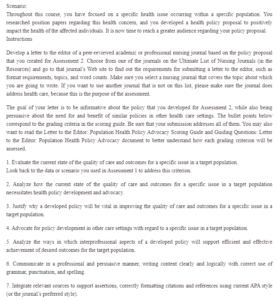
Scenario:
Throughout this course, you have focused on a specific health issue within a particular population. You researched position papers regarding this health concern, and you developed a policy proposal to impact the affected individuals’ health positively. It is now time to reach a greater audience regarding your policy proposal.
Instructions
Develop a letter to the editor of a peer-reviewed academic or professional nursing journal based on the policy proposal you created for Assessment 2. Choose from one of the journals on the Ultimate List of Nursing Journals (in the Resources) and go to that journal’s Web site to find out the requirements for submitting a letter to the editor, such as format requirements, topics, and word counts. Make sure you select a nursing journal that covers the case you will write about. If you want to use another journal that is not on this list, please make sure the journal does address health care because this is the purpose of the assessment.
Your letter aims to be informative about the policy you developed for Assessment 2 while being persuasive about the need for and benefit of similar policies in other health care settings. The bullet points below correspond to the grading criteria in the scoring guide. Be sure that your submission addresses all of them. You may also want to read the Letter to the Editor: Population Health Policy Advocacy Scoring Guide and Guiding Questions: Letter to the Editor: Population Health Policy Advocacy document to better understand how each grading criterion will be assessed.
1. Evaluate the current quality of care and outcomes for a specific issue in a target population.
Review the data or scenario you used in Assessment 1 to address this criterion.
2. Analyze how the current state of the quality of care and outcomes for a specific issue in a target population necessitates health policy development and advocacy.
3. Justify why a developed policy will be vital in improving the quality of care and outcomes for a specific issue in a target population.
4. Advocate for policy development in other care settings about a specific issue in a target population.
5. Analyze how interprofessional aspects of a developed policy will support efficient and effective achievement of desired outcomes for the target population.
6. Communicate professionally and persuasively, writing content clearly and logically with correct grammar, punctuation, and spelling.
7. Integrate relevant sources to support assertions, correctly formatting citations and references using current APA style (or the journal’s preferred style).
 Complete the order form and upload all of your files, including any instructions, rubrics, or other materials provided by your instructor.
 Complete the order payment after filling in the order form. We’ll receive your order and assign it to a writer.
 The assigned writer will complete your paper and forward it to our Editing Team for review and approval.
 Once approved by the editor, the completed paper will be uploaded to your account for you to download, review and approve.