
Learning Theories and Diversity
Nursing is an essential profession in the healthcare delivery industry. It is thus vital to continuously and adequately educate nurses in the classroom and clinical environments. Nurse educators are tasked with providing important teaching for nursing students to ensure they have the knowledge required to implement patient-centered care and improve healthcare outcomes. Nurse educators evaluate learning and competencies in classrooms and clinical environments. In addition, nurses can also assume the role of patient educators. They can educate patients on medication use, adherence to treatment plans, and lifestyle modifications to improve healthcare outcomes. Nurse educators assure patients they can implement the care plans to improve their health status.
Moreover, the United States healthcare industry is complex. Healthcare services are offered to patients from different diversities, including socioeconomic status, culture, ethnicity, and age. Additionally, individual needs are diverse, including preventive care, maintenance treatment, and follow-up. Subsequently, healthcare professionals are various due to training, geographical locations, and competencies. Thus, It is essential to consider diversities when implementing a patient teaching plan.
Hospital Readmission Prevention
The Centers for Medicare and Medicaid Services (CMS) penalize healthcare facilities with readmissions. According to CMS, if a patient is readmitted to a healthcare facility within thirty days, the hospital will not be reimbursed for this readmission (Wadhera et al., 2019). The CMS opines that readmission with the same condition within thirty days is preventable. This “hospital readmission prevention” topic will be delivered to patients with chronic healthcare conditions. Subsequently, this teaching will happen when the patient is still admitted. A follow-up teaching will be carried out using telemedicine after patient discharge. Accordingly, teaching patients inpatient will teach them about their diagnosis. The patients will understand their disease and the plan of care implemented by their doctors. After the physician has developed a care plan, the patient educator will teach self-care strategies to prevent hospital readmission rates.
Educational Theory
It is critical to identify the learning needs of each individual in the audience. For instance, a nurse educator classifying all ethnic and cultural groups with the same attributes will negate the unique needs of each individual (Oermann et al., 2017). However, educating patients about the symptoms of chronic heart failure is complex. The educator must use different teaching strategies based on each patient’s needs. The theory I will utilize to educate patients on hospital readmission prevention is the constructivism learning theory. This theory will allow the patients to construct their own meaning of the new information delivered to them (Kumar Shah, 2019). When processing the information, the purpose will depend on past experiences, beliefs, values, and attitudes. The patient educator should promote feedback and ask guiding questions during the session.
Constructivism acknowledges the existence of prior knowledge. It opines that the patients will interpret what they experience based on what they know (Oermann et al., 2017). Constructivism is learner-centered since it recognizes the role of the learner in engaging information and constructing meaning. As a constructivist teacher, I will guide the patients and facilitate learning by implementing a supportive environment. The learners will actively engage in the learning process to facilitate remembering. Learners who actively participate will comply with treatment plans in their homes. For example, if patients understand the benefits of monitoring their weight daily for fluid overload, they will understand why the physician prescribes daily weight checks. Therefore, this will improve compliance. The patient will know that the daily weight checks are not to burden the patient but are a care plan to monitor fluid overload. In turn, this can exacerbate chronic conditions, resulting in hospital readmission.
Diversity among Patients
The United States population is very diverse. This diversity requires nurses and nurse educators to be culturally competent. The variety present in the American population includes ethnicity, religion, sexual orientation, culture, and linguistics. This diversity is reflected in patients and healthcare professionals. Patients with limited English proficiency have higher chances of understanding their care plan, patient education, and discharge instructions when healthcare professionals providing care are from the same linguistic background (Diamond et al., 2019). Providing culturally competent care will reduce healthcare disparities due to educational level and socioeconomic status. The nurse educator should adjust teaching methods to meet the unique needs of the patients. The nurse educator should also help the patients understand the information provided without cramming the information provided.
Addressing the Issues of Diversity
Patient educators should be sensitive to ethnic and gender differences among patients. They can use the simulation lab and psychomotor and verbal skills to practice scenarios used in real-life patient scenarios. Ensuring gender equality during patient education will eliminate bias. Historically, society has been patriarchal, with men expected to be doctors, managers, or doctors, with women taking a supplementary role. Women should be encouraged to be actively involved in the teaching session. The nurse educator should encourage them to answer and ask questions while ensuring that males are not left out in the teaching sessions.
Conflict Management
Conflicts among patients may be due to gender, religion, linguistic, or cultural differences. Patients come from socioeconomic and cultural backgrounds; solutes may arise due to a lack of knowledge. Nursing educators should implement a culturally competent learning strategy. They should implement a therapeutic relationship and discuss the different points of view of individuals in the audience. Knowing the beliefs and values of the audience promotes cultural diversity and feedback. Patients may have stressors related to their lives, such as work, family, financial, and social obligations. The educator should explain the teaching objectives, address conflicts privately, refrain from sarcasm, and use humor to manage disputes successfully.
Patients with English as a second language may have linguistic challenges when reading informational newsletters. The nurse educator should take additional time to educate these patients and ensure they understand the concepts. They should also provide other resources to make them feel appreciated and included (Dudas, 2018). Incorporating culturally competent education will allow the patients to enjoy the cultural diversity of the audience. A culturally competent education will also create a safe learning environment for the audience.
Conclusion
Diverse healthcare is essential since it improves healthcare outcomes for various patients. Implementing culturally competent education that respects the patient’s preferences, values, and needs is critical. The topic of patient education and prevention of hospital readmissions in patients with chronic conditions such as hypertension is also of great significance. This program aims to ensure compliance with treatment plans to reduce hospital readmissions. The educator will use the constructivism theory to promote learning and appropriate feedback. The educator must also be aware of conflicts and implement strategies to manage the conflicts.
References
Diamond, L., Izquierdo, K., Canfield, D., Matsoukas, K., & Gany, F. (2019). A systematic review of the impact of patient–physician Non-English language concordance on quality of care and outcomes. Journal of General Internal Medicine, 34(8), 1591-1606. https://doi.org/10.1007/s11606-019-04847-5
Dudas, K. (2018). Living in two worlds: Experiences of English as an additional language nursing students. Journal of Cultural Diversity, 25(3), 87–92.
Kumar Shah, R. (2019). Effective constructivist teaching learning in the classroom. Shanlax International Journal of Education, 7(4), 1-13. https://doi.org/10.34293/education.v7i4.600
Oermann, A. M., Shellenbarger, C. T., & Gaberson, C. K. (2017). Clinical teaching strategies in nursing (5th ed.). Springer Publishing Company.
Wadhera, R. K., Yeh, R. W., & Joynt Maddox, K. E. (2019). The Hospital Readmissions Reduction Program — Time for a reboot. New England Journal of Medicine, 380(24), 2289-2291. https://doi.org/10.1056/nejmp1901225
ORDER A PLAGIARISM-FREE PAPER HERE
We’ll write everything from scratch
Question 
Create a 4-5 page high-level teaching plan for a diverse learning environment around appropriate educational theory.
Learning Theories and Diversity
Introduction
When beginning to design a course, nurse educators need to identify the learning theory or theories that will form the foundation of a course’s design and consider the needs of the learners who will take the course.
Note: Assessments in this course build on each other and must be completed sequentially.
It is essential to consider the role of diversity and learning environments when selecting appropriate theories and approaches for a desired learning outcome. For this assessment, you will implement these considerations in an educational background of your choosing.
Preparation
Take time to review educational theories that you have studied in prior courses or used in your work. Do additional research on educational ideas and approaches as necessary.
Optional: Practice implementing these considerations in the Vila Health challenge provided in the Resources before beginning your work here.
As you complete this assessment, you may want to consider other related issues to deepen your understanding or broaden your viewpoint. You are encouraged to consider the questions below and discuss them with a fellow learner, a work associate, an interested friend, or a professional community member.
Note that these questions are for your development and exploration and do need to be completed or submitted as part of your assessment.
Think about some influential educators you have been most significant from. What characteristics made these educators “good”?
How can nurse educators tailor teaching methods to foster student engagement in multiple generations?
Have you ever completed a learning style inventory? If so, do you feel like it adequately assessed your learning style? Why or why not? (If you have not completed one, you might want to search for a free inventory online to see how its results align with your self-knowledge.)
How can you prepare yourself to be a culturally competent educator?
Instructions
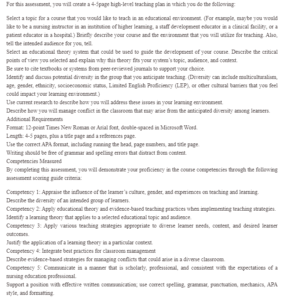
For this assessment, you will create a 4-5page high-level teaching plan in which you do the following:
Select a topic for a course that you would like to teach in an educational environment. (For example, maybe you would like to be a nursing instructor in an institution of higher learning, a staff development educator in a clinical facility, or a patient educator in a hospital.) Briefly describe your course and the environment that you will utilize for teaching. Also, tell the intended audience for you, tell.
Select an educational theory system that could be used to guide the development of your course. Describe the critical points of view you selected and explain why this theory fits your system’s topic, audience, and context.
Be sure to cite textbooks or systems from peer-reviewed journals to support your choice.
Identify and discuss potential diversity in the group that you anticipate teaching. (Diversity can include multiculturalism, age, gender, ethnicity, socioeconomic status, Limited English Proficiency (LEP), or other cultural barriers that you feel could impact your learning environment.)
Use current research to describe how you will address these issues in your learning environment.
Describe how you will manage conflict in the classroom that may arise from the anticipated diversity among learners.
Additional Requirements
Format: 12-point Times New Roman or Arial font, double-spaced in Microsoft Word.
Length: 4-5 pages, plus a title page and a references page.
Use the correct APA format, including running the head, page numbers, and title page.
Writing should be free of grammar and spelling errors that distract from content.
Competencies Measured
By completing this assessment, you will demonstrate your proficiency in the course competencies through the following assessment scoring guide criteria:
Competency 1: Appraise the influence of the learner’s culture, gender, and experiences on teaching and learning.
Describe the diversity of an intended group of learners.
Competency 2: Apply educational theory and evidence-based teaching practices when implementing teaching strategies.
Identify a learning theory that applies to a selected educational topic and audience.
Competency 3: Apply various teaching strategies appropriate to diverse learner needs, content, and desired learner outcomes.
Justify the application of a learning theory in a particular context.
Competency 4: Integrate best practices for classroom management
Describe evidence-based strategies for managing conflicts that could arise in a diverse classroom.
Competency 5: Communicate in a manner that is scholarly, professional, and consistent with the expectations of a nursing education professional.
Support a position with effective written communication; use correct spelling, grammar, punctuation, mechanics, APA style, and formatting.
 Complete the order form and upload all of your files, including any instructions, rubrics, or other materials provided by your instructor.
 Complete the order payment after filling in the order form. We’ll receive your order and assign it to a writer.
 The assigned writer will complete your paper and forward it to our Editing Team for review and approval.
 Once approved by the editor, the completed paper will be uploaded to your account for you to download, review and approve.