
Journal Entry: Practicum Experience Plan
During my practicum experience at Covenant Psychiatric & Mental Health Services, I was able to progress significantly toward the achievement of the goals outlined in my Practicum Experience Plan. My main aim was to complete 80 comprehensive psychiatric examinations individually with 85% accuracy. I surpassed this goal by completing over 100 examinations, consistently using DSM-5-TR criteria under preceptor guidance. Regular feedback from my preceptor helped me refine my clinical reasoning and improve diagnostic precision (American Psychiatric Association, 2022). My second aim was to prepare and implement individualized medication management plans for at least 10 patients per day. At Week 8, I had achieved this goal by closely collaborating with my preceptor, applying current psychopharmacologic guidelines, and titrating medications based on side effects and patient response (Stahl, 2022). Lastly, my third objective was implementing cognitive behavioral therapy (CBT)-informed techniques in 80% of client sessions. Through weekly supervision and role-playing, I utilized therapeutic interventions like reframing and Socratic questioning that increased patient engagement and rapport.
Among the toughest patients was a 15-year-old with early-onset schizophrenia and a violent personality. Safety could not be sacrificed for therapeutic engagement, especially when the patient did not cooperate with medication. Another challenging case involved a pregnant, 36-year-old woman with opioid use disorder and bipolar I disorder. Fetal safety had to be reconciled with psychiatric stabilization, which required cross-referencing among multiple guidelines and experts. The third challenging patient encounter involved a 72-year-old male patient with schizoaffective disorder and multiple medication allergies. It was clinically difficult to develop an effective and safe treatment plan under these constraints. Overall, through these experiences, I learned about the importance of interdisciplinary collaboration, the need for flexible care plans, and the value of empathy in difficult clinical situations (Brunt & Morris, 2023).
Several resources aided in my learning. These included my preceptor’s clinical know-how, biweekly case conference sessions, and online access to current psychiatric literature and guidelines such as UpToDate and the APA practice guidelines. Evidence-based practices such as motivational interviewing for substance abuse and CBT approaches to mood stabilization were critical in managing complex cases (López et al., 2021). Furthermore, the use of tools like the PHQ-9, GAD-7, and Columbia Suicide Severity Rating Scale (C-SSRS) improved evaluation accuracy. I further learned new competencies in medication titration, de-escalation of crises, and documentation of psychotherapy. If I were given a second opportunity, I would work longer in the first few weeks observing before taking high-complexity cases to build confidence incrementally.
Managing patient flow and volume was at first intimidating, but I adjusted by prioritizing urgent cases, streamlining documentation via EMRs, and setting realistic session time limits. I also collaborated with the administrative and nursing staff to maximize scheduling efficiency. As further development of competency, I plan to practice continued education in psychopharmacology and trauma-informed care. I will present these efforts to my preceptor through ongoing reflection sessions and documentation of certificate completion.
Based on my performance, I believe that I am clinically competent, but I can improve further in documentation and facilitation of group therapy. My preceptor provided me with both formal and informal feedback during weekly evaluations and after interacting with patients. Notably, she appreciated my diagnostic ability and patient rapport, but encouraged me to assert myself more while creating treatment plans. This feedback has boosted my self-esteem and clinical decision-making.
References
American Psychiatric Association. (2022). Diagnostic and statistical manual of mental disorders: DSM-5-TR. American Psychiatric Association Publishing.
Brunt, B., & Morris, M. (2023). Nursing professional development evidence-based practice. National Library of Medicine. https://www.ncbi.nlm.nih.gov/books/NBK589676/
López, G., Orchowski, L. M., Reddy, M. K., Nargiso, J., & Johnson, J. E. (2021). A review of research-supported group treatments for drug use disorders. Substance Abuse Treatment, Prevention, and Policy, 16(1), 1–21. https://doi.org/10.1186/s13011-021-00371-0
Stahl, S. M. (2022). Stahl’s essential psychopharmacology: Neuroscientific basis and practical applications. Cambridge University Press. https://doi.org/10.1017/9781009053365
ORDER A PLAGIARISM-FREE PAPER HERE
We’ll write everything from scratch
Question 
Journal Entry: Practicum Experience Plan
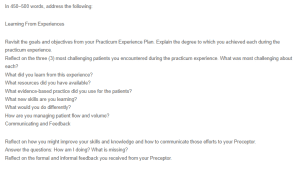
In 450–500 words, address the following:
Learning From Experiences
Practicum Experience
Revisit the goals and objectives from your Practicum Experience Plan. Explain the degree to which you achieved each during the practicum experience.
Reflect on the three (3) most challenging patients you encountered during the practicum experience. What was most challenging about each?
What did you learn from this experience?
What resources did you have available?
What evidence-based practice did you use for the patients?
What new skills are you learning?
What would you do differently?
How are you managing patient flow and volume?
Communicating and Feedback
Reflect on how you might improve your skills and knowledge and how to communicate those efforts to your Preceptor.
Answer the questions: How am I doing? What is missing?
Reflect on the formal and informal feedback you received from your Preceptor.
 Complete the order form and upload all of your files, including any instructions, rubrics, or other materials provided by your instructor.
  Complete the order payment after filling in the order form. We’ll receive your order and assign it to a writer.
 The assigned writer will complete your paper and forward it to our Editing Team for review and approval.
 Once approved by the editor, the completed paper will be uploaded to your account for you to download, review and approve.