
Journal Entry – Non-Human Technologies
Ritzer describes control by non-human technologies as the use of automated systems and standardized procedures to regulate behavior and outcomes. These technologies mask human unpredictability and variability by providing preset routines or programs yielding standard performance. Control is achieved by replacing human judgment with programmed responses, creating a highly managed environment (Ritzer,2010). This shift reduces individual autonomy and promotes conformity in many facets of life. Non-human technologies are structures, equipment, actions or plans that become active without direct human intervention once set in place. These technologies define operations, taking much of the decision-making out of the individual’s hands. This is because the design of these tools has instilled rules and procedures that help organizations manage people even without direct supervision. Therefore, people are conditioned by and limited by technology rather than by people.
One area of my life where Ritzer’s concept of control by non-human technologies applies is my leisure activity of gaming. In many contemporary video games, algorithms regulate the game environment, dictating the rules of the game, the player’s movement path, or even the characters’ behavior (Nguyen & Bavelier, 2023). The choice, creativity, and decision-making, which should be the main hallmarks of a game medium, are meaningfully reduced by these technologies, including the AI-controlled opponents, the reward systems, and the progress tracking. The game controls the rhythm, sequence, and results of player activities, forcing the players to act in certain ways to succeed, for example, to get to the next level or unlock achievements. Therefore, my gaming experience is defined by technology in terms of in-game actions, guiding my decisions and rewarding specific ways of playing instead of being as extensive, creative, and versatile as possible.
I agree with Ritzer’s idea of control through non-human technologies. As I partake in gaming, these structures regulate freedom and dictate behavior in certain ways. Limited choices and the fact that the orders that come from the algorithms dictating how the game unfolds mean that I cannot act in any way I want and must perform tasks in certain ways, which ties in with Ritzer’s concept of control. Even in the case of gaming, one of the most dynamic and progressive markets that should provide a lot of choices, the choice is relative. It often comes with distinct limitations provided by the technology that governs the market (Duguleană et al.,2024). This results in a highly managed environment in which it appears as though I have control over what happens. Yet, the coded rules of the game somewhat predetermine the final experience. It shows how non-human technologies can discipline behavior and keep things orderly without active human supervision. Ultimately, as Ritzer suggests, technology plays a dominant role in guiding my leisure activities, reducing the scope for personal freedom and unpredictability.
As a gamer, I feel controlled by non-human technologies in this activity. The algorithms and in-game systems guide my every move, dictating how I interact with the game and what actions I can take. These technologies define what can be done within the game environment, including how I receive awards and level advancement. Sometimes, I can make my own decisions, but they are limited to a framework that gives them the least flexibility or creativity. My choices are tightly integrated with the game’s systems, and I get the feeling that the game controls me and not the other way around. This control can sometimes work against me regarding creativity or exploration since the technology is often designed to optimize set patterns. However, I get some pleasure from following the established structural framework as it provides a blueprint on how to excel. However, the fact that most of my experience in the game is determined by technology makes me feel that I am not free to execute this activity.
References
Duguleană, A. R., Tănăsescu, C. R., & Duguleană, M. (2024). Emerging trends in play-to-earn (P2E) games. Journal of Theoretical and Applied Electronic Commerce Research, 19(1), 486-506. https://doi.org/10.3390/jtaer19010026
Nguyen, A., & Bavelier, D. (2023). Play in video games. Neuroscience & Biobehavioral Reviews, 153, 105386. https://doi.org/10.1016/j.neubiorev.2023.105386
Ritzer, G. (Ed.). (2010). McDonaldization: The reader. Pine Forge Press.
ORDER A PLAGIARISM-FREE PAPER HERE
We’ll write everything from scratch
Question 
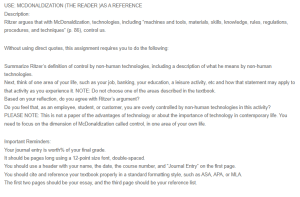
Journal Entry – Non-Human Technologies
USE: MCDONALDIZATION (THE READER )AS A REFERENCE
Description:
Ritzer argues that with McDonaldization, technologies, including “machines and tools, materials, skills, knowledge, rules, regulations, procedures, and techniques” (p. 86), control us.
Journal Entry – Non-Human Technologies
Without using direct quotes, this assignment requires you to do the following:
Summarize Ritzer’s definition of control by non-human technologies, including a description of what he means by non-human technologies.
Next, think of one area of your life, such as your job, banking, your education, a leisure activity, etc and how that statement may apply to that activity as you experience it. NOTE: Do not choose one of the areas described in the textbook.
Based on your reflection, do you agree with Ritzer’s argument?
Do you feel that, as an employee, student, or customer, you are overly controlled by non-human technologies in this activity?
PLEASE NOTE: This is not a paper of the advantages of technology or about the importance of technology in contemporary life. You need to focus on the dimension of McDonaldization called control, in one area of your own life.
Important Reminders:
Your journal entry is worth% of your final grade.
It should be pages long using a 12-point size font, double-spaced.
You should use a header with your name, the date, the course number, and “Journal Entry” on the first page.
You should cite and reference your textbook properly in a standard formatting style, such as ASA, APA, or MLA.
The first two pages should be your essay, and the third page should be your reference list.
 Complete the order form and upload all of your files, including any instructions, rubrics, or other materials provided by your instructor.
  Complete the order payment after filling in the order form. We’ll receive your order and assign it to a writer.
 The assigned writer will complete your paper and forward it to our Editing Team for review and approval.
 Once approved by the editor, the completed paper will be uploaded to your account for you to download, review and approve.