
Investigating the Impact of Time on Transpiration Rate in a Plant Using Vernier Gas Sensors
Abstract
The purpose of this experiment was to measure how much a plant transpires through a gas pressure sensor system. An air-tight tubing was used to connect a living plant stem to a water-filled syringe. Isolation of the system was made through a stopcock, and pressure changes were measured using a pressure sensor hooked to LabQuest. Further, pressure also recorded as transpiration proceeded, as it became lower as the water was being absorbed due to transpiration. The outcome reflected the consistently decreasing pressure, which demonstrated that the plant was transpiring. This approach effectively showed the relationship between transpiration and change of pressure. Still, further adjustments could be used to understand the influence of environmental aspects on the rate of transpiration.
Introduction
Transpiration is a process where plants lose water in the form of vapor via the stomata on the leaves. This is an important process that aids the uptake and movement of water to the leaves through the xylem. Besides, this evaporative loss creates a suction force, drawing water upwards, allowing the movement of water-soluble compounds and heat control, as noted by Navyashree (2023). Transpiration plays a significant role in the research of plant-water relations, particularly during changing environmental circumstances. Notably, transpiration can be measured to give information about water use efficiency, drought response, and plant adaptation. This experiment required a closed system to monitor the effect of the changes in pressure as a result of transpiration, which is the loss of water.
The key advantages of Vernier gas pressure sensors used in plant physiology experiments are their precise measurements in closed systems (Banerji et al., 2024). The research question was: Does transpiration produce measurable pressure changes in a closed system? It was hypothesized that internal pressure would reduce as the plant transpired because of water being pulled up through the stem.
Methods
Procedure
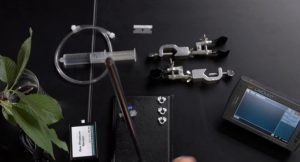
The stem was cut off at an angle of 45 degrees with a razor blade under water to avoid air embolism and to maximize the surface area of water uptake. The cut end was then inserted into a flexible plastic tube that was connected to a syringe containing distilled water. All links were closed to prevent any leak of air. A stopcock was fitted in the link between the gas pressure sensor and the tubing to make the system isolatable.
One of the retorts stands was used to fix the syringe and the plant stem vertically by using clamps. The gas pressure sensor was fitted on the tubing and clamped onto a second stand. Real-time collection of pressure was done via a LabQuest device that was connected to the sensor.
After securing all components, the stopcock was opened momentarily to enable pressure equalization, then shut off to seal the system. The lab quiz was initiated, and pressure readings were taken every three minutes over 15 minutes.
Figure 1: Setup showing the procedure for measuring transpiration using a gas pressure sensor.
Results
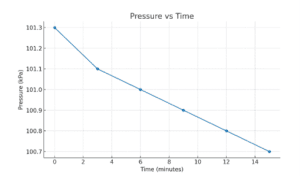
Over the 15-minute period, pressure readings steadily declined from 101.3 kPa to 100.7 kPa. The drop was gradual and steady, indicating that transpiration was taking place via the leaves. There was no sign of leakage or mechanical interference in the process of data collection. The mean value of pressure drops was 0.6 kPa, and the trend was negative in the entire experiment.
Table 1. Pressure values were recorded every 3 minutes during the experiment.
| Time (min) | Pressure (kPa) |
| 0 | 101.3 |
| 3 | 101.1 |
| 6 | 101.0 |
| 9 | 100.9 |
| 12 | 100.8 |
| 15 | 100.7 |
Graph 1: Pressure vs Time
Discussion
The results supported the hypothesis, as transpiration results in a measurable pressure change in a closed system. Water evaporated from the leaves, and plants used the syringe to pump the water, which lowered the internal pressure. The experiment ascertained that this change could also be detected with the help of a gas pressure sensor.
A stable, air-tight system was provided by the usage of clamps and a stopcock. The consistent decrease in pressure was expected according to the physiology of plants and provided by the findings in prior studies. To follow up on this experiment, further investigations would be to test the influence of environmental factors such as wind, the amount of light, or humidity on the rates of transpiration. Repeating the experiments with varied conditions might help gain knowledge about the adaptation process of plants and how they handle water.
References
Banerji, S., Hõrak, H., Torop, J., & Huynh, T. (2024). Unravelling the secrets of plants: Emerging wearable sensors for plants signals and physiology. Advanced Sensor Research, 3(3). https://doi.org/10.1002/adsr.202300023
Navyashree, R. (2023). Water relations and uptake in crops. In Crop Physiology: A Collaborative Insights Volume 1 (1st ed., p. 46). Stella International Publication. https://www.researchgate.net/publication/376834353
ORDER A PLAGIARISM-FREE PAPER HERE
We’ll write everything from scratch
Question 
Investigating the Impact of Time on Transpiration Rate in a Plant Using Vernier Gas Sensors
Assignment Description:
The course project is designed to focus on experimental design. As future scientists, this project orients you to the process of experimental design. It entails designing an experiment using the Vernier instrumentation (gas pressure sensor). The results of the experiment are to be presented in a lab report format. The information in the experiment report should match the experiment design presented earlier. You will share your experiments and results with the class in the last discussion of the class.
Investigating the Impact of Time on Transpiration Rate in a Plant Using Vernier Gas Sensors
Instructions:
For the course project you must perform, analyze and share and the results of an experiment of your own design. You have already turned in and received feedback on your experiment design. You need to carry out your experiment as designed incorporating feedback. With the data collected you will analyze your results and draw conclusions. Your information must then be submitted as a lab report.
Directions on how to write a lab report are found below and in the attached Guidelines for Scientific Papers.
Please review the rubric to ensure you are addressing all expectations. Make sure you read through the grading rubric so that you understand all the information that is required. Your assignment will be automatically submitted to TurnItIn with your submission. Make sure you follow APA reference and citation technique.
How to Write An Experiment Report:
Experiment or lab reports are an excellent way to practice scientific writing. Scientific writing is a style of writing that places a premium on clear, concise language. You should write efficiently and without excess verbiage. This means you want to avoid using more words when fewer will do.
Researchers must pay by the page to have their work published. They want to spend as little as possible on publication, saving more money to fund the actual research. By writing as efficiently as possible they can eliminate excess verbiage and decrease the cost of publication. You will practice this style of writing in your lab reports for the course project.
Lab reports for this course project will have the following style.
Use 12 point font
The report should be written in the 3rd person. Do not use personal pronouns (I, us, we).
Example written incorrectly in 1st person: I applied 5mL of water to each plant daily.
Example written correctly in 3rd person: 5ml of water was applied to each plant daily.
Make sure to use the correct tense. If you are talking about something that has happened in the past, use past tense. Present tense can be used when referring to scientific principle such as “Meiosis involves two divisions.”
Use APA formatted references and in text citations. Direct quotations should not be used in lab reports. Any information that is not common knowledge needs to be cited. When in doubt, cite it. Failure to cite information can be plagiarism. For more information on what constitutes plagiarism go here. If you need to review APA formatting for references and citations go here and scroll down to the bottom of the page (citation examples section).
The experiment/lab report should be organized into the following sections: Title, Abstract, Introduction, Methods, Results, Discussion, Literature Cited. Details about each section are found below and in the attached Guidelines to Scientific Papers resource.
The title of the experiment/lab report should be descriptive. It should state what you are studying and what variable was manipulated. It should be on a separate title page that includes the students name, course section and date.
The abstract is a one paragraph summary of the entire lab report. It should state the purpose of the study, what was done, what was found and what was concluded. Even though it goes at the beginning of the report, you should write this after you have completed the entire lab report.
The introduction section of the report should define the topic and explain its importance. It should share some background information related to the research that you used to help you design your experiment as well as state the research question and your hypothesis. It should be no longer than 1 page in length. MAKE SURE YOU HAVE IN TEXT CITATIONS HERE!(See Guidelines to Scientific Papers resource below for more details)
The methods section should explain how the experiment was conducted. It should not be a list or bullets but should be written in a narrative format. Include only the details that are necessary to replicate the experiment and should explain why the procedure was done. This section should be written in the past tense and should not discuss any results . You need to include a picture that includes your name, the date and your experiment set up in action in the methods section.
The results section should explain the results of the experiment without interpretation or comment. It should be used to summarize general trends. If multiple experiments were conducted each should have a separate paragraph explaining the results. Graphs and tables should be used if appropriate but not as a substitute for a written explanation. Make sure that graphs and tables have a description that would allow the reader to understand the graphic even if they could not see the graphic.
Example of incorrect table/graphic description: Table 1. Bacteria counts and water level for Blackwater River
Example of correct table/graphic description: Table 1. Bacteria counts and water level for Blackwater River in the summer of 2015. Bacteria were sampled using 3 point cross sections along a 10 mile stretch of the Blackwater River. Samples show that as water level decrease so do bacteria counts. During higher flow levels bacteria levels increase. The results the area sampled is impaired for contact recreational use.
The discussion section is where you interpret the results. You should also discuss the results in context of the overall experiment as identified in the introduction of the report. You should tell the reader why the data looks like it does and why it is important to know. Lastly you should discuss potential modifications for the experiment. What kind of changes would you make to this experiment to further knowledge of transpiration? This is not to correct mistakes but usually every experiment ends with more questions than you start with. How would you address those questions in future research?
Rubric: The grading rubric for this assignment is attached. Make sure to review the rubric so that you have all the required components.
Submission Instructions:
1) Upload your lab report as a word document for grading.
The lab report will be checked for originality using Turnitin. Make sure you have proper citations and references for work that is not your own!
 Complete the order form and upload all of your files, including any instructions, rubrics, or other materials provided by your instructor.
  Complete the order payment after filling in the order form. We’ll receive your order and assign it to a writer.
 The assigned writer will complete your paper and forward it to our Editing Team for review and approval.
 Once approved by the editor, the completed paper will be uploaded to your account for you to download, review and approve.