
Internal Disaster Plan
Hospitals play an integral role in health preservation during health catastrophes. Healthcare organizations can only be effective if they bolster their operationalization position. Internal disasters that may be apparent during normal hospital operationalization may jeopardize their position in handling external risks. Such disasters include but are not limited to fire incidents, workplace violence, radiation contamination, utility failures, and acts of terrorism. An internal disaster plan provides a framework for confronting such disasters. Cao et al. (2020) outline the key elements of a hospital disaster plan. These are preparedness, response, recovery, and prevention. This paper details an internal disaster plan.
Size and Type of the Selected Hospital
Southwest Hospital in Forth Worth, TX, is a pioneer hospital in the vast Southwest area of Texas that prides itself in excellent care. The hospital has a bed capacity 120 and a combined staff of 67. Southwest Hospital is a community hospital that serves the neighbourhoods in Forth Worth and beyond. It has both inpatient and outpatient settings.
Type of Internal Disaster
Southwest Hospital has experienced a fair share of disasters in its many years of operation. Recently, there was a fire incident that destroyed part of the hospital. This necessitated the hospital administration, through its disaster preparedness and planning department, to develop an internal disaster plan for fire incidents. An internal disaster plan for fire incidents outlines a plan of action to be adopted in response to fire incidents.
Key Medical and Administrative Staff to Be Contacted
The hospital’s internal disaster plan requires personnel from the disaster preparedness and planning department to be contacted during any fire incident. The hospital’s fire department should also be informed as they are among the first respondents to such incidents. The plan also requires that the staff from the emergency department be alerted to enable them to prepare for any possible casualties. The hospital works concertedly with the local authorities and requires that the local police department and the Fort Worth fire department be notified to complement internal efforts. The plan also lists the heads of nursing and pharmaceutical operations and chief physicians as persons to be contacted.
Central Point for Communication
The Department of Disaster Preparedness and Planning coordinates disaster responses during fire incidents. This department acts as the central communication centre for all orders. A primary communication line has been established and embedded in the hospital’s information system. This enables quicker access to all hospital departments in such instances.
Particular Service Areas
The plan gives provisions for service areas valuable in responding to fire incidents. The Burn Unit is a priority unit that is anticipated to be the primary service area in case of casualties during the incident. The emergency department is another service area that is key in this regard. The plan establishes a triaging system at the emergency department to sort patients and allocate treatment to them. Another service area listed in the plan is the intensive care unit, which handles persons with severe injuries.
Coordination with Other Facilities
Southwest Hospital has an established connection with most community hospitals in Forth Worth. This connection is not well coordinated as these hospitals tend to work independently. Two other community hospitals within Forth Worth can equally handle fire casualties. Coordinating care between these hospitals can reduce the burden on the hospital in the event of a disaster. According to Figueroa, Feyman, Zhou & Joynt Maddox (2022), switching up emergency departments, outsourcing emergency departments, and transferring patients are strategies for hospitals to manage a surge in the number of patients presenting to the emergency departments accustomed to public health emergencies. I intend to collaborate with the neighbouring hospitals in establishing a shared communication channel that will enable information sharing on the position of each hospital in handling casualties. I also intend to develop a framework for patient transfer, emergency department outsourcing, and switching up emergency departments to help this hypothetical group of hospitals handle their strains accustomed to a flux in casualties.
Implementation of Internal Transfers
Internal transfers are another provision highlighted in the plan that is targeted at increasing the hospital’s operational efficiency during disasters. The plan recommends that patients be transferred safely from one area to another if there is a reasonable cause. The plan requires a decision to transfer a patient to another made by the lead physician or the lead nurse. This decision should be communicated to the patient and other caregivers.
Implementation of External Transfers
The plan also gives recommendations on external transfers. The lead physician decides to transfer patients, and the patient should consent. For this reason, the patient should be aware of the reason for their transfer. Transfers can also be made at the patient’s request. A pre-transfer stabilization is done in external transfers. The hospital also facilitates the transfer by providing transportation if the transfer is to nearby facilities. A medical team also accompanies transfers. Farnoosh et al. 2018 assert that inter and intra-hospital transfers are essential in ensuring continuity of care. Disaster plans should thus establish a framework for transferring patients within or to other hospitals.
Evacuation Plan
In the wake of a fire incident, fire alarms go off, and personnel from the disaster planning and fire departments are drawn to the scene. Occupants of the affected room usually leave the premises calmly but quickly via the nearest openings. The disaster planning department’s personnel assesses the rooms and assists those trapped in the building get out. Those injured are taken to the emergency department, triaged and allocated appropriate treatment. Those seriously injured are admitted to the ICU. In case of mass casualties, some patients may be transferred to other nearby healthcare facilities.
Conclusion
An internal disaster plan provides a framework for managing internal disasters. These plans establish protocols that aid allied hospital departments and the hospital in responding to internal disasters such as fires and radiation contamination. These protocols inform intra- and interhospital patient transfers and care coordination between hospitals. Such provisions highlight Southwest Hospital’s internal disaster plan.
References
Cao, Y., Li, Q., Chen, J., Guo, X., Miao, C., & Yang, H. et al. (2020). Hospital Emergency Management Plan During the COVID‐19 Epidemic. Academic Emergency Medicine, 27(4), 309-311. DOI: 10.1111/acem.13951
Farnoosh, L., Hossein-Nejad, H., Beigmohammadi, M. T., & Seyed-Hosseini-Davarani, S. H. (2018). Preparation and Implementation of Intrahospital Transfer Protocol for Emergency Department Patients to Decrease Unexpected Events. Advanced Journal of Emergency Medicine, 2(3), e29. https://doi.org/10.22114/AJEM.v0i0.50
Figueroa, J., Feyman, Y., Zhou, X., & Joynt Maddox, K. (2022). Hospital-level care coordination strategies are associated with better patient experience. Retrieved 6 September 2022, from http://dx.doi.org/10.1136/bmjqs-2017-007597
ORDER A PLAGIARISM-FREE PAPER HERE
We’ll write everything from scratch
Question 
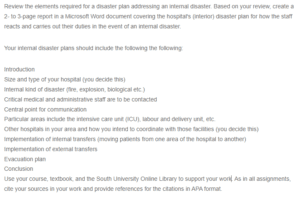
Review the elements required for a disaster plan addressing an internal disaster. Based on your review, create a 2- to 3-page report in a Microsoft Word document covering the hospital’s (interior) disaster plan for how the staff reacts and carries out their duties in the event of an internal disaster.
Internal Disaster Plan
Your internal disaster plans should include the following the following:
Introduction
Size and type of your hospital (you decide this)
Internal kind of disaster (fire, explosion, biological etc.)
Critical medical and administrative staff are to be contacted
Central point for communication
Particular areas include the intensive care unit (ICU), labour and delivery unit, etc.
Other hospitals in your area and how you intend to coordinate with those facilities (you decide this)
Implementation of internal transfers (moving patients from one area of the hospital to another)
Implementation of external transfers
Evacuation plan
Conclusion
Use your course, textbook, and the South University Online Library to support your work. As in all assignments, cite your sources in your work and provide references for the citations in APA format.
 Complete the order form and upload all of your files, including any instructions, rubrics, or other materials provided by your instructor.
  Complete the order payment after filling in the order form. We’ll receive your order and assign it to a writer.
 The assigned writer will complete your paper and forward it to our Editing Team for review and approval.
 Once approved by the editor, the completed paper will be uploaded to your account for you to download, review and approve.