
Integrative Care
Hello Sally,
Great work with your post! You provided an exciting perspective on integrative care. Today, most physicians tend to subscribe more to conventional medicine and interventions. This tendency ignores the other types of care that could be used alongside traditional care. These include herbal care and interventions that consider physical, mental, and spiritual health. Other manipulative procedures, such as massages and energy therapies, also hold great potential in improving care. Some techniques that can be incorporated include Reiki, meditation, prayer, relaxation, hypnosis, yoga, aromatherapy, Qigong, pranic healing, and acupressure. Each method can improve an individual’s health, a holistic concept that includes the body, mind, and soul. The three aspects are dependent on each other. This dependability confirms the need for the healthcare industry to seek out the various techniques that complement conventional healthcare (Rao, 2015).
However, various barriers impede the process of collaboration. These include the lack of faith in other disciplines besides one’s major. It is also tricky for different professionals to work together as a team. The lack of a model that can be relied upon to guide such practice also acts as a barrier. With such obstacles in place, I believe it is even more difficult for patients to seek out these options independently. This implies that providers should try accommodating other healthcare providers offering different care types (Thornton, 2013). Such inclusion could encourage patients to embrace integrative care. It will also enable the facilities to provide holistic care.
References
Rao, G. H. (2015). Integrative approach to health: Challenges and Opportunities. Journal of Ayurveda & Integrative Medicine, 6(3).
Thornton, L. (2013). Essentials of integrative health care: fundamental principles for caring & healing. Beginnings, 33(4), 4-7.,26.
ORDER A PLAGIARISM-FREE PAPER HERE
We’ll write everything from scratch
Question 
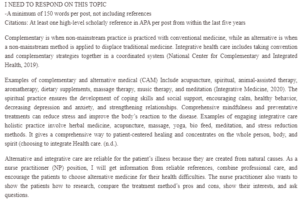
I NEED TO RESPOND ON THIS TOPIC
-A minimum of 150 words per post, not including references
Citations: At least one high-level scholarly reference in APA per post from within the last five years
Integrative Care
Complementary is when non-mainstream practice is practiced with conventional medicine, while an alternative is when a non-mainstream method is applied to displace traditional medicine. Integrative health care includes taking convention and complementary strategies together in a coordinated system (National Center for Complementary and Integrated Health, 2019).
Examples of complementary and alternative medical (CAM) Include acupuncture, spiritual, animal-assisted therapy, aromatherapy, dietary supplements, massage therapy, music therapy, and meditation (Integrative Medicine, 2020). The spiritual practice ensures the development coping skills and social support, encouraging calm, healthy behavior, decreasing depression and anxiety, and strengthening relationships. Comprehensive mindfulness and preventative treatments can reduce stress and improve the body’s reaction to the disease. Examples of engaging integrative care holistic practice involve herbal medicine, acupuncture, massage, yoga, bio feed, meditation, and stress reduction methods. It gives a comprehensive way to patient-centered healing and concentrates on the whole person, body, and spirit (choosing to integrate Health care. (n.d.).
Alternative and integrative care are reliable for the patient’s illness because they are created from natural causes. As a nurse practitioner (NP) position, I will get information from reliable references, combine professional care, and encourage the patients to choose alternative medicine for their health difficulties. The nurse practitioner also wants to show the patients how to research, compare the treatment method’s pros and cons, show their interests, and ask questions.
References
Choosing Integrative Healthcare. (n.d.). Retrieved March 26, 2021, from https://www.takingcharge.csh.umn.edu/article/05-2013/choosing-integrative-healthcare
Integrative medicine. (2020, June 19). Retrieved December 09, 2020, from https://www.mayoclinic.org/tests-procedures/complementary-alternative-medicine/about/pac-20393581
National Center for Complementary and Integrative Health. (2019, April 10). What is Complementary, alternative, and INTEGRATIVE Health? Retrieved March 26, 2021, from https://www.brainline.org/article/what-complementary-alternative-and-integrative-health
 Complete the order form and upload all of your files, including any instructions, rubrics, or other materials provided by your instructor.
 Complete the order payment after filling in the order form. We’ll receive your order and assign it to a writer.
 The assigned writer will complete your paper and forward it to our Editing Team for review and approval.
 Once approved by the editor, the completed paper will be uploaded to your account for you to download, review and approve.