
Infections and Hematologic Disorders
The blood is prone to various infections and disorders which affect multiple body organs. This case analysis paper reviews a case scenario of a 67-year-old whose lab data shows that her hgb, hct, reticulocyte count, and serum B12 levels are low while mean corpuscle volume, plasma iron, and ferritin levels are high, folate, and TIBC are normal. The paper will explain the various hematologic disorders and infections related to the lab data outcomes.
Is your assignment devastating you ? Get in touch with us at eminencepapers.com. Our homework help will save you tons of time and energy required for your assignment papers.
The Factors that Affect Fertility (STDs)
A majority of sexually transmitted diseases (STDs), whether caused by bacteria, fungi, or viruses, are risk factors for infertility in both women and men (Pai et al., 2020). Common STDs such as gonorrhea, chlamydia, and Mycoplasma genitalium are associated with over 30 percent of fertility problems in women (Smolarczyk et al., 2021). Untreated STDs are a risk for inflammation and scarring of the reproductive organs, which affects the potency of the organs in reproductive use. STDs in men can cause inflammatory responses that affect the morphology, motility, and functioning of the sperms during development to maturation, with an impact on the ability of the sperms to swim (Pai et al., 2020). Untreated STDs in women also risk inflammation and scarring within the cervix, fallopian tube, and ovaries. This can lead to obstruction of the fallopian tube and peritoneal damage on the site of infection, with an impact on the victim’s fertility (Pai et al., 2020). Unchecked STDs are also linked to the development of pelvic inflammatory disease (PID). PID is a serious healthcare issue in women that leads to tubal factor infertility (TFI) due to damaged fallopian tubes, the uterus, and the inability of the eggs to move from the ovaries to the uterus (Smolarczyk et al., 2021).
Why Inflammatory Markers Rise in STD/PID
Inflammatory markers, majorly cytokines, C-reactive protein (CRP), and erythrocyte sedimentation rate (ESR) rise as a part of the immune response to infection and inflammation (Glaría & Valledor, 2020). STDs are the causal factors for PID, which is in itself an inflammatory infection of the female reproductive system (Smolarczyk et al., 2021). Both STDs and PID lead to an increased presence of pathogens, inflammation, and damage to the reproductive organs. This triggers an inflammatory response which includes an increased production of the inflammatory markers to counter the infection and repair the damaged tissue within the reproductive system. Persistent STD/PID infection and inflammation can lead to further production of the inflammatory markers with a risk of chronic inflammation and increased damage to the reproductive organs.
Why Prostatitis and Infection Happen and the Causes of Systemic Reaction
Prostatitis is an inflammation of the prostate gland. It can occur as a result of both bacterial and non-bacterial infections. The inflammation of the prostate can also result from other factors, such as injury in the urethra or other parts of the urinary tract leading to the infection of the prostate. On the other hand, systemic reaction can occur, affecting the entire urinary system and other bodily systems due to the persistent inflammation of the prostate. Systemic reaction is the body’s response to an infection affecting multiple body organs due to failure to address an injury or infection in one organ. Untreated prostatitis, regardless of whether bacterial or non-bacterial, can spread to other parts of the urinary system and into the bloodstream. The spread of infection can then trigger an immune response, furthering the inflammation across the entire body or organ systems. Outside of prostatitis, systemic reaction can result from an inflammatory response on either part of the body due to infection or inflammation with an impact on other organs.
Why a Patient Would Need a Splenectomy after a Diagnosis of ITP
A diagnosis of ITP means the patient has a low platelet count. There are various reasons for the low platelet count. Major causes include uncontrolled bleeding or diseases or health conditions causing a reduction in overall blood and platelet levels, such as impairment of the spleen. The spleen plays the role of regulating blood cells by eliminating old and dead cells. This function includes the removal of platelets. Suppose a patient has been diagnosed with ITP in the absence of other factors. In that case, the spleen happens to be destroying both damaged and health platelets leading to a low count. In such a case, a splenectomy will be necessary to prevent the spleen from further destroying more platelets.
Anemia and the Different Kinds of Anemia (Micro and Macrocytic)
Anemia is a hematologic disorder presented by reduced levels of blood. There are several types of anemia. The major types are microcytic and macrocytic. Microcytic anemia is presented by smaller than normal red blood cells. It can result from either iron deficiencies or genetically inherited. Due to the reduced hgb volume, microcytic anemia leads to poor oxygen distribution in the body with a risk of other complications. On the other hand, macrocytic anemia is presented by large red blood cells. Macrocytic can result from a deficiency of folates or vitamin B12 (Sarna et al., 2020).
Conclusion
Regardless of the type of blood disorder or the part of the body affected, such disorders and infections risk the wellness of the individual. Various factors such as bacterial, viral, deficiencies, and genetic factors are responsible for a majority of hematologic disorders and infections. The disorders and infections contribute to increased morbidity and a higher risk of mortality. Early identification and treatment of these disorders and infections can help counter their progression and prevent systemic reactions as well as adverse outcomes.
References
Glaría, E., & Valledor, A. F. (2020). Roles of CD38 in the Immune Response to Infection. Cells 2020, Vol. 9, Page 228, 9(1), 228. https://doi.org/10.3390/CELLS9010228
Pai, M., Venkatesh, S., & Gupta, P. (2020). The role of infections in infertility: A review. International Journal of Academic Medicine, 6(3), 189. https://doi.org/10.4103/IJAM.IJAM_44_19
Sarna, A., Porwal, A., Ramesh, S., Agrawal, P. K., Acharya, R., Johnston, R., Khan, N., Sachdev, H. P. S., Nair, K. M., Ramakrishnan, L., Abraham, R., Deb, S., Khera, A., & Saxena, R. (2020). Characterisation of the types of anaemia prevalent among children and adolescents aged 1–19 years in India: a population-based study. The Lancet Child & Adolescent Health, 4(7), 515–525. https://doi.org/10.1016/S2352-4642(20)30094-8
Smolarczyk, K., Mlynarczyk‐bonikowska, B., Rudnicka, E., Szukiewicz, D., Meczekalski, B., Smolarczyk, R., & Pieta, W. (2021). The Impact of Selected Bacterial Sexually Transmitted Diseases on Pregnancy and Female Fertility. International Journal of Molecular Sciences 2021, Vol. 22, Page 2170, 22(4), 2170. https://doi.org/10.3390/IJMS22042170
ORDER A PLAGIARISM-FREE PAPER HERE
We’ll write everything from scratch
Question 
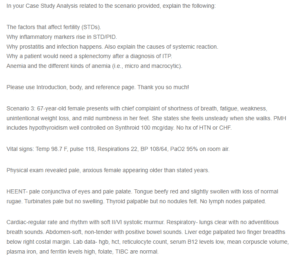
Infections and Hematologic Disorders
In your Case Study Analysis related to the scenario provided, explain the following:
The factors that affect fertility (STDs).
Why inflammatory markers rise in STD/PID.
Why prostatitis and infection happens. Also explain the causes of systemic reaction.
Why a patient would need a splenectomy after a diagnosis of ITP.
Anemia and the different kinds of anemia (i.e., micro and macrocytic).
Please use Introduction, body, and reference page. Thank you so much!
Scenario 3: 67-year-old female presents with chief complaint of shortness of breath, fatigue, weakness, unintentional weight loss, and mild numbness in her feet. She states she feels unsteady when she walks. PMH includes hypothyroidism well controlled on Synthroid 100 mcg/day. No hx of HTN or CHF.
Vital signs: Temp 98.7 F, pulse 118, Respirations 22, BP 108/64, PaO2 95% on room air.
Physical exam revealed pale, anxious female appearing older than stated years.
HEENT- pale conjunctiva of eyes and pale palate. Tongue beefy red and slightly swollen with loss of normal rugae. Turbinates pale but no swelling. Thyroid palpable but no nodules felt. No lymph nodes palpated.
Cardiac-regular rate and rhythm with soft II/VI systolic murmur. Respiratory- lungs clear with no adventitious breath sounds. Abdomen-soft, non-tender with positive bowel sounds. Liver edge palpated two finger breadths below right costal margin. Lab data- hgb, hct, reticulocyte count, serum B12 levels low, mean corpuscle volume, plasma iron, and ferritin levels high, folate, TIBC are normal.
 Complete the order form and upload all of your files, including any instructions, rubrics, or other materials provided by your instructor.
 Complete the order payment after filling in the order form. We’ll receive your order and assign it to a writer.
 The assigned writer will complete your paper and forward it to our Editing Team for review and approval.
 Once approved by the editor, the completed paper will be uploaded to your account for you to download, review and approve.