
Impaired Immune System Care Map
| Assessment
and Data Collection |
Three NANDA-I Approved Nursing Diagnosis | One Smart Goal for EACH Nursing Diagnosis | Two Nursing Interventions with Rationale for EACH Nursing Diagnosis |
| Disease Process:
HIV weakens the client’s immune system, allowing various pathogens, including bacteria and viruses, to cause opportunistic infections. Common Labwork/Diagnostics: Common labwork/diagnostics for major opportunistic infections include · Complete Blood Count (CBC) · Viral Load test · Sputum cultures · Chest X-rays Assessment Data (consider subjective, objective, and health history): Subjective · The client complains of feeling well recently · The client complains of a dry cough
Objective · T: 102 degrees Fahrenheit · HR: 102 beats/minute · RR: 28/minute · BP: 135/86 mmHg
Health History · HIV+ client · Tom is 45-years-old |
Nursing Diagnosis 1:
The patient is at increased risk of bacterial, viral, and fungal infections as related to the poor primary immune system due to HIV-positive status. Nursing Diagnosis 2: Impaired airway clearance related to pulmonary tuberculosis infection as evidenced by the dry cough. Nursing Diagnosis Hyperthermia related to opportunistic infection related to opportunistic infections as evidenced by the elevated core temperature. |
SMART Goal 1:
Improve patient’s knowledge of HIV management and opportunistic infection risk reduction in the next 6 hours
SMART Goal 2: Improve the patient’s airway clearance and pulmonary tuberculosis infection symptoms in 24 hours. SMART Goal3: Help the patient to maintain a body temperature below 98.6° F within 6 hours. |
Goal 1 interventions
1. Patient education on HIV self-management Rationale: Interventions such as patient education improve self-management in patients with HIV patients (Areri et al., 2020). 2. Introduce the patient to antiretrovirals therapy. Rationale: Antiretroviral therapy can strengthen his immunity’s ability to fight off infections. Goal 2 Interventions 1. Educate the patient on the need to adhere to medication for the next six months. Rationale: Improved adherence to the TB care regimen can improve outcomes. 2. Patient counselling Rationale: Patient counselling and education improve patient adherence to medication and treatment outcomes (Pradipta et al., 2020). Goal 3 interventions 1. Focus on treating the underlying causes. Rationale: Elevated body temperature indicates an issue with the body’s thermoregulation. Managing the factor of deregulation can help manage the patient’s temperature. 2. Improve the patient’s intake of cool fluids. Rationale: Cool fluids can reduce high temperatures and help with dehydration. |
References
Areri, H. A., Marshall, A., & Harvey, G. (2020). Interventions to improve self-management of adults living with HIV on Antiretroviral Therapy: A systematic review. PLOS ONE, 15(5), e0232709. https://doi.org/10.1371/JOURNAL.PONE.0232709
Pradipta, I. S., Houtsma, D., van Boven, J. F. M., Alffenaar, J. W. C., & Hak, E. (2020). Interventions to improve medication adherence in tuberculosis patients: a systematic review of randomized controlled studies. Npj Primary Care Respiratory Medicine 2020 30:1, 30(1), 1–10. https://doi.org/10.1038/s41533-020-0179-x
ORDER A PLAGIARISM-FREE PAPER HERE
We’ll write everything from scratch
Question 
For this assignment, you will demonstrate knowledge of the diagnostic process using the template below. You will identify common assessment data, three priority nursing diagnoses, client-centred outcomes, and nursing interventions with rationale for a client with impaired immunity.
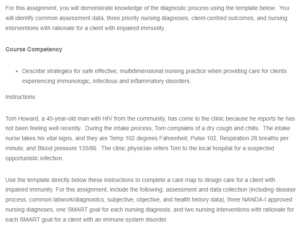
Impaired Immune System Care Map
Course Competency
Describe strategies for safe effective, multidimensional nursing practice when providing care for clients experiencing immunologic, infectious and inflammatory disorders.
Instructions
Tom Howard, a 45-year-old man with HIV from the community, has come to the clinic because he reports he has not been feeling well recently. During the intake process, Tom complains of a dry cough and chills. The intake nurse takes his vital signs, and they are Temp 102 degrees Fahrenheit, Pulse 102, Respiration 28 breaths per minute, and Blood pressure 135/86. The clinic physician refers Tom to the local hospital for a suspected opportunistic infection.
Use the template directly below these instructions to complete a care map to design care for a client with impaired immunity. For this assignment, include the following: assessment and data collection (including disease process, common labwork/diagnostics, subjective, objective, and health history data), three NANDA-I approved nursing diagnoses, one SMART goal for each nursing diagnosis, and two nursing interventions with rationale for each SMART goal for a client with an immune system disorder.
 Complete the order form and upload all of your files, including any instructions, rubrics, or other materials provided by your instructor.
  Complete the order payment after filling in the order form. We’ll receive your order and assign it to a writer.
 The assigned writer will complete your paper and forward it to our Editing Team for review and approval.
 Once approved by the editor, the completed paper will be uploaded to your account for you to download, review and approve.