
IMC Reflection
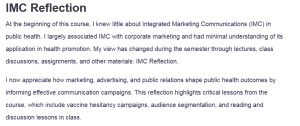
At the beginning of this course, I knew little about Integrated Marketing Communications (IMC) in public health. I largely associated IMC with corporate marketing and had minimal understanding of its application in health promotion. My view has changed during the semester through lectures, class discussions, assignments, and other materials: IMC Reflection.
I now appreciate how marketing, advertising, and public relations shape public health outcomes by informing effective communication campaigns. This reflection highlights critical lessons from the course, which include vaccine hesitancy campaigns, audience segmentation, and reading and discussion lessons in class.
Understanding IMC in Public Health
Prior to this course, I believed that public health messaging was just communicating information. I have now learned that healthy communication is strategic messaging, engaging with the media, and trusting the public. A particularly eye-opening lecture was the one related to the dissemination of misinformation and the application of message framing in debunking public health myths. I was taken aback by what I learned about crisis communication and the role that communicators play in upholding public trust.
Application of IMC Strategies: Vaccine Hesitancy Campaign
The most significant of the assignments was developing an IMC campaign to decrease vaccine hesitancy among parents of daycare-aged children in Mississippi. It encompassed the real-world application of key course principles such as message framing, media planning, and audience segmentation. The PESO (Paid, Earned, Shared, and Owned) model was useful for planning the outreach strategy for the campaign.
Notably, the PESO model enabled me to utilize various communication channels to echo vaccine messages efficiently. Paid media reached hesitant parents via social media, earned media utilized healthcare providers who recommended immunization, shared media involved communities via word of mouth, and owned media offered credible information on public health websites, as outlined by Vasan et al. (2024). Being part of this campaign earned me even greater respect for planned health communication campaigns.
Importance of Audience Segmentation
One of the greatest revelations to me was audience segmentation. I had initially thought that public health messages needed to be developed universally, but I learned that various populations need specialized messaging. Through class discussion and research, I understood that people react differently to the source of their health information based on their values, their beliefs, or their demographics.
An example of this is that my vaccine hesitancy research discovered that young parents aged between 25 and 45 years had the most interest in vaccine safety and vaccine government control. Therefore, the use of scientific evidence in an understandable, non-threatening fashion was necessary to address these concerns. Reaffirming the fact that credibility matters for public health messaging, the credible messengers used were local health workers and community leaders. Class discussion, too, resulted in the widening of my knowledge as classmates would explain how culture and socioeconomic status play out in the perception of health.
Insights from Class Discussions and Readings
The ‘I Vaccinate’ campaign and TED talk by Melinda Gates provided real-life examples of how we could place IMC principles. Local messaging and trustworthy messengers provided better support for public health initiatives than did the one-size-fits-all national campaign. This further seemed to reinforce a central point I will keep in mind when I work in public health going forward: culturally specific communication.
In addition, peer discussions within the class enabled me to realize how various public health issues demand various marketing strategies. Listening to views on social media misinformation, the use of ethical considerations in health advertisements, and emotional appeals enabled me to develop deeper critical thoughts on the effects of IMC.
Professional Growth and Future Application
Looking back at my experience in this course, I have learned important skills in strategic messaging, developing audience, and media selection. In the beginning, I thought public health communication was no more than information transference, but I have learned that successful campaigns involve planning, credibility, and focused messaging. These are the skills that will be useful in my professional career in public health communication, health education, or policy advocacy.
Conclusion
This class shifted my view of the role of IMC in public health. I have become competent in message framing, audience segmentation, and campaign development through discussions, assignments, and lectures. The vaccine hesitancy project and feedback from the “I Vaccinate” campaign reinforced the importance of trust and tailored communication in health promotion. I now feel confident to apply IMC principles to real-world practice in public health so that health messages are not only heard but also acted upon.
References
Vasan, S., Rao, A. A., Priya, S. S., & Gupta, N. (2024). Paid, owned and earned media research: A mixed review, reflections and agendas for future research. FIIB Business Review. https://doi.org/10.1177/23197145241283866
ORDER A PLAGIARISM-FREE PAPER HERE
We’ll write everything from scratch
Question 
Background
This assignment is designed to allow you to reflect on your experience in this course over the semester. It is a chance to provide critical thought about the class content and your comprehension and application of those concepts through assignments.
Format
The assignment format will be a standard Word document. If you do not have Microsoft Office, use the university’s file converter. You will write a 2-page essay in a format of:
- Double-spaced
- One-inch margins
- 12-point font
Instructions
Consider all the content we covered during the semester and how that relates to what you think you will do for a career in the IMC field/in public health. Think about your understanding of public health, the IMC field and common marketing, advertising, and public relations practices when you began this semester compared to your understanding now at the completion of the semester.
IMC Reflection
Write an essay about your experience in this class relative to the fields of IMC and public health. This is an open-ended assignment for you to take in any relevant direction you like. Be truthful; this is not about stating only positive experiences. Please be specific in your reflection and include discussion of at least two of the below elements:
- Particular class lectures, discussions or activity materials
- Specific assignments to apply the course concepts
- Reference to readings from the course textbook
- Perspectives from classmates, supplemental materials (e.g., articles & videos) or discussions you had with others outside of class
This is an individual assignment to be uploaded to Blackboard. The only grading criterion is that you produce a well-written (free of GSP errors) personal reflection that shows critical thought about the course content.
Resource:
 Complete the order form and upload all of your files, including any instructions, rubrics, or other materials provided by your instructor.
  Complete the order payment after filling in the order form. We’ll receive your order and assign it to a writer.
 The assigned writer will complete your paper and forward it to our Editing Team for review and approval.
 Once approved by the editor, the completed paper will be uploaded to your account for you to download, review and approve.