
Identification of a Social Problem – Housing insecurity
The absence of permanent, secure, and reasonably priced housing, or housing insecurity, persists as a pressing social problem in the United States. As a policy advocate and social worker, seeing the reach of this issue and its influence on those who need help is the first step to real progress. This paper identifies housing insecurity as the central issue for investigation, explains who is generally affected, discusses its breach of social work ethics, and lays out the path forward for policy support.
Social Problem
Housing insecurity encompasses multiple conditions, including frequent relocation, being unable to pay for housing, living with many people, and lack of shelter. As revealed by the National Low Income Housing Coalition (NLIHC), more than seven million accessible and reasonably priced rental properties for severely low-income tenants are lacking in America (National Low Income Housing Coalition, 2024). Those who struggle the most from this crisis are people of color, single mothers, LGBTQ+ youth, individuals with disabilities, and veterans. Some of these people do not have supportive housing, rental assistance, or protections as a tenant.
Historical Identification and Actions Taken
Historically, being homeless or lack of stable housing has typically been caused by inequality in society. New Deal-era programs helped some, but redlining and racially restrictive rules made it hard for Black people to get decent housing in the 1930s. Even after the Fair Housing Act was passed in the 1960s to end discrimination, its enforcement has remained mixed. Programs such as Section 8 vouchers and Low-Income Housing Tax Credits (LIHTC) have tried to solve housing problems, yet there is still not enough to meet the need (Hagan et al., 2025). Despite what has been done, many factors still stop marginalized communities from getting safe and affordable housing.
How Affected Populations Have Changed Over Time
During the Great Depression, housing insecurity significantly affected older adults and low-income families. The shape and scale of homelessness and housing difficulties have grown and developed slowly. The National Alliance to End Homelessness emphasizes that everyone deserves a safe, stable home (National Alliance to End Homelessness, 2023). More and more homelessness is reported among the working class, where regular work hours fail to provide enough to cover market-priced housing in cities.
Social Work Values
Housing insecurity contradicts the values held by social work, which include respect and dignity for people, the need for strong connections, and justice for all. The NASW Code of Ethics stresses that social workers should help support the well-being of society by advocating for housing rights (Forbes et al., 2024). Failing to solve problems of shelter often results in mental health issues, jeopardizes safety, and limits people’s chances for better opportunities. In order to help particular vulnerable populations, social workers can frequently communicate with advocacy organizations in local, state, and federal jurisdictions (Jansson, 2017). Therefore, ensuring housing policies are fair is a responsibility for social workers focused on dignity and justice.
Next Steps for Identifying a Policy
The next step is to identify a policy that can help solve the social issue at the local area or state level. One solution is to advocate for proposals for increased rental aid and permanent supportive housing. To do this, I will start by closely reviewing the Housing Choice Voucher Mobility Demonstration and the laws that promote inclusionary zoning. I will also assess both draft legislation and different advocacy strategies using the Urban Institute (www.urban.org), the Center on Budget and Policy Priorities (www.cbpp.org), and the National Low Income Housing Coalition (www.nlihc.org). I will carefully determine if the sources are reliable and impartial before including them while considering the views of those who disagree to improve my proposals.
Conclusion
To sum up, housing insecurity is a significant socioeconomic issue that mostly affects already vulnerable groups. Despite efforts made over time, challenging systemic gaps remain that stop many from getting decent, low-cost housing. Solving this problem is necessary to preserve social work standards and equitable treatment for everyone.
References
Forbes, R., Gomez-Vidal, C., Kang, J., & Krings, A. (2024). Applying a human rights framework to the just transition: Implications for social work. Journal of Human Rights and Social Work. https://doi.org/10.1007/s41134-024-00357-5
Hagan, M., Hepburn, P., Steil, J., & Weiss, B. (2025). Ensuring housing stability and protections for the nation’s renters: Avenues for federal action. Housing Policy Debate, 1–16. https://doi.org/10.1080/10511482.2025.2479457
Jansson, B. S. (2017). Empowerment series: Becoming an effective policy advocate. Cengage Learning.
National Alliance to End Homelessness. (2023). Home – National Alliance to End Homelessness. https://endhomelessness.org/
National Low Income Housing Coalition. (2024). The problem. National Low Income Housing Coalition. https://nlihc.org/explore-issues/why-we-care/problem
ORDER A PLAGIARISM-FREE PAPER HERE
We’ll write everything from scratch
Question 
Identification of a Social Problem – Housing insecurity
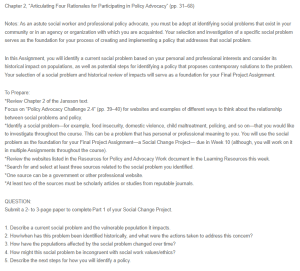
Chapter 2, “Articulating Four Rationales for Participating in Policy Advocacy” (pp. 31–68)
Notes: As an astute social worker and professional policy advocate, you must be adept at identifying social problems that exist in your community or in an agency or organization with which you are acquainted. Your selection and investigation of a specific social problem serves as the foundation for your process of creating and implementing a policy that addresses that social problem.
Identification of a Social Problem – Housing insecurity
In this Assignment, you will identify a current social problem based on your personal and professional interests and consider its historical impact on populations, as well as potential steps for identifying a policy that proposes contemporary solutions to the problem. Your selection of a social problem and historical review of impacts will serve as a foundation for your Final Project Assignment.
To Prepare:
*Review Chapter 2 of the Jansson text.
Focus on “Policy Advocacy Challenge 2.4” (pp. 39–40) for websites and examples of different ways to think about the relationship between social problems and policy.
*Identify a social problem—for example, food insecurity, domestic violence, child maltreatment, policing, and so on—that you would like to investigate throughout the course. This can be a problem that has personal or professional meaning to you. You will use the social problem as the foundation for your Final Project Assignment—a Social Change Project— due in Week 10 (although, you will work on it in multiple Assignments throughout the course).
*Review the websites listed in the Resources for Policy and Advocacy Work document in the Learning Resources this week.
*Search for and select at least three sources related to the social problem you identified.
*One source can be a government or other professional website.
*At least two of the sources must be scholarly articles or studies from reputable journals.
QUESTION:
Submit a 2- to 3-page paper to complete Part 1 of your Social Change Project.
1. Describe a current social problem and the vulnerable population it impacts.
2. How/when has this problem been identified historically, and what were the actions taken to address this concern?
3. How have the populations affected by the social problem changed over time?
4. How might this social problem be incongruent with social work values/ethics?
5. Describe the next steps for how you will identify a policy.
Be sure to incorporate the sources you found related to your selected social problem using standard APA format.
 Complete the order form and upload all of your files, including any instructions, rubrics, or other materials provided by your instructor.
  Complete the order payment after filling in the order form. We’ll receive your order and assign it to a writer.
 The assigned writer will complete your paper and forward it to our Editing Team for review and approval.
 Once approved by the editor, the completed paper will be uploaded to your account for you to download, review and approve.