
Hyperthyroidism in Diabetic Patients
Darnella,
Thank you for sharing your post. Hyperthyroidism occurs in some diabetic patients. The carbohydrate metabolism effect can potentially lead to diabetes control disruptions. Although glucose levels do not always fluctuate, abnormal glucose tolerance testing results can be observed in a patient with hyperthyroidism because of the higher-than-normal increase in glucose. In addition, the thyroid hormone increases the digestive tract absorption rate as well as the levels of thyroid hormones and, hence, increases the resistance of insulin as well as insulin degradation (Nishi, 2018). Our assignment writing help is at affordable prices to students of all academic levels and academic disciplines.
Nishi (2018) also adds that in patients with hyperthyroidism, synthesis and degradation of glycogen increases, and this leads to a decline in levels of glycogen. The absorption of glucose is increased, and so are its production and utilization. Glucose uptake in the peripheral tissues also increases, thus resulting in the exaggerated peaks of glucose mentioned above during a glucose-timed test. The requirements of insulin are raised, and if these are not adequately addressed, it can cause decompensation of control and ultimately lead to diabetic ketoacidosis. Further, in persons with undetected Diabetes, Diabetes can be unmasked by hyperthyroidism because of the abnormally elevated glucose levels due to an increase in insulin resistance. This was likely the case with Mrs. Anderson. An increase in the diabetes medication dosage may be necessitated in persons already treated until the stabilization of thyroid function and the resulting stabilization of glucose occurs.
Reference
Nishi, M. (2018). Diabetes mellitus and thyroid diseases. Diabetology International, 9(2), 108-112.
ORDER A PLAGIARISM-FREE PAPER HERE
We’ll write everything from scratch
Question 
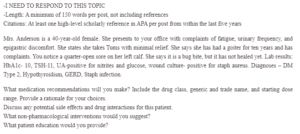
-I NEED TO RESPOND TO THIS TOPIC
-Length: A minimum of 150 words per post, not including references
Citations: At least one high-level scholarly reference in APA per post from within the last five years
Hyperthyroidism in Diabetic Patients
Mrs. Anderson is a 40-year-old female. She presents to your office with complaints of fatigue, urinary frequency, and epigastric discomfort. She states she takes Tums with minimal relief. She says she has had a goiter for ten years and has complaints. You notice a quarter-open sore on her left calf. She says it is a bug bite, but it has not healed yet. Lab results: HbA1c- 10, TSH-11, UA-positive for nitrites and glucose, wound culture- positive for staph aureus. Diagnoses – DM Type 2, Hypothyroidism, GERD, Staph infection.
What medication recommendations will you make? Include the drug class, generic and trade name, and starting dose range. Provide a rationale for your choices.
Discuss any potential side effects and drug interactions for this patient.
What non-pharmacological interventions would you suggest?
What patient education would you provide?
Staph infection:
Dicloxacillin is a narrow-spectrum antibiotic (Penicillin) that treats Staph infections. It is penicillin-resistant and is used to treat skin or tissue infections (2021). It is recommended to use “500mg by mouth every 6 hours for 7 days or 3 days after the acute infection resolves, depending on the nature and severity of the infection” (2021). The dosage range for this medication is 500mg to 4000mg per day. If there is a question of Penicillin allergy, a test should be administered before medication administration.
Type 2 Diabetes:
Due to an HbA1C level of 10, the patient has had an average glucose level of 240 (Rosenthal & Burchum, 2021, pp. 397-400). The patient would be treated initially with Metformin because it is the first-line medication for the treatment of type 2 Diabetes. The initial dose would be 500mg twice or 850mg daily (Rosenthal & Burchum, 2021, pp. 408-409). Metformin is a Biguanide medication with a trade name noted as Glucophage. The most common side effects are decreased appetite, nausea, and diarrhea, which also reduces the absorption of vitamin B12 and folic acid and can cause deficiencies.
Hypothyroidism
Levothyroxine 50 mcg daily for treatment, which is a synthetic thyroid hormone replacement. The Trade name is Synthroid, and the starting dose range is 50-60 mcg. This is the drug of choice for most patients with hypothyroidism (Rosenthal & Burchum, 2021). When administered as prescribed, this medication rarely causes side effects, but an overdose will cause thyrotoxicosis. Several medications can reduce the absorption of this medication, and the patient should verify all drugs with the provider before taking them.
Meds: histamine two receptor blockers (cimetidine), PPI (Prevacid), Sucralfate(Carafate), Cholestyramine(Questran), Colestipol (Colestid), Aluminum-containing antacids (Mylanta), Calcium supplements (Tums), Iron Supplements (ferrous sulfate), Magnesium salts, Orlistat (Xenical) patient should separate administration of these medications with 4 hours of these medications.
GERD
Omeprazole is a proton pump inhibitor and is recommended at a 20 mg daily dose for treatment. The trade name is Prevacid. It is a drug of choice for treating GERD (Rosenthal & Burchum, 2021). Potential side effects of this medication are community-acquired pneumonia-related, possibly to decrease gastric acid, fractures, rebound acid hypersecretion, and diarrhea. This medication interacts with clopidogrel by reducing the beneficial effects but also can reduce the adverse effects.
Non-Pharmacological Interventions
Referrals for wound clinic to monitor wound healing
Referral for Diabetic education for meals, food prep, and glucose monitoring
Referral to Endocrinologists for tracking of new diagnosis Diabetes Type 2
Patient Education (2019)
Provide the patient with information from the American Diabetes Association Website for reference and meal assistance for controlling her Diabetes.
Provide information for Diabetic patients when you are sick
Provide details on monitoring feet and foot care
Provide glucometer
Provide the patient with basic wound care instructions on keeping the site clean and covered and monitoring for s/s of worsening, including smell, drainage, redness, and warmth.
Instruct patient on adverse effects of medication regimen with emphasis on scheduled medications that should be separated due to possible interactions
Encourage the patient to exercise for 30 min 3 times weekly to start.
Reference
Centers for Disease Control and Prevention. (2019, May 30). Education and support. Centers for Disease Control and Prevention. https://www.cdc.gov/diabetes/managing/education.html.
Dicloxacillin – brand name list FROM DRUGS.COM. Drugs.com. (2021, June 30). https://www.drugs.com/ingredient/dicloxacillin.html.
Rosenthal, L. D., & Burchum, J. R. (2021). Lehne’s pharmacotherapeutics for advanced practice nurses and physician assistants. Elsevier.
 Complete the order form and upload all of your files, including any instructions, rubrics, or other materials provided by your instructor.
  Complete the order payment after filling in the order form. We’ll receive your order and assign it to a writer.
 The assigned writer will complete your paper and forward it to our Editing Team for review and approval.
 Once approved by the editor, the completed paper will be uploaded to your account for you to download, review and approve.