
How the Courts Address or Respect Our Rights as Citizens – Presentation
Hello, and welcome to today’s presentation. The presentation highlights the roles courts play in fostering respect for human rights. In particular, the apex court, the United States Supreme Court, has presided over and made decisions on cases with life-changing implications for US citizens. The courts are mostly invited to rule on constitutional matters that affect human rights. The primary function of courts and the justice system is to uphold individual and collective rights granted by the Constitution.
The Maryland vs. King case raised the debate regarding the scope of the police in cases involving DNA identification. During the Supreme Court deliberations on the matter, two opposing sides emerged. On the one hand, there were those who lauded law enforcers for their pragmatism, arguing that one of the law enforcers’ roles is to be creative in resolving cold cases. However, those opposed to the police action against King argued that the move violated his Fourth Amendment and privacy rights. It is worth noting that a DNA test reveals detailed information compared to fingerprints and photographs, as it can show one’s predisposition to certain traits such as violence. The case also offers insights into probable cause and its limits.
The Maryland DNA Collection Act allows law enforcers to collect DNA samples from individuals arrested on violence-related crimes, attempted burglary, and burglary. Having threatened to kill his girlfriend if she reported him to the police after a physical assault, King was arrested on first and second-degree charges. While under arrest, King’s DNA was swabbed and logged into the Maryland state DNA database, where it matched to a DNA sample from an unresolved rape case. Although it was the only evidence linking King to the rape case, the trial charge denied King’s pleas to suppress the DNA evidence, subsequently convicting him of the charge and sentencing him to life in prison. King appealed the conviction, escalating the matter to the United States Supreme Court.
The Maryland DNA Collection Act, which was central to the Maryland v. King case, was initially enacted in 2004. Initially, DNA collection was only meant for official crime investigations, including identifying human remains and missing persons. However, in 2008, the act was amended to allow law enforcers to collect DNA samples from violent crime suspects, such as burglars and assault suspects. The case proceeded to the US Supreme Court after the Maryland Supreme Court ruled against the legality of the police’s DNA sample collection from King (Justia, n.d.). Unsatisfied with the ruling, Maryland state filed an appeal at the Supreme Court.
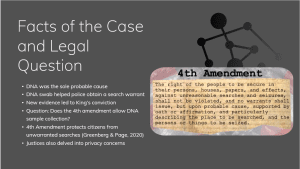
The Maryland v. King case triggered significant controversy, especially because DNA was the sole probable cause that linked King to the rape charges. Having obtained a warrant based on the DNA test results, King felt that his constitutional rights were violated. The primary question in the case for justices to determine was whether the Fourth Amendment allows police to collect DNA samples from citizens without probable cause. The Fourth Amendment protects citizens from unreasonable searches and seizures (Greenberg & Page, 2020). The justices were also to determine whether, by conducting DNA tests, the police accessed critical health information, thus violating an individual’s right to privacy.
Following the Maryland Supreme Court’s order that granted King freedom by implying that the police did not follow the law, Maryland state applied for a stay order pending the determination of an upcoming Supreme Court case. In a ruling granted by Justice Roberts, the US Supreme Court stayed the Maryland Supreme Court decision, implying that King would continue to serve his sentence. The Supreme Court justices subsequently deliberated on the matter and ruled in favor of Maryland state. One of the key decisions was that denying law enforcers the right to leverage DNA testing would weaken their effectiveness. Also, the US SC ruled that just fingerprinting technology, DNA testing is part of the government’s identification procedures, only that it provides detailed information. Ultimately, the court ruled that DNA testing is not unreasonable based on Fourth Amendment standards.
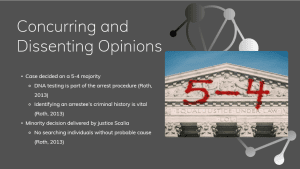
The US Supreme Court decided the case on a 5-4 majority. The majority side, in a decision delivered by Justice Kennedy, argued that DNA testing does not violate the Fourth Amendment rights and that it is not invasive of one’s privacy. The majority of justices also defended law enforcers’ actions following King’s arrest by arguing that investigating a criminal’s history is an important step in the arrest procedure to, among others, ensure the safety of others while the suspects are held in custody. On the other hand, Justice Scalia delivered the dissenting opinion, which mostly relied on the Fourth Amendment provision that protects citizens from unreasonable searches and seizures. The dissenting judges argued that there was no probable cause to warrant King’s DNA testing (Roth, 2013).
In conclusion, the Maryland v. King case challenged the Fourth Amendment provisions regarding the powers police have to search individuals. The decision reflected an emphasis on police effectiveness rather than preserving constitutional rights, especially if the end goal is to resolve cases and bring public peace. The US Supreme Court’s decision expands the government’s authority to search individuals suspected of having committed crimes while in government custody. To that end, suspicionless searches are possible as law enforcers do not require a convincing probable cause. The arguments raised by Maryland state indicate law enforcers’ innovativeness toward beating constitutional limits.
References
Greenberg, E. S., & Page, B. I. (2020). The struggle for democracy: 2018 elections and updates edition. Pearson.
Justia. (n.d.). Maryland v. King, 569 U.S. 435 (2013). Justia Law. https://supreme.justia.com/cases/federal/us/569/435/
Roth, A. L. (2013, October 24). Maryland v. King and the wonderful, horrible DNA revolution in law enforcement. Ssrn.com. https://papers.ssrn.com/sol3/papers.cfm?abstract_id=2344918
ORDER A PLAGIARISM-FREE PAPER HERE
We’ll write everything from scratch
Question 
How the Courts Address or Respect Our Rights as Citizens – Presentation
Instructions
This is Part II of the assignment you submitted in Week 6.

How the Courts Address or Respect Our Rights as Citizens – Presentation
Using the case outline (Part I: How the Courts Address or Respect Our Rights as Citizens) you submitted in Week 6, prepare and submit a presentation, either a narrated PowerPoint, a Kaltura Video, or some other format approved by your instructor. Verify the presentation format with your instructor before starting work on this assignment.
Here are some helpful resources from the GenEd Resource Center to assist you with the technological aspects of the assignment:
Important: In this assignment, you are expected to elaborate on the points you made in the prior assignment in Week 6. This assignment will be graded on your strength to elaborate and explain the facts of the case, proper use of visual aids, good narration, presentation of the case, and how well you stick to the case. Do not copy-paste the outline into this and call it complete.
 Complete the order form and upload all of your files, including any instructions, rubrics, or other materials provided by your instructor.
  Complete the order payment after filling in the order form. We’ll receive your order and assign it to a writer.
 The assigned writer will complete your paper and forward it to our Editing Team for review and approval.
 Once approved by the editor, the completed paper will be uploaded to your account for you to download, review and approve.