
Hematology and Immunology
Fluid therapy is critical to patient management, especially in emergency medical services (EMS). Standard saline solution is the most used fluid therapy in EMS and clinical management of haematology dehydration and other health complications related to fluid and sodium depletion in the body, leading to electrolyte imbalances (Tonog & Lakhkar, 2022). Understanding why and when fluid therapy is to be provided during an emergency and the goals and limitations of fluid therapy is a critical competency in EMS for health professionals, especially paramedics. This paper discusses a case of a motor vehicle accident and the application of liquid treatment using a standard saline solution.
Why Paramedics Give Normal Saline Solution and not Blood in the Ambulance
The standard saline solution was administered instead of blood to the patient’s falling blood pressure. After the patient had the accident and suffered abdominal trauma and lost blood, their blood pressure dropped due to the reduced blood volume. In cases of emergencies involving blood loss, paramedics give patients the standard saline solution to counter cases if the patient is experiencing a circulatory shock. Loss of blood diminishes the amount of blood in circulation, which may hinder the supply of blood patient’s to the patient’s vital organs. The acute loss of the volume of circulating as a result of the injury of the soft tissue and haemorrhage can lead to life-threatening traumatic hypovolemic shock (Standl et al., 2018). Rapidly infusing the standard saline solution is more likely to improve the blood pressure in circulation, reducing hypovolemic circulatory shock. Another reason for giving the common saline solution in ambulances apart from countering hypovolemia is the availability and longer shelf life of the standard saline solution, as well as easy storage compared to blood.
Why Physician may be Reluctant to Order Blood Transfusion Unless Necessary
The reluctance to order a blood transfusion in emergency care unless necessary is majorly due to the concern over blood groups and compatibility. Blood transfusion has an increased risk of causing fatal transfusion reactions in case of incompatible blood groups. Incorrect blood typing during massive transfusion has been linked to a heightened risk of hemolytic transfusion reaction, which can result in multiple organ failures and death of the patient (Davis et al., 2019). A blood transfusion may restore the circulating volume and achieve the blood pressure target. However, allogenic blood transfusion, especially in emergency settings, risks an overload on the circulation systems with unintended outcomes such as lung injury (Gong et al., 2020). Therefore, caution must be taken before a blood transfusion. Further, ordering a blood transfusion is not logical in an emergency setting as the crossmatch screening process may delay restoration of the required circulating blood volume, risking hypovolemia.
Even without a blood transfusion, hematocrit can improve despite the average fluid volume. How does this happen, and how long does it take?
The loss of blood leads to a drop in hematocrit. This further reduces the supply of oxygen to vital organs, causing hypoxia. Through a negative feedback mechanism, hypoxia influences the secretion of endogenous erythropoietin (EPO) from the kidneys. Endogenous erythropoietin (EPO) is a glycoprotein hormone that is naturally produced by the peritubular cells of the renal cortex within the kidney (Schoener & Borger, 2022). EPO works to restore normal hematocrit levels by targeting the red bone marrow and initiating the production of extra red blood cells. This leads to the improvement of hematocrit levels even without the transfusion of blood. The process may take a minimum of 7 days for a notable hematocrit improvement.
Besides the HCT, what other blood component is measured to better understand oxygen-carrying capacity? Explain your answer.
The Hemoglobin (Hb) levels can be used to understand the oxygen-carrying capacity of the blood. Haemoglobin is a molecule in the red blood cell that supports blood oxygen binding on the RBCs for circulation across the blood. The Hb molecules have four subunits, each made of a heme group and a chain of globin. The Hb molecule has four iron atoms from the heme group and acts as the binding sites for oxygen molecules. Therefore, the oxygen-binding capacity of the blood can be best understood by understanding the molecular weight of Hb and the number of oxygen molecules that each Hb tetramer can carry with a particular amount of blood. Average Hb values vary across genders, usually 12 or higher for females and 13 or higher for males.
What is the relationship between blood pressure, heart rate, and respiratory rate when there is blood loss? Explain.
There is a significant relationship between blood pressure, heart rate, and respiratory rate during and after substantial bleeding. The loss of blood leads to a drop in the circulating volume of blood. The low blood volume leads to a reduced amount of blood to the heart at a particular time. The reduced preload blood pressure leads to decreased cardiac output due to decreased stroke volume and stroke rate. Blood pressure is determined by the cardiac output, which includes the volume of blood pumped out and the rate of strokes (M8). Therefore, a reduced cardiac preload volume leads to a reduced stroke volume and stroke rate, hence a reduction in blood pressure. With diminished blood pressure, the sympathetic nervous system induces an increase in the heart rate, leading to an increase in the respiratory rate as a compensatory response to restore blood pressure and oxygen supply.
Conclusion
EMS care requires an understanding of various methods that can help restore blood oxygen supply, blood pressure, and electrolyte balance standard of blood loss. Using the standard saline solution in emergency care settings can help restore blood pressure and fluids to avoid shock and the adverse effects of electrolyte disturbances. A blood transfusion can provide the desired outcomes. However, the transfusion of blood products requires a lot of caution and processing, making them not fit in emergency clinical care.
References
Davis, C. S., Milia, D., Gottschall, J. L., & Weigelt, J. A. (2019). Massive transfusion associated with a hemolytic transfusion reaction: necessary precautions for prevention. Transfusion, 59(8), 2532–2535. https://doi.org/10.1111/TRF.15405
Gong, Y., Cao, X., Mei, W., Wang, J., Shen, L., Wang, S., Lu, Z., Yu, C., Che, L., Xu, X., Tan, J., Ma, H., & Huang, Y. (2020). Anesthesia Considerations and Infection Precautions for Trauma and Acute Care Cases During the Coronavirus Disease 2019 Pandemic: Recommendations From a Task Force of the Chinese Society of Anesthesiology. Anesthesia and Analgesia, 131(2), 326–334. https://doi.org/10.1213/ANE.0000000000004913
Magder, S. (2018). The meaning of blood pressure 11 Medical and Health Sciences 1102 Cardiorespiratory Medicine and Haematology Luigi Forni. Critical Care, 22(1), 1–10. https://doi.org/10.1186/S13054-018-2171-1/FIGURES/5
Schoener, B., & Borger, J. (2022). Erythropoietin Stimulating Agents. StatPearls. https://www.ncbi.nlm.nih.gov/books/NBK536997/
Standl, T., Annecke, T., Cascorbi, I., Heller, A. R., Sabashnikov, A., & Teske, W. (2018). The Nomenclature, Definition and Distinction of Types of Shock. Deutsches Ärzteblatt International, 115(45), 757. https://doi.org/10.3238/ARZTEBL.2018.0757
Tonog, P., & Lakhkar, A. D. (2022). Normal Saline. StatPearls. https://www.ncbi.nlm.nih.gov/books/NBK545210/
ORWe’ll PLAGIARISM-FREE PAPER HERE
We’ll write everything from scratch
Question 
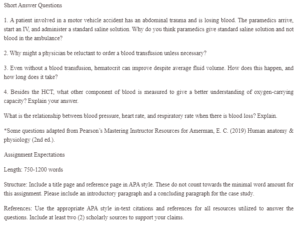
Short Answer Questions
1. A patient involved in a motor vehicle accident has an abdominal trauma and is losing blood. The paramedics arrive, start an IV, and administer a standard saline solution. Why do you think paramedics give common saline solution and not blood in the Ambulance?
Hematology and Immunology
2. Why might a physician be reluctant to order a blood transfusion unless necessary?
3. Even without a blood transfusion, hematocrit can improve despite average fluid volume. How does this happen, and how long does it take?
4. Besides the HCT, what other component of blood is measured to give a better understanding of oxygen-carrying capacity? Explain your answer.
What is the relationship between blood pressure, heart rate, and respiratory rate when there is blood loss? Explain Pearson’s suggestions adapted from Pearson’s Mastering Instructor Resources for Amerman, E. C. (2019) Human anatomy & physiology (2nd ed.).
Assignment Expectations
Length: 750-1200 words
Structure: Include a title page and reference page in APA style. These do not count towards the minimal word amount for this assignment. Please include an introductory paragraph and a concluding paragraph for the case study.
References: Use the appropriate APA style in-text citations and references for all resources utilized to answer the questions. Include at least two (2) scholarly sources to support your claims.
 Complete the order form and upload all of your files, including any instructions, rubrics, or other materials provided by your instructor.
 Complete the order payment after filling in the order form. We’ll receive your order and assign it to a writer.
 The assigned writer will complete your paper and forward it to our Editing Team for review and approval.
 Once approved by the editor, the completed paper will be uploaded to your account for you to download, review and approve.