
Heart Failure
Case Study: A 78-Year-Old Male Presents with A Diagnosis of Heart Failure
List three symptoms the patient exhibits and the path principles.
Heart failure may present with dyspnea, weakness and fatigue, and edema of the feet, ankles, and legs. All these symptoms result from the heart’s diminished pumping capabilities. The reduced pumping abilities cause blood to back up in the pulmonary veins. This causes pulmonary hypertension. Because of the pressure in the pulmonary vessels, fluid extravasation occurs into the lung parenchyma, leading to pulmonary edema (Mullens et al., 2019). This causes lung congestion, making the patient have difficulty breathing and shortness of blood. Fatigue and weakness occur due to the heart’s inability to pump enough blood to the tissues. This results in reduced tissue perfusion. Edema is due to fluid buildup in the body tissues (Mullens et al., 2019). As blood flow out of the heart is impaired, so is inflow into the heart. Blood builds up in vessels, resulting in high intravascular pressures. Because of the high intravascular pressure, extravasation occurs in the interstitial space. This presents as edema. Hire our assignment writing services in case your assignment is devastating you.
What role does hypertrophy play in heart failure?
Hypertrophy is usually a compensatory mechanism that enables the heart to pump enough blood to perfuse all the tissues and organs (Gogiraju et al.,2019). The heart may hypertrophy to overcome the excessive workload of pumping, such as when there is an increase in peripheral resistance. An example is hypertension.
Does this patient have Ischemic disease? Why or why not?
Heart failure does not necessarily mean that the patient has ischemic heart disease. Ischemic heart disease, however, can cause heart failure, which may diminish the heart’s pumping capabilities.
What is Virchow’s Triad?
Virchow’s triad is a factor that briefly summarizes the mechanisms by which one can develop venous thromboembolism. They are divided into factors that cause hypercoagulability, endothelial injury or dysfunction, and factors that cause hemodynamic changes, such as stasis or turbulence of blood (Luow & Ntusi, 2019).
References
Gogiraju, R., Bochenek, M. L., & Schäfer, K. (2019). Angiogenic endothelial cell signaling in cardiac hypertrophy and heart failure. Frontiers in cardiovascular medicine, 6, 20.
Louw, V. J., & Ntusi, N. A. (2019). Virchow’s triad revisited. SAMJ: South African Medical Journal, 109(11), 822-823.
Mullens, W., Damman, K., Harjola, V. P., Mebazaa, A., Brunner‐La Rocca, H. P., Martens, P., … & Coats, A. J. (2019). The use of diuretics in heart failure with congestion—a position statement from the Heart Failure Association of the European Society of Cardiology. European journal of heart failure, 21(2), 137-155.
ORDER A PLAGIARISM-FREE PAPER HERE
We’ll write everything from scratch
Question 
Heart Failure
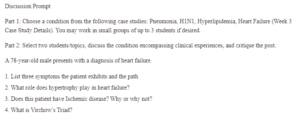
Discussion Prompt
Part 1: Choose a condition from the following case studies: Pneumonia, H1N1, Hyperlipidemia, Heart Failure (Week 3 Case Study Details). You may work in small groups of up to 3 students if desired.
Part 2: Select two students/topics, discuss the condition encompassing clinical experiences, and critique the post.
A 78-year-old male presents with a diagnosis of heart failure.
- List three symptoms the patient exhibits and the path
- What role does hypertrophy play in heart failure?
- Does this patient have Ischemic disease? Why or why not?
- What is Virchow’s Triad?
 Complete the order form and upload all of your files, including any instructions, rubrics, or other materials provided by your instructor.
 Complete the order payment after filling in the order form. We’ll receive your order and assign it to a writer.
 The assigned writer will complete your paper and forward it to our Editing Team for review and approval.
 Once approved by the editor, the completed paper will be uploaded to your account for you to download, review and approve.