
Health Promotion and Disease Prevention
The primary goal of public health is to promote the health and welfare of individuals and the entire population. Furthermore, public health protects people from environmental hazards and conditions (DeSalvo et al., 2017). It also ensures that there are safe and quality healthcare services that the population can access. It conducts research to promote healthy lifestyles and disease prevention strategies.
Do you need help with your assignment ? Get in touch with us at eminencepapers.com. We are determined to provide you with great service.
Disease Prevention
Disease prevention is the specific interventions directed to communities and individuals for the prevention of diseases, reduction of disease burden, and any risk factors linked to the disorders (WHO, 2015). There are two main levels of disease prevention. The first level is primary prevention. Primary prevention strategies prevent an individual from developing a disease (World Health Organization (WHO), 2015). These may involve approaches to improve health, such as addressing the health impacts of the social determinants of health, providing information on unhealthy lifestyles that are risk factors for diseases, consultation with individuals at the community levels on risk reduction measures, nutritional supplementation, education on dental hygiene and prevention strategies such as vaccinations for children and adults and finally post-exposure prophylaxis in exposed individuals (WHO, 2015).
Secondary prevention involves detecting the disease at an early stage, improving the likelihood of positive healthcare outcomes (WHO, 2015). The activities in secondary prevention include community-based health screening programs to detect diseases, maternal and child health screening programs, and preventive pharmacotherapy administered at the early stages of diseases (WHO, 2015). Tertiary prevention aims to target the clinical settings of the conditions (Kisling & Das, 2021). This prevention is done in symptomatic patients to reduce disease severity and associated prognosis. Tertiary prevention reduces disease effects. An example is rehabilitative services.
Existing Disease Prevention Model
The Health Belief Model is used to guide disease prevention strategies. It is utilized to explain and predict health behavior changes in individuals (Jones et al., 2015). In simpler terms, it is used to understand the health behaviors of individuals. The key aspects of HBM focus on individual concern about their health conditions, which can predict their health-related behaviors. This model describes factors that determine health-related behaviors such as “perceived susceptibility to disease, perceived severity of the disease, perceived benefits of actions, perceived barriers to action, cues to action and self-efficacy of individuals” (Jones et al., 2015). This model can be utilized to implement short and long-term prevention strategies. It can be used alone or in combination with other models.
Benefits and Concerns of HBM
The main benefit of this model is that it is easy to implement, use, and test (Jones et al., 2015). The theoretical framework of this model can be used to investigate the cognitive factors that impact the health-related behaviors of individuals. Investigators can also focus on variables that are preconditions for health-related behaviors (Jones et al., 2015). This means that it can be used to implement practical interventions.
HBM has a couple of limitations. It does not consider the beliefs and attitudes of individuals that impact health behavior ((Jones et al., 2015). It also does not consider habitual behaviors such as smoking ((Jones et al., 2015). In addition, it does not consider social acceptability behaviors that are non-health related. This model does not consider economic or environmental factors that may serve as barriers or promoters of recommended action ()(Jones et al., 2015.
Health Promotion
Health promotion involves empowering individuals to enhance control over their health by conducting health literacy programs and collaboration to improve healthy behaviors (WHO, 2015). This consists of implementing strategies in communities that have an increased risk of negative health issues. Health promotion programs address behavior-related risk factors, including cigarette smoking, unhealthy diet, and lack of physical activity. In addition to this, health promotion addresses areas such as psychiatry health, drug abuse control, sexual health, and HIV-related behavior (WHO, 2015).
Existing Health Promotion Model
The behavioral change model utilizes a preventive approach to focus on lifestyle behaviors that affect health. This model aims to urge individuals to adopt healthy behavioral changes, use preventive healthcare services, and take charge of their health (Laverack, 2017). This model is more medicalized since it tends to blame the victim. The hypothesis behind this model is that providing individuals with medical information will help them change their behaviors and beliefs.
Benefits and Concerns of Behavior Change Model
This model focuses on healthcare professionals as the custodians of healthcare knowledge. This enables healthcare professionals to transmit this knowledge to individuals, which increases their ability, allowing them to adopt healthy lifestyle behaviors. This model, however, has a couple of limitations. The individuals being taught are largely passive in the process; it has a moralistic tone (Laverack, 2017). In addition to this, it is deficit-focused since it only emphasizes medical problems (Laverack, 2017). This model focuses on risk rather than preventive factors. Finally, it does not consider socio-ecological and social determinants of health.
Role of Evidence-Based Practice in the Success of Disease Prevention and Health Promotion
Health promotion and disease prevention are complicated since there are several inputs required for decision-making. Evidence-based practice may thus be helpful in the public health space. Evidence-based public health (EBPH) involves using sound and current scientific evidence while considering individual preferences to implement disease prevention and health promotion strategies (Brownson et al., 2017). EBPH is important since it uses available scientific literature through sound research methods while involving the affected communities in the decision-making process. EBPH is important since it enables public health professionals to access high-quality scientific evidence to implement good health promotion and disease prevention strategies (Brownson et al., 2017). It also increases the chances of success of health promotion strategies and policies. Finally, it leads to more human resource productivity and efficient use of resources (Brownson et al., 2017). Evidence-based practice should thus be incorporated in public health.
Role of Health Teaching in Disease Prevention and Health Promotion
Health education is an excellent strategy for implementing disease prevention and health promotion programs. Health education teaches individuals various health-related topics. The health teaching can be tailor-made for target communities Rural Health Information Hub (RHIB), 2021 (). The multiple issues include health benefits/risks and offer tools to build individual capacity and support lifestyle changes. Health learning activities can consist of courses, webinars, classes, workshops, and lectures. Health education programs must improve the main objective of disease prevention and health promotion programs. The materials required for health education should be culturally appropriate (RHIB, 2021). They must consider the preferences of the target communities to ensure cultural competency. Health education should address cultural and linguistic challenges and any barriers faced when delivering health education.
Conclusion
Disease prevention and health promotion programs aim to empower communities and individuals to adopt lifestyle changes and reduce the chances of developing chronic conditions. Policy formulators should thus focus on implementing these programs to reduce the disease burden in society. The healthcare landscape is ever-changing, and health education is at the center of successful disease prevention and health promotion programs. Healthcare professionals must use healthcare models to help them in designing and implementing these programs. In addition to this, they must incorporate evidence-based practice in disease prevention programs. Finally, health promotion allows individuals to be players in their health. Healthcare services should be preventive and not curative.
References
Brownson, R. C., Baker, E. A., Deshpande, A. D., & Gillespie, K. N. (2017). Evidence-based public health. Oxford University Press.
DeSalvo, K. B., Wang, Y. C., Harris, A., Auerbach, J., Koo, D., & O’Carroll, P. (2017). Public health 3.0: A call to action for public health to meet the challenges of the 21st century. Preventing Chronic Disease, 14. https://doi.org/10.5888/pcd14.170017
Jones, C. L., Jensen, J. D., Scherr, C. L., Brown, N. R., Christy, K., & Weaver, J. (2015). The health belief model as an explanatory framework in communication research: Exploring parallel, serial, and moderated mediation. Health Communication, 30(6), 566-576. https://doi.org/10.1080/10410236.2013.873363
Kisling, L. A., & Das, J. M. (2021, May 9). Prevention strategies – StatPearls – NCBI bookshelf. National Center for Biotechnology Information. https://www.ncbi.nlm.nih.gov/books/NBK537222/
Laverack, G. (2017). The challenge of behavior change and health promotion. Challenges, 8(2), 25. https://doi.org/10.3390/challe8020025
Rural Health Information Hub (RHIB). (2021). Health education strategies – Rural health promotion and disease prevention toolkit. Rural Health Information Hub. https://www.ruralhealthinfo.org/toolkits/health-promotion/2/strategies/health-education
World Health Organization (WHO). (2015, February 1). Health promotion and disease prevention through population-based interventions, including action to address social determinants and health inequity. WHO EMRO |. https://www.emro.who.int/about-who/public-health-functions/health-promotion-disease-prevention.html
ORDER A PLAGIARISM-FREE PAPER HERE
We’ll write everything from scratch
Question 
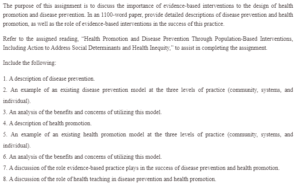
The purpose of this assignment is to discuss the importance of evidence-based interventions to the design of health promotion and disease prevention. In an 1100-word paper, provide detailed descriptions of disease prevention and health promotion, as well as the role of evidence-based interventions in the success of this practice.
Health Promotion and Disease Prevention
Refer to the assigned reading, “Health Promotion and Disease Prevention Through Population-Based Interventions, Including Action to Address Social Determinants and Health Inequity,” to assist in completing the assignment.
Include the following:
- A description of disease prevention.
- An example of an existing disease prevention model at the three levels of practice (community, systems, and individual).
- An analysis of the benefits and concerns of utilizing this model.
- A description of health promotion.
- An example of an existing health promotion model at the three levels of practice (community, systems, and individual).
- An analysis of the benefits and concerns of utilizing this model.
- A discussion of the role evidence-based practice plays in the success of disease prevention and health promotion.
- A discussion of the part of health teaching in disease prevention and health promotion.
 Complete the order form and upload all of your files, including any instructions, rubrics, or other materials provided by your instructor.
 Complete the order payment after filling in the order form. We’ll receive your order and assign it to a writer.
 The assigned writer will complete your paper and forward it to our Editing Team for review and approval.
 Once approved by the editor, the completed paper will be uploaded to your account for you to download, review and approve.