
Gynecologic Health
Case #3 (Lucy) and Description of the Case Chosen: A Brief Case Write-Up
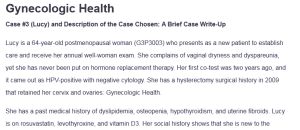
Lucy is a 64-year-old postmenopausal woman (G3P3003) who presents as a new patient to establish care and receive her annual well-woman exam. She complains of vaginal dryness and dyspareunia, yet she has never been put on hormone replacement therapy. Her first co-test was two years ago, and it came out as HPV-positive with negative cytology. She has a hysterectomy surgical history in 2009 that retained her cervix and ovaries: Gynecologic Health.
She has a past medical history of dyslipidemia, osteopenia, hypothyroidism, and uterine fibroids. Lucy is on rosuvastatin, levothyroxine, and vitamin D3. Her social history shows that she is new to the neighborhood following the death of her husband, and she stays alone. The woman plays pickleball three times a week, eats well, and has one glass of wine every night.
Physical examination revealed a walnut-sized lump in the left breast, which needed further evaluation. The case evokes issues related to the genitourinary syndrome of menopause (GSM), the risk of breast cancer, and the necessity of comprehensive preventive care for postmenopausal women.
| Outline Subjective data.
Identify data provided in your chosen case and any additional data needed.
Chief Complaint:
Menopausal Status:
History:
Gynecological History:
Medical History: Family History:
Medications:
Social History: |
Outline
Objective findings.
Identify findings provided in your chosen case and any additional data needed.
Vital Signs: – BP: 130/78 – Pulse: 78 – RR: 18 – Temp: 98.1°F – Weight: 152 lbs – Height: 67” – BMI: 23.8
General Appearance:
Integumentary:
Abdomen: External Genitalia:
Speculum Exam:
Bimanual Exam:
Breast Exam: Additional Objective Data Needed: – Diagnostic imaging for the left breast mass (mammogram and breast ultrasound) – Pap smear with HPV testing (due to prior HPV-positive result and retained cervix) – Wet mount microscopy and vaginal pH testing (to evaluate for atrophic vaginitis) – TSH and free T4 levels (to assess thyroid function) – Bone mineral density test (to monitor osteopenia) |
Identify diagnostic tests, procedures, laboratory work indicated.
Describe the rationale for each test or intervention with supporting references. Mammogram and Breast Ultrasound:
Pap Smear with HPV Co-Testing: Although Lucy had a hysterectomy, her cervix was retained. Due to her positive HPV result two years ago, current guidelines recommend repeat co-testing every five years for women aged 30-65 if prior cytology was negative (Perkins et al., 2021). Continued surveillance is necessary.
Wet Mount and Vaginal pH Testing: To evaluate for atrophic vaginitis, especially given vaginal dryness and dyspareunia. Postmenopausal atrophic changes typically show elevated vaginal pH (>5) and absence of lactobacilli (UpToDate, 2024).
TSH and Free T4:
Bone Mineral Density Test (DEXA Scan): |
Distinguish at least three differential diagnoses.
Describe the rationales for your choice of each diagnosis with supporting references. 1. Atrophic Vaginitis (N95.2): Lucy presents with classic symptoms of vaginal dryness and dyspareunia, which are hallmark signs of atrophic vaginitis, also known as GSM. The condition results from estrogen deficiency leading to thinning of vaginal epithelium and reduced lubrication. Physical exam findings of atrophic changes and sparse pubic hair further support this diagnosis (Flores & Hall, 2021).
2. Breast Mass – Rule out Breast Cancer (N63.2):
3. Hypothyroidism (E03.9): |
Identify appropriate medications, treatments or other interventions associated with each differential diagnosis.
Describe rationales and supporting references for each. 1. Atrophic Vaginitis (Genitourinary Syndrome of Menopause): – Treatment: Over-the-counter vaginal moisturizers and lubricants (such as Replens) for symptom relief.
Vaginal estrogen therapy (such as estradiol 0.01% cream, 2-4 g intravaginally twice weekly). – Rationale:
2. Breast Mass (Rule out Breast Cancer): – Treatment/Intervention: Diagnostic bilateral mammogram and targeted breast ultrasound.
Referral to a breast specialist for further evaluation (e.g., biopsy if imaging is suspicious). – Rationale: A new palpable breast mass in a woman over 50 with a family history of breast cancer warrants immediate diagnostic imaging. Early identification of malignancy improves prognosis. On the other hand, referral ensures appropriate oncologic or surgical management if necessary (Daly & Puckett, 2022)
3. Hypothyroidism: – Treatment/Intervention: Continue levothyroxine 75 mcg daily.
Order TSH and free T4 to evaluate current thyroid function and adjust the dose if needed. – Rationale: TSH monitoring is recommended every 6-12 months or sooner if symptoms suggest under- or over-treatment. Maintaining euthyroid state is critical to prevent symptoms like fatigue, cognitive decline, and metabolic disturbance in postmenopausal women (Daly & Puckett, 2022).
|
Explain key
Social Determinants of Heath (SDoH) for your chosen case.
Several social determinants of health may influence Lucy’s care outcomes.
First, social isolation is a notable concern—she recently relocated after the death of her husband and now lives alone. This transition may affect her mental health, adherence to follow-up care, and her ability to recognize or act upon new symptoms.
Second, although Lucy maintains a healthy lifestyle and engages in regular physical activity (pickleball 3x/week), her emotional support network may be limited, which is particularly important as she manages postmenopausal symptoms and a new breast mass finding.
In addition, access to healthcare could pose a challenge in a new geographic location, especially if she has not yet established care with specialists such as an endocrinologist or gynecologist.
Her economic status is not disclosed, but financial limitations could impact her ability to afford prescription treatments, specialist referrals, or hormone therapy.
Lastly, her health literacy may influence her understanding of HPV surveillance, breast cancer screening, and menopause management, which emphasizes the need for clear, supportive patient education.
|
Describe collaborative care referrals and patient education needs for your chosen case.
Describe rationales and supporting references for each. 1. Referral to Breast Specialist (Surgical Oncology):
2. Referral to Gynecologist or Women’s Health NP:
3. Referral to Endocrinologist:
Patient Education Needs HPV Surveillance: Lucy needs education on the importance of regular cervical screening due to her HPV-positive status and retained cervix. Clarify that even after a hysterectomy, screening is still needed when the cervix is present (Eun & Perkins, 2020).
Genitourinary Syndrome of Menopause: Provide education on lifestyle modifications, including the use of vaginal lubricants and moisturizers. Discuss the safety and benefits of localized estrogen therapy, particularly in symptom relief and quality of life (Eun & Perkins, 2020).
Breast Health: Reinforce the importance of follow-up imaging and the potential need for biopsy. Provide support for decision-making and address emotional concerns related to family cancer history.
Medication Adherence and Follow-Up: Emphasize the need for consistent use of thyroid medication and routine monitoring. Ensure the patient understands dosage timing, dietary interactions (e.g., calcium), and when to seek reevaluation.
Emotional and Grief Support: Encourage Lucy to consider grief counseling or support groups to address the emotional toll of her recent loss. Emotional wellness is closely linked to physical health and treatment adherence (Cacciatore et al., 2021). |
References
Bleibel, B., & Nguyen, H. (2020). Vaginal atrophy. PubMed; StatPearls Publishing. https://www.ncbi.nlm.nih.gov/books/NBK559297/
Cacciatore, J., Thieleman, K., Fretts, R., & Jackson, L. B. (2021). What is good grief support? Exploring the actors and actions in social support after traumatic grief. PLOS ONE, 16(5), 1–17. https://doi.org/10.1371/journal.pone.0252324
Daly, C., & Puckett, Y. (2022). Approach new breast mass. PubMed; StatPearls Publishing. https://www.ncbi.nlm.nih.gov/books/NBK560757/
Eghtedari, B., & Correa, R. (2023, August 28). Levothyroxine. National Library of Medicine; StatPearls Publishing. https://www.ncbi.nlm.nih.gov/books/NBK539808/
Eun, T. J., & Perkins, R. B. (2020). Screening for cervical cancer. Medical Clinics of North America, 104(6), 1063–1078. https://doi.org/10.1016/j.mcna.2020.08.006
Flores, S. A., & Hall, C. A. (2021). Atrophic vaginitis. PubMed; StatPearls Publishing. https://www.ncbi.nlm.nih.gov/books/NBK564341/
Hong, A. R., & Kang, H.-C. (2023). Evaluation and management of bone health in patients with thyroid diseases: A position statement of the Korean thyroid association. Endocrinology and Metabolism, 38(2), 175–189. https://doi.org/10.3803/enm.2023.1701
Malherbe, F., Nel, D., Molabe, H., Cairncross, L., & Roodt, L. (2022). Palpable breast lumps: An age-based approach to evaluation and diagnosis. South African Family Practice, 64(1), 5571. https://doi.org/10.4102/safp.v64i1.5571
Perkins, R. B., Guido, R. L., Saraiya, M., Sawaya, G. F., Wentzensen, N., Schiffman, M., & Feldman, S. (2021). Summary of current guidelines for cervical cancer screening and management of abnormal test results: 2016–2020. Journal of Women’s Health, 30(1), 5–13. https://doi.org/10.1089/jwh.2020.8918
Varacallo, M., Seaman, T. J., Jandu, J. S., & Pizzutillo, P. (2023, August 4). Osteopenia. PubMed; StatPearls Publishing. https://www.ncbi.nlm.nih.gov/books/NBK499878/
ORDER A PLAGIARISM-FREE PAPER HERE
We’ll write everything from scratch
Question 

Case studies provide the opportunity to simulate realistic scenarios involving patients presenting with various health problems or symptoms. Such case studies enable nurse learners to apply concepts, lessons, and critical thinking to interviewing, screening, diagnostic approaches, as well as the development of treatment plans.
For this Case Study Assignment, you will analyze a case study scenario to obtain information related to a comprehensive well-woman exam and determine differential diagnoses, diagnostics, and develop treatment and management plans.
To prepare:
- Review the 4 case studies in this week’s Learning Resources. Select one of the cases to prepare your written assignment.
- Review the Learning Resources for this week and pay close attention to the media program related to the basic microscope skills. Also, consider re-reviewing the media programs found in Week 1 Learning Resources.
- Carefully review the clinical guideline resources.
Gynecologic Health
Assignment Instructions:
- Use the Case Study Template from the Learning Resources to complete the assignment. Your submission must include a brief case write-up, followed by the fully completed template, which must be integrated into the document rather than submitted separately.
- Include a title page, a case summary in your own words, the completed template, and a reference page formatted in APA style.
- Ensure your submission meets all criteria outlined in the template and rubric for completeness and accuracy.
- This is a case study assignment. The instruction requires selecting one of the four case studies and developing a workup using the attached template.
- Please see attached the Grading rubric
 Complete the order form and upload all of your files, including any instructions, rubrics, or other materials provided by your instructor.
  Complete the order payment after filling in the order form. We’ll receive your order and assign it to a writer.
 The assigned writer will complete your paper and forward it to our Editing Team for review and approval.
 Once approved by the editor, the completed paper will be uploaded to your account for you to download, review and approve.