
Global Healthcare Comparison Matrix and Narrative Statement
Mental health disorders such as depression, anxiety, and schizophrenia are leading causes of disability worldwide, contributing substantially to mortality and reduced quality of life. The World Health Organization highlights the need for integrated, culturally competent, and accessible care (World Health Organization [WHO], 2022). This paper compares mental health policies in the United States and the United Kingdom, evaluates their strengths and weaknesses, and explores the impact of social determinants of health (SDH) on outcomes.
Part 1: Global Health Comparison Matrix
| Global Healthcare Issue | Mental Health | |
| Description | Mental disorders cause significant disability and economic loss globally. Depression is a leading cause of disability, and suicide is the fourth leading cause of death among 15 to 29-year-olds (WHO, 2023). | |
| Country | United States | United Kingdom |
| Describe the policy in each country related to the identified healthcare issue. | The Mental Health Parity and Addiction Equity Act (MHPAEA, 2008) mandates parity between mental health/substance use disorder benefits and medical/surgical benefits. The Affordable Care Act expanded parity and preventive coverage. The 988 Suicide & Crisis Lifeline was launched nationally in 2022 to improve crisis response. Further, the NIMH 2020 Strategic Plan guides mental health research priorities. | NHS Long Term Plan & Mental Health Implementation Plan (2019/20–2023/24) commits ring-fenced funding to expand access to NHS Talking Therapies, 24/7 crisis services, and community mental health teams. NICE issues standardized guidelines for evidence-based mental health care. In addition, the reform of the Mental Health Act 1983 aims to enhance patient rights and reduce unnecessary detentions. |
| What are the strengths of this policy? | Enforceable parity standards; broader coverage under ACA; 988 Lifeline increases crisis access; NIMH 2020 aligns research funding with clinical priorities. | Universal coverage removes financial barriers; ring-fenced investment ensures sustained funding; NICE guidelines provide standardization; the Talking Therapies program increases access to evidence-based psychological care. |
| What are the weaknesses of this policy? | Enforcement of parity is inconsistent; high out-of-pocket costs and limited provider networks hinder access; rural areas face severe workforce shortages; follow-up after crisis contact can be inconsistent. | Persistent workforce shortages cause long waiting times; regional disparities in access; Mental Health Act reform implementation is slow. |
| Explain how the social determinants of health may impact the specified global health issue. (Be specific and provide examples) | Poverty and housing instability increase mental illness risk and reduce treatment adherence. Stigma and cultural beliefs deter help-seeking in minority communities. Limited broadband access restricts tele-mental health uptake in rural areas (Knifton & Inglis, 2020). | Socioeconomic deprivation correlates with a higher prevalence of severe mental illness. Language barriers limit access for migrant populations—geographic disparities influence waiting times for services (Kirkbride et al., 2024). |
| How has each country’s government addressed cost, quality, and access to the selected global health issue? | Cost: ACA mandates coverage of essential mental health benefits; Medicaid expansion increases low-income access.
Quality: CMS and DOL enforce parity and monitor network adequacy. Access: 988 Lifeline, tele-mental health expansion, and Certified Community Behavioral Health Clinics increase entry points. |
Cost: NHS care is free at the point of delivery.
Quality: NICE guidelines ensure consistent evidence-based interventions. Access: Talking Therapies, expanded crisis lines, and community mental health teams target earlier intervention and reduced admissions. |
| How has the identified health policy impacted the health of the global population? (Be specific and provide examples) | U.S. crisis lines and parity models have influenced the WHO’s mental health policy recommendations for integrating crisis services with community follow-up. NIMH research outputs inform global best practices in early intervention and suicide prevention. | The NHS Talking Therapies model has influenced global adoption of primary-care-integrated mental health services. NICE guidelines serve as an international reference for evidence-based care pathways. |
| Describe the potential impact of the identified health policy on the role of nurses in each country. | Nurses engage in screening, crisis triage, chronic mental illness management, and tele-mental health. Advanced practice psychiatric nurses expand access through prescribing and integrated behavioral health roles (Emerson et al., 2023).
|
Mental health nurses deliver assessment, crisis stabilization, psychological support, and medication management in community and inpatient settings. They lead multi-disciplinary teams and contribute to national quality improvement initiatives. |
| Explain how global health issues impact local healthcare organizations and policies in both countries. (Be specific and provide examples) | The WHO’s mental health action plan shapes federal grant funding priorities for integrated care models. Local hospitals incorporate WHO-aligned mental health equity goals into Community Health Needs Assessments. E-government tools (patient portals, crisis text lines) expand engagement. | WHO guidance informs NHS Integrated Care Systems’ mental health commissioning. Digital self-referral systems and online therapy options improve engagement and align with the WHO’s technology-enabled care priorities (McGowan et al., 2024). |
| General Notes/Comments | Continued investment in enforcement, workforce expansion, and culturally competent care delivery is needed to bridge persistent gaps. | Scaling workforce capacity and delivering on legislative reforms will be critical to sustaining equitable access. |
Part 2: Plan for Social Change
Advocating for the Incorporation of a Global Perspective/Lens into Local Practice and Nurse Leadership
To integrate a global lens, I would advocate for aligning local mental health programs with WHO’s Mental Health Action Plan priorities—early intervention, community integration, and equity in access. Advocacy would involve presenting comparative evidence from U.S. and U.K. policies to local health boards, demonstrating how parity enforcement, crisis infrastructure, and standardized care pathways can be adapted regionally. Collaborating with policymakers, insurers, and community leaders would ensure funding streams for tele-mental health expansion and workforce training, particularly in underserved rural and low-income areas.
Impact on Local Practice and Nurse Leadership
Incorporating a global perspective would enhance my leadership role by encouraging the adoption of evidence-based screening tools modeled on NICE guidelines and NIMH research priorities. In practice, this could mean introducing standardized depression and suicide risk assessments in primary care and embedding nurses within integrated behavioral health teams. Using digital self-referral systems, similar to NHS Talking Therapies, would improve patient engagement and reduce wait times. As a nurse leader, I would champion training in cultural competence to address SDH barriers like stigma, language differences, and limited technology access.
Contribution to Social Change
Embedding a global lens contributes to social change by reducing inequities in mental health care and fostering a more culturally responsive system. Applying strategies proven in both the U.S. and U.K.—such as universal screening, community-based therapy access, and integrated crisis response—promotes equitable outcomes. Nurses, as trusted professionals, can lead these initiatives, ensuring that policies translate into practical benefits for vulnerable populations. Ultimately, this approach builds sustainable, inclusive systems that reflect the interconnected nature of global health while improving local mental health outcomes.
Conclusion
The U.S. and U.K. take different approaches to mental health policy: the U.S. focuses on parity laws and crisis infrastructure, while the U.K. relies on universal coverage and standardized pathways. Both face workforce challenges and SDH-driven disparities. Integrating WHO priorities into nursing leadership can bridge these gaps, foster equitable care, and position nurses as agents of systemic improvement.
References
Emerson, M. R., Huber, M., Mathews, T. L., Kupzyk, K., Walsh, M., & Walker, J. (2023). Improving integrated mental health care through an advanced practice registered nurse–led program: Challenges and successes. Public Health Reports, 138(1_suppl), 22S28S. https://doi.org/10.1177/00333549221143094
Kirkbride, J. B., Anglin, D. M., Colman, I., Dykxhoorn, J., Jones, P. B., Patalay, P., Pitman, A., Soneson, E., Steare, T., Wright, T., & Griffiths, S. L. (2024). The social determinants of mental health and disorder: Evidence, prevention and recommendations. World Psychiatry, 23(1), 58–90. https://doi.org/10.1002/wps.21160
Knifton, L., & Inglis, G. (2020). Poverty and mental health: Policy, practice and research implications. BJPsych Bulletin, 44(5), 193–196. https://doi.org/10.1192/bjb.2020.78
McGowan, L. J., Graham, F., Lecouturier, J., Goffe, L., Echevarria, C., Kelly, M. P., & Sniehotta, F. F. (2024). The views and experiences of integrated care system commissioners about the adoption and implementation of virtual wards in England: Qualitative exploration study. Journal of Medical Internet Research, 26(47), e56494. https://doi.org/10.2196/56494
World Health Organization. (2022, June 17). WHO highlights the urgent need to transform mental health and mental health care. WHO. https://www.who.int/news/item/17-06-2022-who-highlights-urgent-need-to-transform-mental-health-and-mental-health-care
World Health Organization. (2023, March 31). Depressive disorder (depression). WHO. https://www.who.int/news-room/fact-sheets/detail/depression
ORDER A PLAGIARISM-FREE PAPER HERE
We’ll write everything from scratch
Question 
If you talk about a possible poor health outcome, do you believe that outcome will occur? Do you believe eye contact and personal contact should be avoided?
You would have a difficult time practicing as a nurse if you believed these to be true. But they are very real beliefs in some cultures.
Differences in cultural beliefs, subcultures, religion, ethnic customs, dietary customs, language, and a host of other factors contribute to the complex environment that surrounds global healthcare issues. Failure to understand and account for these differences can create a gulf between practitioners and the public they serve.
In this Assignment, you will examine a global health issue and consider the approach to this issue by the United States and by one other country.
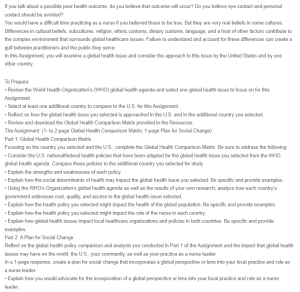
Global Healthcare Comparison Matrix and Narrative Statement
To Prepare:
• Review the World Health Organization’s (WHO) global health agenda and select one global health issue to focus on for this Assignment.
• Select at least one additional country to compare to the U.S. for this Assignment.
• Reflect on how the global health issue you selected is approached in the U.S. and in the additional country you selected.
• Review and download the Global Health Comparison Matrix provided in the Resources.
The Assignment: (1- to 2-page Global Health Comparison Matrix; 1-page Plan for Social Change)
Part 1: Global Health Comparison Matrix
Focusing on the country you selected and the U.S., complete the Global Health Comparison Matrix. Be sure to address the following:
• Consider the U.S. national/federal health policies that have been adapted for the global health issue you selected from the WHO global health agenda. Compare these policies to the additional country you selected for study.
• Explain the strengths and weaknesses of each policy.
• Explain how the social determinants of health may impact the global health issue you selected. Be specific and provide examples.
• Using the WHO’s Organization’s global health agenda as well as the results of your own research, analyze how each country’s government addresses cost, quality, and access to the global health issue selected.
• Explain how the health policy you selected might impact the health of the global population. Be specific and provide examples.
• Explain how the health policy you selected might impact the role of the nurse in each country.
• Explain how global health issues impact local healthcare organizations and policies in both countries. Be specific and provide examples.
Part 2: A Plan for Social Change
Reflect on the global health policy comparison and analysis you conducted in Part 1 of the Assignment and the impact that global health issues may have on the world, the U.S., your community, as well as your practice as a nurse leader.
In a 1-page response, create a plan for social change that incorporates a global perspective or lens into your local practice and role as a nurse leader.
• Explain how you would advocate for the incorporation of a global perspective or lens into your local practice and role as a nurse leader.
• Explain how the incorporation of a global perspective or lens might impact your local practice and role as a nurse leader.
• Explain how the incorporation of a global perspective or lens into your local practice as a nurse leader represents and contributes to social change. Be specific and provide examples.
Assignment document should include:
1. Title page
2. Introductory paragraph
3. Global health comparison matrix
4. Plan for social change
5. Conclusion
6. References
 Complete the order form and upload all of your files, including any instructions, rubrics, or other materials provided by your instructor.
  Complete the order payment after filling in the order form. We’ll receive your order and assign it to a writer.
 The assigned writer will complete your paper and forward it to our Editing Team for review and approval.
 Once approved by the editor, the completed paper will be uploaded to your account for you to download, review and approve.