
Global Health Regulations, Partnerships, and Governance
How Global Policy Can Impact Health Programs and Services as It Relates to Environmental Sustainability
Global health plays a significant role in the security of a country as much as it does in the world’s safety. As the world and the different economies become more globalized, including extensive international commerce and trade, it becomes necessary for health to be viewed from a global perspective. Health is more than just healthcare. Although access to healthcare is critical, man’s behaviors and economic, social, and physical environments in which man plays, works, and lives also have a significant part in the drivers of health. Consequently, health policy means more than just the policy on healthcare (Woolf et al., 2016).
The public policy of a country ultimately influences global policies. The courses of action, regulatory measures, system of laws, and funding priorities that individual governments implement all form part of international policies (Wu et al., 2018). While the debate rages on the appropriate size and the roles different governments take, guidelines can and still currently play a significant role in the everyday lives of global citizens. Because clinical care forms a single factor that influences global health, policies that do not appear upfront as being health-related can have a significant impact on the health of the global village. For example, the simple health policies on handwashing implemented by every country that was not previously strictly followed have significantly spread the COVID-19 virus. Though simple hand hygiene had been part of government policies and even taught in schools, the public did not consider it until such a point that it became mandatory to follow the guidelines to stay alive.
The World Health Organization has advocated for disease prevention, encouraging nations to have more preventive measures than treatment (Yarnell & O’Reilley, 2013). This has worked well in child immunization and in eliminating diseases such as polio. The World Health Organization today presses on with this urgency for individual governments to advocate for preventing the spread of COVID-19. When each country emphasizes its hand hygiene policies, the subsequent global impact is bound to be realized with sustainable and lasting results and perhaps even the total eradication of COVID-19.
Summary of the Global Health Policy Quiz
I have to admit that I performed dismally on the quiz, 4/10. I realize there is much that I do not know about the U.S. and its global funding program(s). First, I was amazed that the U.S. contributes less than 1% of the federal budget to international funding, yet this amount is the highest among all other developed countries’ contributions. More amazing is that the 1% is stretched to fund international health programs in more than 60 countries worldwide. Most of the funding goes to sub-Saharan Africa.
I fail to understand the rationale of the government’s funding in the African continent. According to the quiz answers, which I did not answer correctly, the leading cause of death in the continent is infection of the lower respiratory tract, including pneumonia. Additionally, the continent has 99% of the global deaths in children aged five years and below. However, most U.S. government funds HIV/AIDS in Africa (KFF, n.d). How does that make sense? Shouldn’t the most crucial share be treating infectious diseases like bronchitis, T.B., and other lower respiratory tract infections? If funding the HIV/AIDS programs is for preserving lives, wouldn’t it make more sense to save the lives of the young? At this point, one tends to believe the conspiracy theories on the West’s attempts at reducing the African population. With my new knowledge, I will advocate for more funding to go to diseases that kill more Africans and pose a higher risk to the U.S. COVID-19 has shown us that infectious diseases should be a priority regarding prevention measures and policies.
References
KFF (n.d). Global Health Policy Quiz. http://kff.org/quiz/global-health-policy-quiz/.
Woolf, S. H., Zimmerman, E., Haley, A., & Krist, A. H. (2016). Authentic engagement of patients and communities can transform research, practice, and policy. Health Affairs, 35(4), 590-594.
Wu, X., Ramesh, M., Howlett, M., & Fritzen, S. A. (2018). The public policy primer: managing the policy process. Routledge.
Yarnell, J., & O’Reilly, D. (Eds.). (2013). Epidemiology and disease prevention: A global approach. Oxford University Press.
ORDER A PLAGIARISM-FREE PAPER HERE
We’ll write everything from scratch
Question 
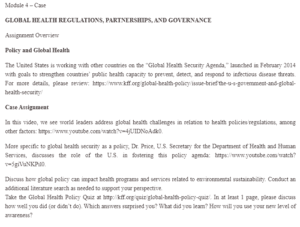
Module 4 – Case
Global Health Regulations, Partnerships, and Governance
GLOBAL HEALTH REGULATIONS, PARTNERSHIPS, AND GOVERNANCE
Assignment Overview
Policy and Global Health
The United States is working with other countries on the “Global Health Security Agenda,” launched in February 2014, with goals to strengthen countries’ public health capacity to prevent, detect, and respond to infectious disease threats. For more details, please review: https://www.kff.org/global-health-policy/issue-brief/the-u-s-government-and-global-health-security/
Case Assignment
In this video, world leaders address global health challenges about health policies/regulations, among other factors: https://www.youtube.com/watch?v=4jUIDNoAdk0.
More specific to global health security as a policy, Dr. Price, U.S. Secretary for the Department of Health and Human Services, discusses the role of the U.S. in fostering this policy agenda: https://www.youtube.com/watch?v=5giVuNKPil0.
Discuss how global policy can impact health programs and services related to environmental sustainability. Conduct an additional literature search as needed to support your perspective.
Take the Global Health Policy Quiz at http://kff.org/quiz/global-health-policy-quiz/. In at least 1 page, please discuss how well you did (or didn’t do). Which answers surprised you? What did you learn? How will you use your new level of awareness?
 Complete the order form and upload all of your files, including any instructions, rubrics, or other materials provided by your instructor.
  Complete the order payment after filling in the order form. We’ll receive your order and assign it to a writer.
 The assigned writer will complete your paper and forward it to our Editing Team for review and approval.
 Once approved by the editor, the completed paper will be uploaded to your account for you to download, review and approve.