
Framework-Literature Alignment
Dissertation I: A Qualitative Case Study of USA Basketball Certified Youth Development Coaches by Bridgette Marchelle Tarpley King
Introduction
Bridgette’s dissertation raises a problem in sports leadership training relating to leadership training gaps. Most coaching activities focus on equipping athletes with technical skills, ignoring leadership training initiatives. Sports leaders and coaches require leadership training to equip them with the necessary skills they can leverage to lead teams. Besides, such training goes a long way to equip coaches with the ethical guidelines necessary to help athletes prosper. Offering such training to coaches is crucial because it equips them with the necessary skills to influence others.
One of the topics in the literature review that relates to the problem is servant leadership. Servant leadership refers to a leadership style in which the leader puts the interests of their followers first before serving their own interests (Takamatsu, 2022). It is closely related to soft power, in which a leader is not so powerful, but their persuasion skills are so outstanding that they can influence others to align with a specific objective without coercion. In the sports industry, servant leadership is vital because it encompasses empathy and a commitment to helping others grow.
The primary theoretical framework in this study is the servant leadership theory. Also, three sub-theories were used to support the primary theory, including deontological ethics, teleological ethics, and virtue-based ethics. These theoretical frameworks reinforce the need to leverage soft power to deliver positive coaching experiences.
Alignment between the Theoretical Framework, Literature, and the Problem Statement
In her dissertation, Bridgette defines the problem that needs to be addressed and connects it to the broader topic of sports. In this case, the problem lies in the training gap for coaches that fails to instill in them the leadership skills required to persuade and influence athletes.
Subsequently, the conceptual framework identifies key variables in the study and shows the relationship between the variables. In the current study, the key variables are the elements of ethics and servant leadership. For instance, issues relevant to equity, such as the right to a fair process, security and safety, and fair play (Lam, 2014). If sports managers and coaches are properly instructed on these aspects during their coaching training course, they will lead athletes properly by creating an environment that feels welcoming and inclusive. On the other hand, the servant leadership conceptual framework supports this literature because once coaches are equipped with these capabilities, they can only apply them successfully if they put the players’ interests above their own.
Dissertation II: Motivational Factors of Coaching Participants towards the Development of Leadership Skills in High School Student-Athletes by Brandon Seigler
Introduction
Brandon’s dissertation addresses the problem of a lack of understanding of the motivational factors that may influence coaches to focus on more than just physical training but also instill life skills in athletes. The problem is informed by research findings that student-athletes are in a better position to develop life skills compared to their non-athlete counterparts. To that end, most coaches believe that they play an active role in equipping learners with life skills beyond physical skills. However, a significant number of coaches believe that this is a burden; hence, they should only focus on physical training.
One aspect of the literature review that closely connects with the research problem is the unique role student-athlete coaches play. Unlike professional-athlete coaches who coach adults, student-athlete coaches play a unique role in providing moral guidance and care to fairly young people who are in the process of developing some basic life skills; hence, the a need for proper guidance. Another topic in the literature connected to the research problem is the influence of student-athletes’ personalities on the coaches’ ability to leverage their ability to provide them with life skills. While some students prefer an autocratic coaching style, others prefer a democratic coaching style (Bekiari, 2014). Therefore, depending on the athletes’ personalities, a coach may be unable to offer life-changing skills.
The author used the functionalist theoretical model synonymous with the US sports industry. Based on the theory, every team, group, or social unit is classified as a stand-alone society (Martin & Lee, 2015). The theory further avers that actions can be explained not based on their meaning but on their impact.
Alignment between the Theoretical Framework, Literature, and the Problem Statement
The functionalist theoretical framework used by the author serves as a bedrock for this investigation. From the outset, the functionalist framework facilitates an in-depth understanding of the problem: a lack of understanding of the factors of motivation that influence student-athlete coaches to instill life skills in players. The functionalist theory avers that athletics is a unified society, making it necessary for coaches to instill common goals and values.
An advanced version of the functionalist theory, positive youth development (PYD), asserts the need for coaches to be actively involved in developing the youths’ life skills. Positive youth development asserts that young people undergo positive development when they participate in sports by learning cognitive, social, intellectual, and emotional skills that enable them to become functional members of society (Jones et al., 2011). PYD demonstrates that athletic participation can help student-athletes learn important skills; hence, coaches should play an active role in ensuring that athletes learn these important life skills.
Dissertation III: Sport Specialization and the Impact on Youth Sport – Catherine E. Angel
Introduction
In her dissertation, Catherine delves into sport specialization and its impacts on continued participation in sport by youths. This examination is based on research findings that young people who specialize early are likely to withdraw. The research problem is to establish the factors that contribute to youths’ withdrawal from sports if they specialize early on. To investigate the problem effectively, the author has identified the factors that motivate young athletes to specialize as peer influence, sports enjoyment, and ability.
The literature begins by defining sport specialization and the factors that support young people as they specialize in sports. Sport specialization refers to a focus on a single sport for at least eight months in a year. The youths’ continued participation in sport specialization depends on parental support, social support, coaching style, and athletes’ personality traits. To that end, multiple players play a crucial role in encouraging youth to continue participating in sports. Also, the author highlights elite sports participation as one of the reasons why young people specialize earlier, hoping that this may help them gain the necessary skills to become professional athletes. However, this leads to stress as young people struggle to prove a point to their coaches and isolate themselves to focus. Such stress potentially contributes to early withdrawal.
Notably, the investigation is based on social learning theory. The theory refers to one’s ability to develop skills and awareness that can help them manage emotions, cooperate well with others, and build positive relationships. Coaches can leverage the theory to examine whether young athletes are coping well even as they specialize.
Alignment between the Theoretical Framework, Literature, and the Problem Statement
Concepts from the social learning theory can be used to guide young athletes who wish to specialize in sports. In particular, the theory offers insights into how one can learn by being self-aware and demonstrating great relational skills. The relationships will help them learn effectively by observing, modeling, and imitating. That way, there is little likelihood that young individuals will quit sports.
Besides, the literature review indicated that most young athletes quit earlier due to stress and burnout, but this can be rectified through social relationships. Positive social relationships help people avoid issues like the fear of missing out, stress, and burnout, even just by talking to one another. Hence, sports coaches should encourage young people to form positive relationships.
Conclusion
The overall topic in the three dissertations is centered on student-athlete participation, the crucial life skills that sports participation offers them, and the role of coaches in fostering these skills. Bridget’s dissertation theoretical framework, the servant leadership theory, provides insights into the skills coaches need to become great servant leaders for the student-athlete participants. Effective coach training should focus on equipping them with soft power skills so that they can guide and influence young people positively. In the second dissertation, Brandon leveraged the functionalist and positive youth development theories to show that coaches can offer more than physical training. Coaches can catalyze young people to learn emotional intelligence and relational skills that will help them become important people in society. However, there is a gap in the functionalist and PYD theories as it is not clear what common skills are relevant in the athletics society. Finally, Catherine applied the social learning theory to show how coaches can help young student-athletes who participate in sport specialization from a young age to avoid quitting. She affirms that positive relationships can help such youth learn by modeling, observation, and imitation and potentially avoid quitting.
References
Bekiari, A. (2014). Verbal aggressiveness and leadership style of sports instructors and their relationship with athletes’ intrisic motivation. Creative Education, 5(2), 114–121. https://doi.org/10.4236/ce.2014.52018
Jones, M. I., Dunn, J. G., Holt, N. L., Sullivan, P. J., & Bloom, G. A. (2011). Exploring the ‘5Cs’ of positive youth development in sport. Journal of Sport Behavior, 34(3), 250–267. https://psycnet.apa.org/record/2011-17095-003
Lam, E. T. (2014). The roles of governance in sport organizations. Journal of Power, Politics & Governance, 2(2), 19–31. https://jppg.thebrpi.org/journals/jppg/Vol_2_No_2_June_2014/2.pdf
Martin, J. L., & Lee, M. (2015). Social structure. International Encyclopedia of the Social & Behavioral Sciences, 22, 713–718. https://doi.org/10.1016/b978-0-08-097086-8.32154-7
Takamatsu, S. (2022). Coaching servant leadership: Scale development and validation. Frontiers in Sports and Active Living, 4. https://doi.org/10.3389/fspor.2022.871495
ORDER A PLAGIARISM-FREE PAPER HERE
We’ll write everything from scratch
Question 
Framework-Literature Alignment
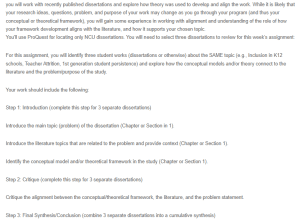
you will work with recently published dissertations and explore how theory was used to develop and align the work. While it is likely that your research ideas, questions, problem, and purpose of your work may change as you go through your program (and thus your conceptual or theoretical framework), you will gain some experience in working with alignment and understanding of the role of how your framework development aligns with the literature, and how it supports your chosen topic.
You’ll use ProQuest for locating only NCU dissertations. You will need to select three dissertations to review for this week’s assignment:
Framework-Literature Alignment
For this assignment, you will identify three student works (dissertations or otherwise) about the SAME topic (e.g., Inclusion in K12 schools, Teacher Attrition, 1st generation student persistence) and explore how the conceptual models and/or theory connect to the literature and the problem/purpose of the study.
Your work should include the following:
Step 1: Introduction (complete this step for 3 separate dissertations)
Introduce the main topic (problem) of the dissertation (Chapter or Section in 1).
Introduce the literature topics that are related to the problem and provide context (Chapter or Section 1).
Identify the conceptual model and/or theoretical framework in the study (Chapter or Section 1).
Step 2: Critique (complete this step for 3 separate dissertations)
Critique the alignment between the conceptual/theoretical framework, the literature, and the problem statement.
Step 3: Final Synthesis/Conclusion (combine 3 separate dissertations into a cumulative synthesis)
Review the conceptual/theoretical framework for each of the three dissertations, and synthesize how each one supported the overall topic and literature and where gaps still may exist.
Length: 3-5 pages, not including title or reference pages
I Included a minimum of 3 dissertation studies from NCU library.
 Complete the order form and upload all of your files, including any instructions, rubrics, or other materials provided by your instructor.
  Complete the order payment after filling in the order form. We’ll receive your order and assign it to a writer.
 The assigned writer will complete your paper and forward it to our Editing Team for review and approval.
 Once approved by the editor, the completed paper will be uploaded to your account for you to download, review and approve.