
Final Observation Project – Case Study
The child I have been observing throughout my project is Sarah M., a three-year-old female. She lives with her two parents and an older brother in a co-merciful and language-wavy home. Sarah’s family is involved in her progress and teaches her with learning items, playing arrangements, and emotional stability. Her home setting is characterized by the presence of both structured and unstructured learning, which fosters healthy development in all aspects.
Milestones and Growth Chart Findings
Sarah seems to be achieving her development according to age requirements. A child is expected to catch up to their peers by age three, being able to climb, run, and speak simple sentences, as well as express affection. Sarah exhibits these behaviors regularly. Her gross motor coordination is good; she can run, climb furniture, and pedal a tricycle. Her pincer skills are developing gradually, for example, her ability to use Velcro closures on her shoes and page-turning skills on her books. She has language development as a strength; she says sentences of four to five words and can articulate herself in a self-assured and clear manner. According to observational checklists and informal measurements, Sarah is operating within the standard growth spaces.
Running Record Findings
In my records of running, Sarah consistently showed an interest in pretend play and problem-solving. She used words to explain her actions and also showed interest in exploring things in her environment. Among the patterns found was her perseverance in difficult situations (when she fitted the blocks together or when addressing the puzzles). Sarah was also willing to listen to guidance from adults and sometimes asked questions when in doubt. These observations demonstrate the improvement of both cognitive and social-emotional areas.
Experimental Results and Findings
I conducted a classical Piagetian liquid conservation task with Sarah as a way of evaluating her concept of quantity. Sarah was right in identifying the same water levels between two identical glasses. Nonetheless, she demonstrated limited conservation skills when the water in one glass was transferred into a taller and narrower glass; she was convinced that the water had become more than it was previously, saying, “It’s taller.” This is consistent with Piaget’s (2-7 years) preoperational stage in development, when children are characterized by centration (focusing on one characteristic/salient feature), as well as the inability to conserve aspects. This was a normal reaction for her age, and she did not appear to be in distress or seem confused.
Anecdotal Record Insights
Two anecdotal documents have been used to highlight significant changes in Sarah’s behavior. She has successfully developed fine motor skills and problem-solving skills, as evidenced by the first example, where she managed to solve the problem of properly wearing her shoes on her own. In the second one, she exhibited sympathy as she rescued a butterfly trapped in a web in collaboration with her brother. This accident projects social-emotional maturity and early morality development. In both documents, one can see how her independence grows, how she communicates with the help of language, and her emotional intelligence.
Theoretical Applications: Piaget, Erikson, and Bandura
Jean Piaget would argue that Sarah is preoperational and is characterized by egocentrism and symbolic thinking. Her conservation experiment and imaginative play back this. She engages in symbolic and pretend play, and also concentrates on appearance rather than logical thinking, a confirmation that she falls within a stage of development. Further, according to the psychosocial theory given by Erikson, Sarah falls under the initiative versus guilt stage. She is also active, experimenting with doing things, deciding what to do, and wanting to be independent (except running overshoes, helping the butterfly). The fact that she confidently behaves indicates that this stage can be positively resolved with the help of nurturing adults. Additionally, the social learning theory presented by Albert Bandura is also apparent in the fact that Sarah mimicked the actions of her elder brother in the rescue of the butterflies. Her cooperation, common cause, and learning through observation help to support Bandura’s theory of learning behavior in children by observing others and then repeating their actions when rewarded.
Overall Progress and Functioning in Developmental Domains
Sarah M. is developing properly in the three domains of development. In the physical aspect, she is physically sound and replicates typical age-appropriate motor regulation, which includes running, climbing, and picking up small items such as Velcro straps. On a cognitive front, she is inquisitive, develops symbolic thinking, and has emerging problem-solving abilities, although she is still in the preoperational stage, characterized by appearance-based reasoning. Socially and emotionally, Sarah is a likable child who can express empathy and articulate her thoughts and feelings clearly. In general, she is at the typical stage of a three-year-old without any indicators of a developmental delay.
ORDER A PLAGIARISM-FREE PAPER HERE
We’ll write everything from scratch
Question 
Case Study Directions:
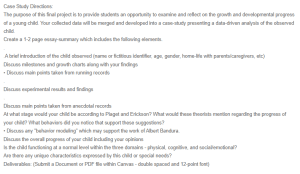
The purpose of this final project is to provide students an opportunity to examine and reflect on the growth and developmental progress of a young child. Your collected data will be merged and developed into a case-study presenting a data-driven analysis of the observed child.
Create a 1-2 page essay-summary which includes the following elements.
Final Observation Project – Case Study
.A brief introduction of the child observed (name or fictitious identifier, age, gender, home-life with parents/caregivers, etc)
Discuss milestones and growth charts along with your findings
• Discuss main points taken from running records
.
Discuss experimental results and findings
.
Discuss main points taken from anecdotal records
At what stage would your child be according to Piaget and Erickson? What would these theorists mention regarding the progress of your child? What behaviors did you notice that support these suggestions?
• Discuss any “behavior modeling” which may support the work of Albert Bandura.
Discuss the overall progress of your child including your opinions
Is the child functioning at a normal level within the three domains – physical, cognitive, and social/emotional?
Are there any unique characteristics expressed by this child or special needs?
Deliverables: (Submit a Document or PDF file within Canvas – double spaced and 12-point font)
 Complete the order form and upload all of your files, including any instructions, rubrics, or other materials provided by your instructor.
  Complete the order payment after filling in the order form. We’ll receive your order and assign it to a writer.
 The assigned writer will complete your paper and forward it to our Editing Team for review and approval.
 Once approved by the editor, the completed paper will be uploaded to your account for you to download, review and approve.