
Falls Prevention in the Acute Care Healthcare Improvement Project
D157: Managing Resources in an Era of Disruption
Human Resource Management
Project Team Members
Choosing the appropriate team members both in the planning and during the implementation of the Health Improvement Project (HIP) was a crucial step in ensuring that the fall prevention initiative in the acute care unit was a success. Every member was selected in terms of clinical expertise and leadership skills, as well as patient safety outcomes. The project team members whose titles were chosen include two Inpatient Directors (E.M. and M.O.), Nurse Manager/Acute Care (J.L.), and Nurse Educator (A.C.). These positions were thoughtfully designed, taking into consideration the making of a well-rounded team that could assist in both the formulation of the strategies and ensuring the implementation of the fall prevention protocols at the front lines.
The rationale for forming such a team is based on the interdisciplinary character of fall prevention, which requires the strategic involvement of both clinical and administrative leaders. The identified stakeholders consist of two Inpatient Directors (E.M. and M.O.) who provide the executive oversight and adjust the project to the institutional priorities and resource distribution. The Nurse Manager (J.L.) was selected based on his experience and experience in operation and leadership during bedside shift reports as one of the key interventions in the project. The Nurse Educator (A.C.) was key to the development and deployment of a training program to clinical staff to reinforce the fall prevention protocol. In my capacity as the Project Manager, I coordinated all members and ensured that timelines and deliverables in terms of implementation were met. Members brought their unique experiences that were necessary in terms of the success of the initiative. The small but influential team also resulted in simplified communication, effective planning, and implementation of the HIP, which made the project not only possible but also sustainably applicable in the acute care environment.
Concerning roles and expectations, every team member was endowed with responsibilities that were specific to these individuals. In my role as Project Lead, I handled the general plan, made sure that stakeholders were involved, and tracked the milestones. The Nurse Educator designed education and directed in-service training. The Nurse Manager was able to control floor-level communication and focus on compliance with the new protocols daily. The two Inpatient Directors provided institutional support and offered supervision of the budget and compliance issues. Such separate roles promoted responsibility and the reduction of repetitive duties.
During both stages, the team operated under well-specified expectations that had been outlined in the RACI chart and were realized in the Personnel Costs Table. The first stage of planning involved working on a protocol, planning the education of the staff, data collection design, and customization of the electronic health record (EHR). In the implementation stage, the focus was shifted toward the training sessions, fall risk compliance monitoring in real-time, and collecting feedback from the staff and patients. Meetings were to be held regularly to determine progress and deal with issues. These attempts further supported teamwork and maintained the project in line with SMART goals developed in Phase 1.
“Personnel Costs Table”
| Team Member (Use the specific role or title for each team member) | Number of Personnel | Estimated Annual Salary | Hourly Rate | Number of Projected Hrs. for HIP | Individual Cost |
| Project Manager (D.R) | 1 | $85,000 | $40.87 | 20 | $817.40 |
| Stakeholders (From D156) | |||||
| Inpatient Director (E.M.) | 1 | $115,000 | $55.29 | 10 | $552.90 |
| Inpatient Director (M.O.) | 1 | $115,000 | $55.29 | 10 | $552.90 |
| Nurse Manager/Acute Care (J.L.) | 1 | $98,000 | $47.12 | 20 | $942.40 |
| Nurse Educator (A.C.) | 1 | $85,000 | $40.87 | 30 | $1,226.10 |
| TOTAL COST (This total cost line becomes one line item in the ProForma) | $4,091.70 |
Project Team Member Engagement
Team Management
Effective management of the project team is imperative for the successful implementation of the Fall Prevention in Acute Care Health Improvement Project. To develop a high-functioning team, I have adopted some team-building ideas that focus more on collaboration, trust, and coaching. At the beginning of the project, I began organizing team huddles where stakeholders were given a chance to present their roles and their concerns and clarify responsibilities. Such initial communication encouraged psychological safety and transparency, which are crucial to creating trust (Potthoff et al., 2023). I also adopted an open-door policy in my coaching style, and members were free to approach me in case they required clarity or coaching on training issues or solutions to a problem. This mechanism of coaching strengthened respect and accountability among team members.
To facilitate team interactions, I have incorporated some team guidelines on three key pillars: communication, conflict resolution, and decision-making. Communication issues were addressed by conducting update meetings every two weeks and keeping a common thread of emails so everyone would always see the same material and give out the same feedback. In case of conflicts, such as choosing to train on busy shifts, we employed a systematic method, which involved discussion, compromise, and mediation by leaders (Nikitara et al., 2024). The model of decision making was based on a consensus; the ideas of frontline employees were also involved in plans and were to secure buy-in to assist staff members in owning them. These approaches enhanced team spirit, a respectful, and mission-oriented work culture that favored every stage of the project.
Support for Team Members
During the implementation of the project, a key issue was supporting project team members in maintaining morale and productivity. To foster a healthy work environment, I applied evidence-based leadership practices, including rewards for efforts and regular feedback mechanisms. According to Cohen et al. (2023), organizational support and frequent communication minimize burnout and improve the well-being of medical professionals. I ensured that employees were identified during team meetings, and I promoted peer-to-peer recognition. To demonstrate psychological safety, I also validated team members’ issues in the change process and solved them collectively.
To foster work-life balance, I ensured that I had a flexible schedule during the training to suit the schedules of the different clinical workers. Ray and Pana-Cryan (2021) show that flexibility in the schedule and the participation process in planning relieve fatigue and enhance work satisfaction. Accordingly, the training was provided in small, frequent sessions over several days, as well as missed sessions during the night shift. This guarantees complete participation without overwhelming anyone and interfering with patient care. In addition, I promoted micro-breaks and talked to the nurse manager to prevent overloading the staff members with various duties during busy times. These interventions assisted in avoiding emotional burnout and led the personnel to believe their well-being is equally important as the introduction of the initiative.
“Healthcare Improvement Project RACI Chart”
See Appendix B.
Financial Resource Management
“Pro Forma Operating Budget”
The Pro Forma Operating Budget used in my fall prevention in acute care HIP was particularly developed utilizing financial forecasting. To achieve both impact and sustainability, the key goal was to tie financial estimates with clinical and operational goals. The forecasting process started with an identification of all resource requirements, especially personnel, as fall prevention programs are labor-intensive. With the help of my preceptor and real-time data from the Human Resources department, I calculated the hourly rates. I determined the approximate number of hours that each interested party would dedicate to the project. For example, the Nurse Educator was allocated 30 hours, taking into consideration the preparation of the materials and the administration of training. Other essential stakeholders like the Inpatient Directors (E.M. and M.O.), Nurse Manager/Acute Care (J.L.), and Nurse Educator (A.C.) were to be included in the same.
Total personnel cost was calculated by multiplying each projected labor hour by the corresponding hourly rate, thus resulting in a total personnel cost of $4,091.70. This amount has been entered into the pro forma budget as a new line item on personnel. I also projected non-personnel costs that included the following: $100 in training materials and handouts, $120 per laminated signage, $150 in incentives and recognition badges, and $200 per contingency, such as undue expansion of shift overlaps or other sessions. This made the total estimated budget about $4,741.70.
The implementation of the HIP in its control phase will be critical in ensuring that the project is within the intended budget and that the project is run as per the schedule. At this stage, I will build up a system of monthly reviews with other project stakeholders, during which we will discuss the development of the budget regarding the pro forma forecast. This involves monitoring the production of time records, participating in training, and using resources and expenses as compared to the estimated records at the start. Every cost will be classified and compared to the projected amount to identify the variances early enough. There will also be project process milestones that include completion of training, integration of EHR fall alerts, and audit after training, which will be reported against the implementation timeline (Tsai et al., 2020). The check-ins will be done on the last Friday of every month, and any delays and/or overspending will trigger a collaborative corrective action.
Such reviews act as a two-fold accountability mechanism: fiscally, as a means of checking cost variances, and operationally, as a means of observing milestones of the processes. As such, in a case where the staff training goes on even during daily shifts and experiences unexpected overtime, then arrangements may be made to stagger the sessions or request shift exchanges in advance. Such deviations will be flagged and identified promptly through the input of charge nurses and administrative coordinators. All kinds of control data will be recorded and stored in the internal dashboard that team leads can access in real time to obtain insights and be transparent.
Budget Variances
In order to control budget variances, a real-time tracking sheet will be kept to compare the actual and the predicted costs. Any deviations above 10% of the forecast will be elevated to the nurse manager and financial analyst so that they can review them promptly. Such categories of variance cause will include underestimated resources, unplanned shifts, and delayed execution. As an example, in the case of overtime compensation that is more than the $200 contingency, we would have to explain and rebalance future funds. There will be a variance log where resolution strategies will be noted and addressed in the stakeholder meetings. The practice will sustain a financial-related discipline and instill a certain degree of ongoing improvement against future healthcare improvement efforts.
D157 Task 1 Healthcare Improvement Project Charter
Justification
Falls in acute care are among the most common and expensive adverse events that result in prolonged hospital stays, higher medical expenses, and high morbidity in patients. According to the Agency for Healthcare Research and Quality (AHRQ), between 700,000 and one million inpatients in the U.S. fall in hospitals annually, and a third of all these falls lead to injury (Xia, Zheng, Zheng Lin, et al., 2022). At my current place of clinical practice, the number of fall occurrences has been higher than the national standard despite the established awareness efforts. This patient safety gap speaks of the necessity of well-ordered intervention as soon as possible. A standardized bedside shift report is an evidence-based practice, likely to decrease communication errors and increase continuity of care, which directly affects the fall rates (Jimmerson et al., 2020). Addressing this concern, the Health Improvement Project relates to the objectives of the organization, such as working with patient outcomes, avoiding damage that could be prevented, and determining quality care metrics in terms of reimbursement and accreditation.
Purpose of the Project
The primary purpose of the HIP is to implement and evaluate a fall prevention intervention that will encompass the implementation of the structured reporting of shifts at the bedside in all units where nurses work within the acute care facility. The intervention will likely improve the levels of safety among patients, reduce the number of falls by 30% in six months, and improve communication across the disciplines. The initiative will allow nurses to determine communication using the terms handoffs, early detection of at-risk patients, and engagement with patients (Blazin et al., 2020). Lastly, the project will assist in creating a safety and transparency culture among the workers and enhance the performance of the hospital in terms of national quality outcomes.
Significant Risks
Staff resistance to change, disruption of the workflow, and poor staff coverage during both training and implementation are the main threats to the successful implementation of this project. Resistance among the staff might be driven by doubts about the usefulness of bedside shift reports or, instead, the feeling that they increase the workload for the staff. To resolve this, the project will help focus on early engagement of stakeholders, up-skilling using specific education sessions, and enforcement using coaching and recognition techniques (Cheraghi et al., 2023). There are also workflow threats during training, whereby training is done during clinical responsibilities. This will be reduced through staggered training and make-up training that will be optional. Also, there are current staffing shortages that can affect implementation fidelity. In response, leadership support has been obtained in order to provide sufficient staffing and access to floating nurses in the implementation of the intervention. These risks were realized in the course of planning and consultation with stakeholders, and each risk has a mitigation plan that is in line with the quality improvement systems.
Project Budget
The cost of the Fall Prevention in Acute Care project was developed thoroughly by planning the budget totals based on personnel costs and the projected non-personnel costs. The personnel cost included was a total of $4091.70, including the labor input of the Project Manager, Inpatient Directors, Nurse Manager/Acute Care, and Nurse Educator. Such calculations were made using average hourly compensation and an estimated amount of time assigned to planning, implementation, and evaluation of the process.
Non-personnel costs amounted to $650, covering items identified as necessary, like printed training materials, laminated fall risk checklists, signage in rooms occupied by the patients, and small incentives to encourage staff participation. This raised the total estimated cost of the project to $4,741.70, which was reflected in the pro forma operation budget. This budget will contribute to a strategic investment in fall prevention by achieving the organizational objectives associated with the safety improvement of patients and the mitigation of preventable adverse events.
Project Timeline
- Project Kickoff June 24, 2025: This is the actual launch of the project, during which the stakeholders align with it, resources will be ready, and the communication plan is finalized. The project is expected to end on December 15, 2025.
- Completion of Staff Education and Training: By July 29th, 2025, all nursing and support staff should be educated and complete training on bedside shift reporting. The education component will involve sessions conducted by the nurse educator, with opportunities to take make-up sessions to guarantee a 95% rate of staff participation.
- Preliminary Evaluation by 11/30/2025: The new protocol is expected to be completed and part of daily practices at this time. To measure the success of the project, an initial assessment of the fall rates, staff, and workflow will also be carried out.
Final Evaluation- reduction in falls by 15% from baseline data to be accomplished by December 15th, 2025.
References
Blazin, L. J., Amorn, J. S., Hoffman, J. M., & Burlison, J. D. (2020). Improving patient handoffs and transitions through the adaptation and implementation of I-PASS across multiple handoff settings. Pediatric Quality & Safety, 5(4), e323. https://doi.org/10.1097/pq9.0000000000000323
Cheraghi, R., Ebrahimi, H., Kheibar, N., & Sahebihagh, M. H. (2023). Reasons for resistance to change in nursing: An integrative review. BMC Nursing, 22(1), 1–9. https://doi.org/10.1186/s12912-023-01460-0
Cohen, C., Pignata, S., Bezak, E., Tie, M., & Childs, J. (2023). Workplace interventions to improve well-being and reduce burnout for nurses, physicians, and allied healthcare professionals: A systematic review. British Medical Journal Open, 13(6), 1–23. https://doi.org/10.1136/bmjopen-2022-071203
Jimmerson, J., Wright, P., Cowan, P. A., King-Jones, T., Beverly, C. J., & Curran, G. (2020). Bedside shift report: Nurses’ opinions based on their experiences. Nursing Open, 8(3), 1393–1405. https://doi.org/10.1002/nop2.755
Nikitara, M., Dimalibot, M. R., Latzourakis, E., & Constantinou, C. S. (2024). Conflict management in nursing: Analyzing styles, strategies, and influencing factors: A systematic review. Nursing Reports, 14(4), 4173–4192. https://doi.org/10.3390/nursrep14040304
Potthoff, S., Finch, T., Bührmann, L., Etzelmueller, A., Genugten, C. van , Girling, M., May, C., Perkins, N. J., Vis, C., & Rapley, T. (2023). Towards an implementation-stakeholder engagement model (I-STEM) for improving health and social care services. Health Expectations, 26(5). https://doi.org/10.1111/hex.13808
Ray, T. K., & Pana-Cryan, R. (2021). Work flexibility and work-related well-being. International Journal of Environmental Research and Public Health, 18(6), 3254. NCBI. https://doi.org/10.3390/ijerph18063254
Tsai, C. H., Eghdam, A., Davoody, N., Wright, G., Flowerday, S., & Koch, S. (2020). Effects of electronic health record implementation and barriers to adoption and use: A scoping review and qualitative analysis of the content. Life, 10(12), 1–27. https://doi.org/10.3390/life10120327
Xia, L., Zheng, Y., Lin, Z., Chen, P., Mei, K., Zhao, J., Liu, Y., Song, B., Gao, H., Sun, C., Yang, H., Wang, Y., Song, K., Yang, Y., Luan, X., Wen, X., Yin, X., Fu, A., Cai, Y., . . . Gu, Z. (2022). Gap between risk factors and prevention strategies? A nationwide survey of fall prevention among medical and surgical patients. Journal of Advanced Nursing, 78(8), 2472–2481. https://doi.org/10.1111/jan.15177
ORDER A PLAGIARISM-FREE PAPER HERE
We’ll write everything from scratch
Question 
Falls Prevention in the Acute Care Healthcare Improvement Project
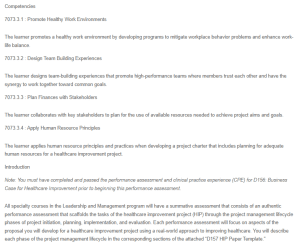
Competencies
7073.3.1 : Promote Healthy Work Environments
The learner promotes a healthy work environment by developing programs to mitigate workplace behavior problems and enhance work-life balance.
7073.3.2 : Design Team Building Experiences
Falls Prevention in the Acute Care Healthcare Improvement Project
The learner designs team-building experiences that promote high-performance teams where members trust each other and have the synergy to work together toward common goals.
7073.3.3 : Plan Finances with Stakeholders
The learner collaborates with key stakeholders to plan for the use of available resources needed to achieve project aims and goals.
7073.3.4 : Apply Human Resource Principles
The learner applies human resource principles and practices when developing a project charter that includes planning for adequate human resources for a healthcare improvement project.
Note: You must have completed and passed the performance assessment and clinical practice experience (CPE) for D156: Business Case for Healthcare Improvement prior to beginning this performance assessment.
All specialty courses in the Leadership and Management program will have a summative assessment that consists of an authentic performance assessment that scaffolds the tasks of the healthcare improvement project (HIP) through the project management lifecycle phases of project initiation, planning, implementation, and evaluation. Each performance assessment will focus on aspects of the proposal you will develop for a healthcare improvement project using a real-world approach to improving healthcare. You will describe each phase of the project management lifecycle in the corresponding sections of the attached “D157 HIP Paper Template.”
In D156, you initiated your healthcare improvement project (HIP) by completing a needs assessment, SWOT analysis, Impact analysis, and a Gantt Chart to determine the feasibility of your proposed HIP.
In this task, you will leverage your previous coursework and project activities while building your project plan. Collaborate with your project team, specialized experts in your field of interest, or colleagues from your current or former organization. You will establish team member roles and responsibilities, attain, and allocate financial resources, and complete a project charter.
This task requires the submission of the provided “D157 HIP Paper Template” including the following section(s) of your HIP paper which you will be developing in this performance assessment:
• “Human Resource Management”
• “Project Team Member Engagement”
• “Financial Resource Management”
• “Project Charter”
The following templates should be completed and submitted as appendices to your provided “HIP Paper Template”:
• SMART GOAL Worksheet from D156 (Appendix A)
• RACI Chart (Appendix B)
• “Project Pro Forma Operating Budget” (Appendix C)
During your clinical practice experience (CPE), you were reviewed on whether the elements found within the “RACI Chart”, and “Personnel Cost Table” were completed. The CPE provides you an opportunity to practice and improve these items before including them in your performance assessment. In this task, these elements will be evaluated on content and quality of completion.
 Complete the order form and upload all of your files, including any instructions, rubrics, or other materials provided by your instructor.
  Complete the order payment after filling in the order form. We’ll receive your order and assign it to a writer.
 The assigned writer will complete your paper and forward it to our Editing Team for review and approval.
 Once approved by the editor, the completed paper will be uploaded to your account for you to download, review and approve.