
Exploring Bach’s Brandenburg Concerto No. 3
The chosen work for this midterm essay is Brandenburg Concerto No. 3 in G major, BWV 1048, composed by Johann Sebastian Bach. This magnificent piece was composed during the Baroque period (1600-1750) and is an exemplar of the concerto grosso style, which has a small solo group set against a larger ensemble (Matias and Lutfiansyah). The Brandenburg Concerto No. 3 is an excellent example of not only how skilled of a composer Bach was, but it also serves as a hallmark of the stylistic traits that characterize the Baroque period, making it compelling to study.
Instrumental Music
The Brandenburg Concerto No. 3 is a composition without vocal accompaniment and features the strings most prominently. The ensemble includes three solo violinists along with a group of three violas, three cellos, and a continuo that showcases the triumphs of Bach’s Complex writing and the skill needed from each player. It is the strings, working together or alternately, that can create such vigorous and captivating sounds that can draw listeners into a realm where sounds and instruments merge.
This piece is an astounding demonstration of instrumental music that showcases the technicality and emotional power of string instruments in a way that can only be attributed to Bach. The introduction begins with an astonishing encapsulation that grabs the listener’s attention, demonstrating the striking timbre of the strings and preparing the audience for the elaborate dialogue that occurs throughout the concerto.
Musical Style and Characteristics
To grasp the composition in its entirety, one must appreciate the musical style that defined the Baroque period. This time is famous for its multifaceted polyphony, detailed ornamentation, and strong emotive accent. Features of the baroque style are visible throughout Brandenburg Concerto No. 3, as Bach intertwines multiple melodies to produce a rich texture that invokes excitement and energy (Marshall 66).
The Brandenburg Concerto No. 3 by Johan Sebastian Bach further highlights the cultural and historical legacy of his work. This period is defined by grave sociopolitical shifts, with absolutist monarchs emerging alongside court music as a focal image for artistic culture. During the era, the arts underwent a boom as they became popular. Composers such as Bach were commissioned to create sophisticated works for the entertainment of the nobles (Honisch 1584). The Brandenburg Concerto No. 3, written for the Margrave of Brandenburg, showcased Bach’s mastery while satiating the prevailing opulence of the era.
Elements of Music
Sound
The sound of this composition is astounding as it possesses an eminent and warm blend that leaves the audience enchanted. The playful dynamics throughout the piece intensify louder and softer passages to further the sense of dialogue among the instruments.
Rhythm
Rhythm is of the utmost importance to this concerto, as it is governed by a lively tempo that propels the music forward. The piece is predominantly set in a 3/4 meter, invoking a dance-like quality (Fei 83). The rhythmic patterns are not stagnant but fluid, using accents and syncopated rhythms that enhance the vigor of the performance.
Melody and Harmony
Bach’s melody is striking yet intricate, with rich Baroque-style ornamentation. The harmony is underpinned by vital interactions of consonant triads and dissonant triads, arpeggios meticulously integrated into the structure (Sagall 57). These shifts generate compelling tension and release, a hallmark of Bach’s innovative musical expression.
Musical Texture
In the case of Brandenburg Concerto No. 3, the discussion of its musical texture immediately brings its polyphonic character to mind. The counterpoint fascination of the Baroque era can be seen in the way the three violin parts interact with one another, creating a dialogue (Rakochi 285). The texture sometimes becomes homophonic, allowing a single melody to emerge, yet Bach always returns to the rich complexity of polyphony.
Comparison to Other Musical Periods
Bach’s work contrasts with the Renaissance and Classical periods, highlighting the distinct features unique to each period, suggesting the Baroque period had differences compared to the other two. The Renaissance period emerged before the Baroque period, and it predominantly focused on vocal music and a simpler harmonic progression. Baroque, on the other hand, embraced instrumental complexity and innovative forms, setting the stage for later developments in Western music, according to Spieth et al. Of note is that the classical period that followed the Baroque period was defined by greater clarity and balance in musical structure. Classical period works by Haydn and Mozart underscore the dominance of melodic clarity and harmony as well as the profound emotional appeal heaped upon listeners (Keefe). This development depicts an interesting shift in music development because each period advanced on the previous one.
Conclusion
In conclusion, Johann Sebastian Bach’s Brandenburg Concerto No. 3 is one of the purest representations of Baroque music with its multifaceted textures, complex melodies, and spirited rhythms. Analyzing the Brandenburg Concerto reveals the extensive and complex interplay of the instruments, which are filled with emotions characteristic of Bach’s music. I especially wanted to discuss this composition because of its exuberance and appeal, representing the spirit of the Baroque era. I learned through this course the importance of understanding the historical background and how other factors like musical styles and culture influence the development of music. Delving into Brandenburg Concerto No. 3 not only expanded my knowledge of Bach’s brilliant techniques but also developed my understanding of music as a whole in relation to historical context.
Works Cited
Fei, Qinqian. “Ornamentation in Baroque Music: How Is It Appropriately Utilized in Scores and Performances?” Studies in Social Science & Humanities, vol. 2, no. 3, Mar. 2023, pp. 81–86. https://doi.org/10.56397/sssh.2023.03.11.
Honisch, Erika Supria. “Music 547 Spring 2018—Sound, Music, Conflict, 1570–1750,” 2017, https://doi.org/10.17613/nsmv-xx11
Keefe, Simon P. Haydn and Mozart in the Long Nineteenth Century: Parallel and Intersecting Patterns of Reception. Cambridge University Press, 2023.
Marshall, Robert L. “On Bach’s Universality.” Universal Bach: Lectures Celebrating the Tercentenary of Bach’s Birthday, 1986, pp. 50–81. https://doi.org/10.70249/9780871694263-006.
Matias, Ferry, and Abraham Lutfiansyah. “Global Culture Reproduction Through the String Orchestra’ Repertoire.” Jomantara Indonesian Journal of Art and Culture, vol. 1, no. 1, Jan. 2021, pp. 1–13. https://doi.org/10.23969/jijac.v1i1.3407.
Rakochi, Vadim. “Genesis of the Concerto for Orchestra.” Journal of History Culture and Art Research, vol. 9, no. 1, Mar. 2020, pp. 273–285. https://doi.org/10.7596/taksad.v9i1.2435.
Sagall, Sabby. “The Late Baroque Style.” Music and Capitalism: Melody, Harmony, and Rhythm in the Modern World, Palgrave Macmillan, 2021, pp. 19–69. https://doi.org/10.1057/978-1-137-52095-1_2.
Spieth, Darius, et al. “Baroque and Classical Music.” Exploring the Arts (2022).
ORDER A PLAGIARISM-FREE PAPER HERE
We’ll write everything from scratch
Question 
Exploring Bach’s Brandenburg Concerto No. 3
Be aware that all papers will be screened by an AI Content Detector.
Course Level Learning Outcomes
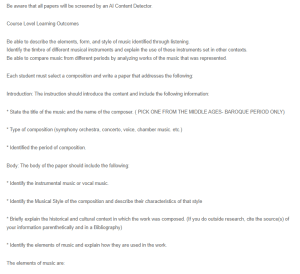
Exploring Bach’s Brandenburg Concerto No. 3
Be able to describe the elements, form, and style of music identified through listening.
Identify the timbre of different musical instruments and explain the use of these instruments set in other contexts.
Be able to compare music from different periods by analyzing works of the music that was represented.
Each student must select a composition and write a paper that addresses the following:
Introduction: The instruction should introduce the content and include the following information:
* State the title of the music and the name of the composer. ( PICK ONE FROM THE MIDDLE AGES- BAROQUE PERIOD ONLY)
* Type of composition (symphony orchestra, concerto, voice, chamber music. etc.)
* Identified the period of composition.
Body: The body of the paper should include the following:
* Identify the instrumental music or vocal music.
* Identify the Musical Style of the composition and describe their characteristics of that style
* Briefly explain the historical and cultural context in which the work was composed. (If you do outside research, cite the source(s) of your information parenthetically and in a Bibliography)
* Identify the elements of music and explain how they are used in the work.
The elements of music are:
Sound: pitch, dynamics, and timbre
Rhythm: Beat, Meter, Accent and Syncopation, and Tempo
* Identify and discuss the following musical components:
1, Melody
Harmony: Consonance and Dissonance, triads, broken Chords Arpeggios
Musical Texture: Monophonic, Polyphonic, Homophonic, and changes of Texture
*Compare the musical period presented in the composition to the other periods that have been discussed in the course.
3. Conclusion: The final paragraph should summarize the paper’s main points, then explain why you chose to write about that particular work of music and what you learned through this course.
If outside sources are used, appropriate citations and bibliographical references must be included. The instructor will inform the student of these requirements and how to cite them.
The paper should be at least 500 words long, but you may write more as you wish. Lastly, it should be in MLA format.
 Complete the order form and upload all of your files, including any instructions, rubrics, or other materials provided by your instructor.
  Complete the order payment after filling in the order form. We’ll receive your order and assign it to a writer.
 The assigned writer will complete your paper and forward it to our Editing Team for review and approval.
 Once approved by the editor, the completed paper will be uploaded to your account for you to download, review and approve.