
Examining Conceptual Frameworks
Part One: Framework Visualization
Part Two: Narrative
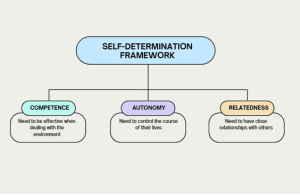
The self-determination theory (SDT) encompasses three human needs: autonomy, relatedness, and competence. Autonomy refers to the need for one to have some level of control over one’s activities. On the other hand, competence refers to the need to demonstrate one’s level of mastery in a subject area and to be recognized for such mastery. Relatedness refers to the need for a caring relationship with others, and it is applicable in academic or research settings because it involves people coming together to work toward a common goal.
Autonomy
Autonomy is a crucial aspect as far as academic integrity is concerned because it offers learners a sense of independence. Learners feel a sense of fulfillment when they understand they have significant control over their activities (Martela & Riekki, 2018). For instance, instructors may give learners assignments but allow them the autonomy to handle the tasks in the formats they prefer. For instance, an instructor may provide the freedom to choose the format by which they will complete the tasks. One may use a word narration or PowerPoint presentations to do assignments. This way, the learners will select the format they are most comfortable with. Besides, an instructor may give learners the freedom to work alone or in groups. By providing such freedom, students will feel a sense of control over their activities and will likely avoid academic dishonesty as they are in a position to explore their capabilities and exploit their potential (Jiang et al., 2019). This concept contributes to research on academic integrity because it shows how students may be facilitated to exploit their potential.
Competence
According to Kanat-Maymon et al. (2015), competence, as indicated above, is the need by humans to demonstrate their capabilities and be recognized for that. It involves presenting learners with small opportunities for success to bolster their confidence in handling different tasks. Such opportunities can be in the form of low-stakes assessments, group activities, or even responding to questions in a classroom setting. Enabling students to gain confidence by providing opportunities for small successes aligns with the adage that success begets success. For instance, asking students to come up with write-ups to critique articles by following simple instructions will go a long way to assure them that they possess outstanding skills to be great writers. Once convinced that they are competent, such learners will complete their tasks in the future without seeking external assistance.
Moreover, addressing students’ need for competence will allow instructors to avail the resources to support the students’ competence needs. For instance, gamification and response cards provide students with key insights in real time (Irvine, 2019). With constant assessment, an instructor can identify a learner’s core strengths and subsequently provide aids to facilitate their learning. Besides, instructors can share insights on how the learners can leverage online resources to develop their content (Irvine, 2019). The competence aspect of the self-determination theory will enhance current research on integrity by demonstrating the strategies that may be implemented to assure learners that they are competent and, hence, do not need to practice academic dishonesty.
Relatedness
Relatedness, a psychological need to connect with others, is also a key component of the self-determination theory. This concept of the SDT encourages positive relationships to improve individual competence (Ryan & Deci, 2000). From an instructor’s perspective, there is a need for them to come early to the classroom and create some time for chatting with students to create a friendly environment. This way, students will feel free to engage with teachers and ask questions if they do not understand some concepts. Also, teachers can create opportunities for students to connect through classroom activities. For instance, group activities, classroom discussions, and online discussion sessions provide students with the opportunity to connect, exchange ideas, and build positive relationships. Relatedness as a concept of the self-determination theory will ensure academic integrity because students will leverage networks available within a school setting to build their knowledge; hence, no need for academic dishonesty.
References
Irvine, J. (2019). Self-determination theory as a framework for an intermediate/senior mathematics preservice course. Journal of Instructional Pedagogies, 22. https://files.eric.ed.gov/fulltext/EJ1216799.pdf
Jiang, J., Vauras, M., Volet, S., Salo, A.-E., & Kajamies, A. (2019). Autonomy-supportive and controlling teaching in the classroom: A video-based case study. Education Sciences, 9(3), 229. https://doi.org/10.3390/educsci9030229
Kanat-Maymon, Y., Benjamin, M., Stavsky, A., Shoshani, A., & Roth, G. (2015). The role of basic need fulfillment in academic dishonesty: A self-determination theory perspective. Contemporary Educational Psychology, 43, 1–9. https://doi.org/10.1016/j.cedpsych.2015.08.002
Martela, F., & Riekki, T. J. J. (2018). Autonomy, competence, relatedness, and beneficence: A multicultural comparison of the four pathways to meaningful work. Frontiers in Psychology, 9(1157). https://doi.org/10.3389/fpsyg.2018.01157
Ryan, R. M., & Deci, E. L. (2000). Self-determination theory and the facilitation of intrinsic motivation, social development, and well-being. American Psychologist, 55(1), 68–78. https://doi.org/10.1037//0003-066x.55.1.68
ORDER A PLAGIARISM-FREE PAPER HERE
We’ll write everything from scratch
Question 
Examining Conceptual Frameworks
Conceptual frameworks are purposeful cultivation of related concepts and/or theories to support a researcher’s problem and purpose. This framework needs to align with the research questions and methodology as well. One way to show this framework is with a visualization; however, a narrative is needed as well to explain the interconnectedness of all the pieces. In this two-part assignment, you will build a visualization of your conceptual framework and then explain in a narrative how each part interacts and supports your problem and purpose.

Examining Conceptual Frameworks
Instructions
Part 1:
Often, conceptual frameworks are shown as a visual. For this assignment, use Canva to diagram a potential conceptual framework for your topic of interest. Use the 5-steps in “How to Develop a Conceptual Framework” to identify key concepts, find literature on these concepts, decide how they relate, and choose an existing conceptual framework or build a new one. Portray this framework in a clearly labeled graphic.
Note: If you are doing qualitative research, make sure your framework doesn’t include arrow lines in your graphic, which could imply causal or correlational linkages.
Part 2:
Write a 2-page narrative examining how each part of the conceptual framework interacts with one another and how each part supports your problem and purpose. Cite relevant sources.
Length: 1 labeled graphic, along with a 2-page narrative
 Complete the order form and upload all of your files, including any instructions, rubrics, or other materials provided by your instructor.
  Complete the order payment after filling in the order form. We’ll receive your order and assign it to a writer.
 The assigned writer will complete your paper and forward it to our Editing Team for review and approval.
 Once approved by the editor, the completed paper will be uploaded to your account for you to download, review and approve.