
Evidence-Based Practice
Thoughts on evidence-based practice
Evidence-based practice (EBP) involves meticulous steps, asking questions, researching, and using the evidence. These three steps are then followed by integrating evidence into training, evaluation of results, and sharing of findings. EBP is motivated by the need to fill the gap between knowledge and practice among healthcare providers. This requires that healthcare professionals use current study findings to solve clinical problems. It is important in promoting positive outcomes, making informed treatment plan decisions, and ensuring that clients access the best care possible. EBP plays a role in reducing healthcare costs, improving job satisfaction, and reducing unnecessary burnout. However, healthcare organizations must create a learning culture that supports EBP. Nurses and other care providers should have time and access to research materials in online or physical form (Chien, 2019). Failure to nurture the culture of learning incapacitates any efforts toward adopting EBP into daily practices. This difficulty occurs because nurses and other professionals in the organization view it as a time-wasting practice and do not understand the benefits and importance. Thus, it is also necessary to train all professionals to ensure an understanding of EBP and its potential benefits. Hire our assignment writing services in case your assignment is devastating you.
Evidence supporting Jean Watson’s Theory of Human Caring
Jean Watson’s Theory of Human Caring advocates that nurses should offer authentic care to improve patient outcomes. The theory asserts the need for a comfortable, peaceful, and beautiful environment to engage the soul, mind, and body through care. Nurses play a key role in this theory because they are the chief givers of care in the medical sector. Implementing the idea is expected to create a harmonious balance between illnesses and the health experiences of an individual. The people-oriented approach highlights love as the most important source of healing in the nursing profession. The interactions between patients and nurses entail four aspects: the healing process, caring moment, awareness of the healing process, and maintaining the relationship. Research studies have established the importance of giving such authentic care to patients and its effects on the healing process. Nurses who adopt the theory tend to benefit from the experience alongside patients (Dyess, Boykin, & Rigg, 2010).
Creating and sustaining an Evidence-Based nursing environment
The journey towards EBP care begins with the acquisition of the resources. These resources can be physical or available on online platforms. A health facility must gain access to the online platforms and assure healthcare workers of access to libraries. Diverting the conversations and discussions towards EBP is important in creating awareness among all healthcare professionals. The process is reinforced through education and training on EBP and its importance. This leads to the next step, which involves the declaration of EBP as a leadership requirement and standard operating procedure. Discouraging trial and error methods are critical in driving healthcare providers towards adopting EBP into daily practice. Collaboration between professionals is essential to enhancing the decision-making process while referring to EBP. It also creates platforms for sharing information on various successes in integrating EBP into daily procedures. Appointing an EBP leader ensures that nurses and physicians can engage a knowledgeable individual and obtain information rapidly. This eliminates any bottlenecks and delays arising from research efforts (Gallagher-Ford, 2014).
References
Chien, L.-Y. (2019). Evidence-Based Practice and Nursing Research. J Nurs Res., 27(4). doi:10.1097/jnr.0000000000000346
Dyess, S., Boykin, A., & Rigg, C. (2010). Integrating Caring Theory With Nursing Practice and Education: Connecting With What Matters. Journal of Nursing Administration, 40(II).
Gallagher-Ford, L. (2014). Implementing and Sustaining EBP in RealWorld Healthcare Settings: A Leader’s Role in Creating a Strong Context for EBP. Worldviews on Evidence-Based Nursing, 11(1), 72-74.
ORDER A PLAGIARISM-FREE PAPER HERE
We’ll write everything from scratch
Question 
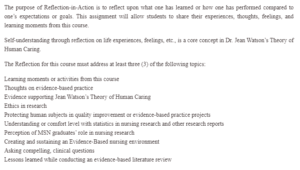
The purpose of Reflection-in-Action is to reflect upon what one has learned or how one has performed compared to one’s expectations or goals. This assignment will allow students to share their experiences, thoughts, feelings, and learning moments from this course.
Evidence-Based Practice
Self-understanding through reflection on life experiences, feelings, etc., is a core concept in Dr. Jean Watson’s Theory of Human Caring.
The Reflection for this course must address at least three (3) of the following topics:
Learning moments or activities from this course
Thoughts on evidence-based practice
Evidence supporting Jean Watson’s Theory of Human Caring
Ethics in research
Protecting human subjects in quality improvement or evidence-based practice projects
Understanding or comfort level with statistics in nursing research and other research reports
Perception of MSN graduates’ role in nursing research
Creating and sustaining an Evidence-Based nursing environment
Asking compelling, clinical questions
Lessons learned while conducting an evidence-based literature review
 Complete the order form and upload all of your files, including any instructions, rubrics, or other materials provided by your instructor.
 Complete the order payment after filling in the order form. We’ll receive your order and assign it to a writer.
 The assigned writer will complete your paper and forward it to our Editing Team for review and approval.
 Once approved by the editor, the completed paper will be uploaded to your account for you to download, review and approve.