
Evidence-Based Population Health Improvement Plan: Diabetes Improvement Plan
Hello, and welcome to today’s presentation on the Evidence-Based Population Health Improvement Plan. Today, I will be presenting a comprehensive initiative designed to reduce health disparities in Hispanic adults living with type 2 diabetes mellitus, or T2DM in short. This group experiences higher ratios of diagnosis, challenges, and obstacles in the effective management of the disease. This session aims to 1) enlist the epidemiological data that justifies T2DM as a community health priority, 2) define an ethical and culturally perceptive health improvement plan, highlight measures of success, 3) detail the communication and stakeholder engagement plan, and 4) illustrate the value and relevance of the evidence and technology that form the core of this plan.
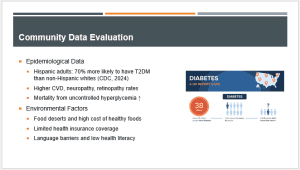
Let’s begin by looking at the data that identifies this as a population-focused priority for care. According to the National Diabetes Statistics Report published by the (Centers for Disease Control and Prevention [CDC], 2024), Hispanic adults are about 70% more likely to be diagnosed with type 2 diabetes compared to non-Hispanic whites. The inequity goes further than diagnosis because this population has elevated cases of severe complications, such as cardiovascular disease (CVD), neuropathy, and retinopathy. There is also disproportionate mortality due to uncontrolled hyperglycemia.
Environmental factors compound these risks. Hispanic communities have poor access to healthy and affordable foods, or food deserts, and access to healthier dietary options is expensive. In many cases, the insurance coverage is minimal, and follow-up is intensified or medication compliance becomes more difficult. Health literacy and language hindrances also diminish the involvement in preventive care and self-management of the disease. The health behaviors and adherence to the treatment average are influenced by cultural aspects like people’s preferences and how family decisions are made, among others. The best practices and the professional literature prescribe the combination of culturally competent learning with technology-based surveillance to eliminate these disparities successfully.
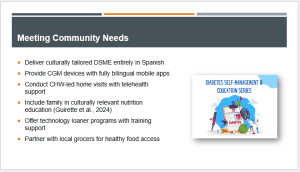
With the data indicating a need for targeted intervention, the proposed health improvement plan is built on the principles of equity, inclusivity, and cultural sensitivity. At its core is a culturally tailored Diabetes Self-Management Education (DSME) program, delivered entirely in Spanish and designed to include family members in the learning process. This ensures that information is linguistically accessible and culturally relevant, increasing the likelihood of sustained behavior change.
The plan also integrates continuous glucose monitoring (CGM) devices paired with bilingual mobile health applications. These devices monitor blood sugar levels in real-time and enable patients to make quick corrections to diet, exercise, and drug regimen. Community health workers (CHWs) will be the most important layer, visiting patients in their homes and delivering telehealth services to address access disparities and establish trust among community members. Nutritional education will be modified to include well-known foods utilizing healthier and culturally relevant methods of preparation, which, according to Guirette et al. (2024), promotes successful and sustainable proper management of T2DM. To eliminate technology inaccessibility, the program will provide technology loan programs and bilingual digital literacy workshops. Collaborations with the local grocers will enhance the availability of affordable, healthy foods. The evidence base supports these interventions through improvements in HbA1c control, treatment adherence, and patient engagement in culturally adjusted and technologically improved interventions.
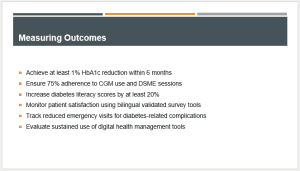
To ensure this plan delivers measurable results, three core outcome criteria have been selected. First, we aim for at least a 1% reduction in mean HbA1c within six months, a benchmark supported by the American Diabetes Association for meaningful clinical improvement. Second, we will track adherence, with a target of at least 75% of participants regularly using CGM devices and attending DSME sessions. Third, we aim for a 20% improvement in diabetes-related health literacy scores, measured through validated bilingual assessment tools.
Additional outcomes will involve patient satisfaction tracked via a culturally sensitive survey, a decline in emergency care of diabetes complications, and long-term adoption of digital health tools past the initial intervention time. By data collection at baseline, mid-point, and after the intervention, adjustments will be made in a timely manner and ensure the program’s momentum. These results add up the clinical, behavioral, and educational indicators, making it a clear assessment of the impact of the program.
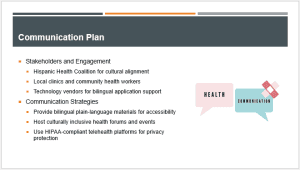
Effective communication is essential for building trust, ensuring participation, and sustaining engagement. Key stakeholders in this initiative include the Hispanic Health Coalition, local clinics and public health departments, community health workers, and technology vendors. The Hispanic Health Coalition will provide cultural alignment and endorsement, while local clinics and CHWs will deliver outreach and personalized patient support. Technology vendors will ensure the bilingual apps remain user-friendly and secure.
Communication strategies will prioritize accessibility and inclusivity. All materials will be produced in English and Spanish, using plain language and culturally appropriate visuals. Infographics and short instructional videos will address low literacy levels. Community forums and culturally inclusive health events will offer opportunities for two-way dialogue, allowing participants to voice concerns and provide feedback. HIPAA-compliant telehealth platforms will safeguard privacy while expanding care access. Social media campaigns in both languages will broaden outreach, and interactive Q&A sessions with healthcare professionals will encourage trust and active participation.
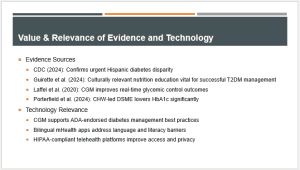
The evidence base for this plan is both strong and directly relevant to the needs of Hispanic adults with T2DM. To begin with, CDC (2024) provides robust epidemiological data underscoring the urgency of addressing this disparity. Second, Guirette et al. (2024) show that culturally relevant nutrition education is crucial for promoting long-term, successful T2DM management. Third, Laffel et al. (2020) demonstrate the clinical value of CGM in improving real-time glycemic control and preventing complications. Lastly, Porterfield et al. (2024) show that CHW-led DSME significantly lowers HbA1c and improves adherence, particularly in underserved populations.
The technology chosen is equally relevant. CGM devices align with ADA best practices by providing continuous, actionable data that supports timely intervention. Bilingual mHealth tools handle language and literacy obstacles and provide culturally accepting education and alerts. Telehealth platforms that follow HIPAA provisions eliminate transportation limitations, increase the availability of follow-up care, and ensure patient privacy. Cumulatively, these evidence-based approaches and technology assets ensure that the plan is clinically effective, culturally competent, and sustainable to the target population.
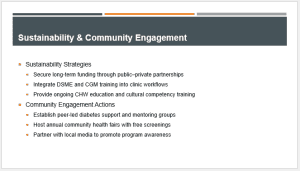
Sustainability also depends on both stable funding and community ownership in the long term. We will be seeking to establish public-private partnerships, applying for grants and local business sponsorships, so as to have continuing financing of the programs. The training and practice of DSME and CGM will be embedded into the work of a regular clinic, not a special time-limited project, but that makes it part of normal care. Additional training of CHWs on cultural competency will ensure the program remains high-quality and relevant.
Peer-led groups in which participants will share their experiences and strategies and engage in support and mentoring with each other will be created to help promote a deep community. Free screenings, awareness, and new participants will be attained through annual community health fairs. The program’s successes will be emphasized in local media, notably Spanish-language radio and television, which will promote its further involvement. These measures are correlated with best practice in public health, which will guarantee the sustainability of the program and its subsequent growth far beyond what was achieved at the time of its introduction.
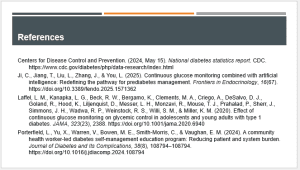
Centers for Disease Control and Prevention. (2024, May 15). National diabetes statistics report. CDC. https://www.cdc.gov/diabetes/php/data-research/index.html
Ji, C., Jiang, T., Liu, L., Zhang, J., & You, L. (2025). Continuous glucose monitoring combined with artificial intelligence: Redefining the pathway for prediabetes management. Frontiers in Endocrinology, 16(67). https://doi.org/10.3389/fendo.2025.1571362
Laffel, L. M., Kanapka, L. G., Beck, R. W., Bergamo, K., Clements, M. A., Criego, A., DeSalvo, D. J., Goland, R., Hood, K., Liljenquist, D., Messer, L. H., Monzavi, R., Mouse, T. J., Prahalad, P., Sherr, J., Simmons, J. H., Wadwa, R. P., Weinstock, R. S., Willi, S. M., & Miller, K. M. (2020). Effect of continuous glucose monitoring on glycemic control in adolescents and young adults with type 1 diabetes. JAMA, 323(23), 2388. https://doi.org/10.1001/jama.2020.6940
Porterfield, L., Yu, X., Warren, V., Bowen, M. E., Smith-Morris, C., & Vaughan, E. M. (2024). A community health worker-led diabetes self-management education program: Reducing patient and system burden. Journal of Diabetes and Its Complications, 38(8), 108794–108794. https://doi.org/10.1016/j.jdiacomp.2024.108794
ORDER A PLAGIARISM-FREE PAPER HERE
We’ll write everything from scratch
Question 
For this assessment, you will create a 5-7 slide PowerPoint presentation about a population health improvement plan. You will then record a video of no more than five minutes presenting your PowerPoint.
Evidence-Based Population Health Improvement Plan – Diabetes Improvement Plan
Expand All
Introduction
Master’s-level nurses need to be able to think critically about the evidence, outcomes data, and other relevant information they encounter throughout their daily practice. Often the evidence or information that a nurse encounters, researches, or studies is not presented in the exact context of that nurse’s practice. A key skill of the master’s-level nurse is to transfer evidence from the context in which it was presented and apply it to a different context in order to maximize the benefit to patients in that new context.
Professional Context
Master’s-level nurses need to be able to think beyond the bedside. It is important to be able to research, synthesize, and apply evidence that will result in improved health outcomes for the communities and populations that are part of your care setting. Improving outcomes at a community or population level, even incrementally, can create noticeably significant, aggregate health improvements for patients across all of a care setting.
Scenario
Your organization has created an initiative to improve one of the pervasive and chronic health concerns in the community. Some examples of possibilities for health improvement initiatives include type 2 diabetes, HIV, obesity, and communicable diseases. You will need to do your own research to gather and evaluate the relevant data for your chosen issue.
Once you have created a presentation for the initiative, you have been asked to present to a group of community stakeholders. The purpose of your presentation is to inform and enlist support for the initiative from your audience.
Instructions
The optional Evidence-Based Population Health Improvement Plan Presentation Template [PPTX] Download Evidence-Based Population Health Improvement Plan Presentation Template [PPTX]is provided to help you prepare your slides. If you choose to work without the template, consider referring to Creating a Presentation: A Guide to Writing and Speaking and Guidelines for Effective PowerPoint Presentations.
The suggested headings for your presentation are:
Community Data Evaluation.
Meeting Community Needs.
Measuring Outcomes.
Communication Plan.
Evidence.
In your presentation, you will:
Evaluate the environmental and epidemiological data about your community to determine a population-focused priority for care.
Identify the relevant data. This can be communicated in a table or chart.
Describe the major population health issue suggested by the data within your community.
Explain how environmental factors affect the health of community residents.
Identify the level of evidence, validity, and reliability for each source.
Explain what evidence in the current literature (published within the last five years) supports your evaluation of the data and the population focused priority of care you have selected.
Develop an ethical health improvement plan with outcome criteria that addresses the population health priority that you identified in your evaluation.
Consider the environmental realities and challenges existing in the community.
Include interventions that will meet community needs.
Address potential barriers or misunderstandings related to various cultures prevalent in the community.
Propose criteria that can be used to evaluate the achievement of the plan’s outcomes for your population health improvement.
Explain why your proposed criteria are appropriate and useful measures of success.
Explain a plan to collaborate with a specific community organization to support the implementation of the population health improvement in an ethical, culturally sensitive, and inclusive way.
Identify the community stakeholders that are relevant to your Population Health Improvement Plan.
Develop a clear communication strategy that is mindful of the cultural and ethical expectations of colleagues and community members regarding data privacy.
Ensure that your strategy enables you to make complex medical terms and concepts understandable to members of the community regardless of disabilities, language, or level of education.
Explain the value and relevance of the evidence and technology resources used as the basis of a population health improvement plan.
Explain why the evidence is valuable and relevant to the community health concern you are addressing.
Explain why each piece of evidence is appropriate and informs the goal of improving the health of the community.
Communicate the Evidence-Based Population Health Improvement Plan in a professional, effective manner that engages the community organization stakeholders and the community-at-large to implement and sustain change.
What specific actions can the community stakeholders take themselves to build a feeling of community ownership in your plan?
Integrate relevant sources to support assertions, correctly formatting citations and references using APA style.
Before starting to record your presentation make sure you have:
Set up and tested your microphone and headset using the installation instructions provided by the manufacturer. You only need to use the headset if your audio is not clear or high quality when captured by the microphone.
Practice using the equipment to ensure the audio quality is sufficient.
Consult Using Kaltura for guidance on how to record your presentation and upload it in the courseroom.
Microsoft PowerPoint also allows you to record your narration with your slides. If you choose this option, simply submit your presentation to the appropriate area of the courseroom. Your narration will be included with your slides.
Remember to practice delivering and recording your presentation multiple times to ensure effective delivery.
Note: If you require the use of assistive technology or alternative communication methods to participate in this activity, please contact Disability Services at DisabilityServices@Capella.edu to request accommodations.
Submission Requirements
Length of submission: 5–7 slides. Balance text with visuals. Avoid text-heavy slides. Add detailed speaker notes to fully support the content of the presentation. Speaker notes must match the audio.
Length of Video Presentation: No more than five minutes. Speaker notes must match the audio.
Font and font size: Appropriate size and weight for a presentation, generally 24–28 points for headings; no smaller than 18 points for bullet-point text. Use a suitable professional typeface, such as Times or Arial, throughout the presentation.
Number of references: Cite a minimum of 3–5 sources of scholarly or professional evidence that support your evaluation, recommendations, and plans. Current source material is defined as no older than five years unless it is a seminal work.
APA formatting: Resources and citations are formatted according to current APA style.
What to Submit
Along with your recording, submit your slides with speaker notes as a PDF.
Save your PowerPoint files as a PDF with notes.
The speaker notes will be processed through Turnitin.
Competencies Measured
By successfully completing this assessment, you will demonstrate your proficiency in the following course competencies and scoring guide criteria:
Competency 1: Apply evidence-based practice to plan patient-centered care.
Explain a plan to collaborate with a specific community organization to support the implementation of the population health improvement in an ethical, culturally sensitive, and inclusive way.
Competency 2: Apply evidence-based practice to design interventions to improve population health.
Develop an ethical health improvement plan with outcome criteria that addresses the population health priority for care identified in the evaluation.
Competency 3: Evaluate the value, relevance, and ethics of available evidence upon which clinical decisions are made.
Evaluate the environmental and epidemiological data about your community to determine a population-focused priority for care.
Explain the value and relevance of the evidence and technology resources used as the basis of a population health improvement plan.
Competency 5: Communicate effectively with diverse audiences, in an appropriate form and style, consistent with organizational, professional, and scholarly standards.
Communicates the Evidence-Based Population Health Improvement Plan in a professional, effective manner that engages the community organization stakeholders and the community-at-large to implement and sustain change.
Integrate relevant and credible sources of evidence to support assertions, correctly formatting citations and references using APA style.
 Complete the order form and upload all of your files, including any instructions, rubrics, or other materials provided by your instructor.
  Complete the order payment after filling in the order form. We’ll receive your order and assign it to a writer.
 The assigned writer will complete your paper and forward it to our Editing Team for review and approval.
 Once approved by the editor, the completed paper will be uploaded to your account for you to download, review and approve.