
Episodic/Focused Note Template
Patient Information:
- Initials: D.B.
- Age: 54
- Sex: Male
- Race: Black
S.
CC: “My lower back’s been killing me every day for the past two weeks.”
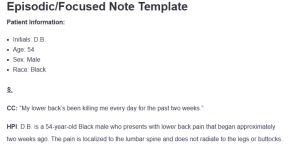
HPI: D.B. is a 54-year-old Black male who presents with lower back pain that began approximately two weeks ago. The pain is localized to the lumbar spine and does not radiate to the legs or buttocks. He describes the pain as a tight, squeezing sensation that is present at baseline and worsens throughout the day. Initially, the discomfort is moderate (5/10) but increases to severe (8–9/10) by evening, especially after work: Episodic/Focused Note Template.
The pain is constant throughout the day and does not fully resolve with rest. It is aggravated by standing for long periods, heavy lifting, and bending, which are regular components of his job as a warehouse supervisor. He reports some relief with sitting or reclining, although the discomfort never completely subsides. He denies any associated numbness, tingling, leg weakness, fever, bowel or bladder changes, or recent trauma.
This is the first episode of such persistent pain, and he has not sought any previous evaluation, imaging, or physical therapy. He has been self-medicating with Ibuprofen 400 mg TID PRN, which offers partial, temporary relief. The pain has begun interfering with his work duties and overall quality of life.
Current Medications:
- Lisinopril 10 mg PO daily – for hypertension
- Metformin 500 mg PO BID – for type 2 diabetes mellitus
- Ibuprofen 400 mg PO TID PRN – for back pain
Allergies: No known drug, food, or environmental allergies.
PMHx: The patient has a past medical history significant for hypertension and type 2 diabetes mellitus, both of which are currently managed with prescribed medications. He has no history of prior surgeries, hospitalizations, or injuries. His immunizations are current, including receiving the Tdap vaccine in 2022.
Soc Hx: The patient is employed full-time as a warehouse supervisor. His role involves heavy lifting and prolonged standing. He lives with his spouse, denies tobacco use, and drinks alcohol occasionally (2–3 drinks/week). He uses a seatbelt consistently and does not text while driving.
He reports a strong family and social support network. He owns his home in a suburban neighborhood with access to local health facilities. He does not engage in regular exercise due to work-related fatigue.
Fam Hx: The patient’s father passed away at the age of 68 due to a myocardial infarction. His mother is currently 81 years old and lives with hypertension and osteoarthritis. The patient denies any known family history of spinal disorders, neurologic conditions, or cancer.
ROS:
General: No fever, chills, weight loss, or fatigue.
HEENT: No vision changes, headaches, or hearing loss.
Cardiovascular: No chest pain, palpitations, or edema.
Respiratory: No shortness of breath or cough.
GI: No nausea, vomiting, diarrhea, or constipation.
GU: No urinary or bowel changes.
Musculoskeletal: Reports persistent low back pain with stiffness and decreased flexibility. Denies joint swelling.
Neurologic: No paresthesia, weakness, or gait disturbances. No dizziness or headaches.
Psychiatric: No depression, anxiety, or mood changes.
Endocrine: Diabetic, denies polydipsia, polyphagia, or polyuria.
Integumentary: No skin lesions, rashes, or ulcers.
O.
Physical Exam:
General: The patient appears alert, oriented to person, place, and time, and in no acute distress. He moves cautiously and slowly, exhibiting mild discomfort when transitioning from sitting to standing. He maintains good eye contact and is cooperative throughout the encounter.
Head: The scalp is intact with no signs of trauma, lesions, or tenderness. Facial expression is consistent with mild discomfort.
EENT: The pupils are symmetrical, round, and receptive to light. Squints are normal. No icterus of the sclera or conjunctival inflammation.
Intact tympanic membranes are pearly gray. Moist oropharynx, no lesions, intact mucous membranes.
Neck: Trachea is midline. There is neither lymphadenopathy nor thyromegaly. No distention of jugular veins. There is no pain or stiffness in neck movements.
Cardiovascular: Regular rate and rhythm are noted without murmurs, gallops, or rubs. No peripheral edema or varicosities are observed. Pulses are 2+ and equal bilaterally in the upper and lower extremities.
Respiratory: Lungs are clear to auscultation bilaterally. No wheezes, rales, or rhonchi are appreciated. Chest expansion is symmetrical, and no use of accessory muscles is noted.
Abdomen: Abdomen is soft, non-tender, and non-distended. Bowel sounds are present in all quadrants. No masses, organomegaly, or bruits were detected on palpation or auscultation.
Musculoskeletal: Inspection reveals no gross deformities or swelling in the spine or extremities. Palpation elicits tenderness over the lumbar vertebrae, specifically at L3–L5. Paraspinal muscles are tight with no palpable spasms.
Range of motion of the lumbar spine is limited; flexion is restricted to 45 degrees due to pain, and extension and rotation cause discomfort. No step-offs or bony abnormalities are detected. Straight leg raise test is negative bilaterally. No joint erythema or effusion noted in the lower extremities.
Neurological: Strength is 5/5 in both upper and lower extremities. Sensory exam reveals intact light touch, vibration, and proprioception in bilateral lower extremities. Deep tendon reflexes are 2+ and symmetric at the patella and Achilles tendons. Gait is mildly antalgic, with cautious steps and mild guarding of the lower back.
Skin: Skin is warm and dry. No rashes, lesions, or signs of pressure injuries are observed. No bruising or ecchymosis is noted over the spine or extremities.
Diagnostic Results: Imaging and labs have not yet been performed. An X-ray of the lumbar spine and basic labs will be carried out.
A.
Differential Diagnoses
Primary Diagnosis: Chronic Low Back Pain – ICD-10: M54.5
Chronic low back pain is possible based on the symptoms, physical examination, and clinical history presented by the patient. He complains of incessant lumbar pain, which has been going on for more than two weeks, and is exacerbated daily through physical activity and standing. During the physical examination, it appeared that there was tenderness on the level L3-L5, difficulty in flexion and extension at the lumbar, and the straight leg raise test was negative.
The absence of a radicular sign and preserved neurological functions further confirms this diagnosis. His lifting in a warehouse (on a frequent and cumulative basis) and standing are expected to result in long-term mechanical strain (Miotto et al., 2020).
Differential Diagnoses
- Lumbar Strain – ICD-10: S39.012A
The history of the patient with back pain during movement, the fact that there are no signs of neurological disorders, as well as the results of the musculoskeletal system examination, show that the most likely diagnosis could be paraspinal pain and not paraspinal deformity. Lumbar strain is among the most common causes of acute or sub-acute low back pain in patients with symptomatic and physically demanding jobs. This is likely, but now belongs to a group of secondary differentials due to symptom duration associated with it and the absence of recent trauma (Casiano & De, 2023).
- Degenerative Disc Disease – ICD-10: M51.36
Degenerative disc disease could also be contributing to the patient’s ongoing symptoms, as he is quite advanced in age and has a stressful job. Although the patient reports no pain radiating down the legs or weakness, the chronic and gradually developing character of the pain makes one apprehensive about some degenerative changes involving the discs. Imaging is required to confirm disc space narrowing or osteophyte formation, including lumbar spine X-ray or MRI (Donnally et al., 2023).
- Facet Joint Syndrome – ICD-10: M47.816
The manifestation of facet joint arthropathy is characterized by local back pain in the lower area that is exacerbated during extension and twisting, as was the case with the patient. Pain is usually not radiant and usually shows scant neurologic involvement. This disorder is often missed, even without imaging or diagnostic blocks, though not ruled out, given his occupational and limited range of motion (Curtis et al., 2023).
The patient will receive a lumbar spine X-ray to evaluate for structural abnormalities. If symptoms persist beyond six weeks, an MRI will be ordered. Labs, including CBC and CMP, will be obtained. He is referred to physical therapy for core strengthening and postural correction.
Medications include continuing Ibuprofen 400 mg TID PRN and starting Cyclobenzaprine 5 mg at bedtime for 7 days (Trung & Bajaj, 2024). Patient education included safe lifting, proper posture, and heat application. A 4-week follow-up is scheduled.
Reflection
I agree with my preceptor’s conservative approach and learned that physical therapy can be more effective long-term than relying solely on medications. In future cases, I would consider using a functional assessment tool. We addressed weight management, glucose control, and back injury prevention for health promotion. His age, race, and physical job increase his risk for chronic musculoskeletal strain, and our care plan was tailored to be practical, culturally sensitive, and preventive.
References
Casiano, V., & De, N. (2023, December 11). Back pain. PubMed; StatPearls Publishing. https://www.ncbi.nlm.nih.gov/books/NBK538173/
Curtis, L., Shah, N., & Padalia, D. (2023, January 9). Facet joint disease. PubMed; StatPearls Publishing. https://www.ncbi.nlm.nih.gov/books/NBK541049/
Donnally, C. J., III, Hanna, A., & Varacallo, M. A. (2023, August 4). Lumbar degenerative disk Disease. StatPearls – NCBI Bookshelf. https://www.ncbi.nlm.nih.gov/books/NBK448134/
Miotto, R., Percha, B. L., Glicksberg, B. S., Lee, H.-C., Cruz, L., Dudley, J. T., & Nabeel, I. (2020). Identifying acute low back pain episodes in primary care practice from clinical notes: Observational study. JMIR Medical Informatics, 8(2), e16878. https://doi.org/10.2196/16878
Trung, V., & Bajaj, T. (2024). Ibuprofen. National Library of Medicine; StatPearls Publishing. https://www.ncbi.nlm.nih.gov/books/NBK542299/
ORDER A PLAGIARISM-FREE PAPER HERE
We’ll write everything from scratch
Question 
Episodic Visit: Musculoskeletal Focused Note
For this Assignment, you will work with a patient with a musculoskeletal condition that you examined during the last three weeks. You will complete your third Episodic/Focused Note Template Form for this course where you will gather patient information, relevant diagnostic and treatment information as well as reflect on health promotion and disease prevention in light of patient factors such as age, ethnic group, previous medical history (PMH), socio-economic, cultural background, etc. In this week’s Learning Resources, please review the Focused Note resources for guidance on writing Focused Notes.
Note: All Focused Notes must be signed, and each page must be initialed by your preceptor. When you submit your Focused Notes, you should include the complete Focused Note as a Word document and pdf/images of each page that is initialed and signed by your preceptor. You must submit your Focused Notes using Turnitin.
Episodic/Focused Note Template
Note: Electronic signatures are not accepted. If both files are not received by the due date, faculty will deduct points per the Walden Late Policies.
To prepare:
- Use the Episodic/Focused Note Template found in the Learning Resources for this week to complete this assignment.
- Select a patient that you examined during the last three weeks based on musculoskeletal conditions. With this patient in mind, address the following in a Focused Note:
Assignment:
- Subjective: What details did the patient provide regarding her personal and medical history?
- Objective: What observations did you make during the physical assessment?
- Assessment: What were your differential diagnoses? Provide a minimum of three possible diagnoses. List them from highest priority to lowest priority. What was your primary diagnosis and why?
- Plan: What was your plan for diagnostics and primary diagnosis? What was your plan for treatment and management, including alternative therapies? Include pharmacologic and nonpharmacologic treatments, alternative therapies, and follow-up parameters as well as a rationale for this treatment and management plan.
- Reflection notes: What would you do differently in a similar patient evaluation?
 Complete the order form and upload all of your files, including any instructions, rubrics, or other materials provided by your instructor.
  Complete the order payment after filling in the order form. We’ll receive your order and assign it to a writer.
 The assigned writer will complete your paper and forward it to our Editing Team for review and approval.
 Once approved by the editor, the completed paper will be uploaded to your account for you to download, review and approve.