
Environmental Influence as the Strongest Predictor of Helping Behavior
Helping behavior is a foundational component of human social interaction, critical for fostering connection, cooperation, and moral responsibility. The desire to comprehend the motive forces behind prosocial behavior continues to be one of the interests in social psychology. There is long-standing controversy between individuals who feel that helping behavior is the result of genetically determined biological predispositions and those who claim that environmental forces shape helping behavior. Although genetic factors can bring forth emotional characteristics that favor helping conduct, strong evidence exists that proves environmental influence in the form of upbringing, social norms, and contextual situations is the more assertive influencer. This paper presents a research-guided contention that environmental influences outweigh genetic factors in the emergence and expression of helping behavior. It also takes into account the counterarguments related to genetic determinism and disarms them using social psychological theory and empirical studies.
Environmental Influences on Helping Behavior
Environmental factors significantly shape prosocial behavior through mechanisms such as modeling, reinforcement, and cultural norms. The social learning theory teaches that individuals acquire behavior as they observe others, imitate them, and receive their feedback (McLeod, 2025). When children are raised watching caring and selfless treatment of adults or other powerful persons around them, they are more likely to apply the same in their interactions. Recurring reward behavior, such as praising when someone shares or when they volunteer for something, hardens these actions into patterns.
Moreover, helping behavior is context-sensitive and often emerges in response to specific environmental cues. According to Batson’s empathy-altruism hypothesis, witnessing the suffering of another person elicits an empathic concern that in turn leads to an individual helping another, without any personal gain (Miyazono & Inarimori, 2021). Although empathy may be temperamental, it is largely molded and triggered by an individual’s own experience as well as social exposure. Environments that facilitate perspective-taking, emotional literacy, and moral responsibility are direct antecedent conditions of the development of empathy-based helping behavior.
Research Evidence Supporting Environmental Dominance
Empirical research emphasizes the effect of environmental variables upon genetics in forecasting helping behavior. A longitudinal study by Van Meegen et al. (2024) revealed that adolescents who had moral discussions with their parents, emotional support, and involvement in the community exhibited increased prosocial behavior. This conclusion emphasizes the lasting implications of daily socialization habits on shaping an interest in altruism.
Intervention programs also support the effectiveness of the environment. Formalized service-learning within a learning environment has been demonstrated to promote both empathy and civic-mindedness among adolescents and young adults. Wondimu and Admas (2024) found that students who participated in community service projects not only reported more helping behaviors but also internalized values of social responsibility. These could not be associated with innate characteristics but organized, planned experiences that would encourage prosocial participation. The ability to shape the helping behavior via exposure to the environment reveals the versatility of the behaviors and the critical nature of external influences in their growth.
Counterargument: The Genetic Perspective
According to the genetic view proponents, helping behavior is based on an inherited disposition that includes emotional sensitivity and empathy. Biological factors, including the release of oxytocin, have also been associated with bonding and empathic reactions, which means that there is a neurochemical basis for some prosocial behaviors. From this perspective, individuals with genetic predispositions for empathy or sociability may be more inclined to help others. These traits can manifest early and persist over time, even across varying environments, suggesting a baseline biological influence on helping behavior. This argument posits that while the environment may refine behavior, the predisposition to help originates within the genetic code.
Rebuttal: Why Environment Still Prevails
While the genetic argument has merit, it lacks explanatory power regarding the wide variability of helping behavior across different cultures, socioeconomic backgrounds, and historical contexts. If helping behavior were predominantly genetic, one would expect relatively stable patterns of prosocial behavior across populations. However, helping behavior is heavily influenced by cultural norms, religious teachings, economic conditions, and even media exposure—all environmental variables.
Furthermore, genetic predispositions require environmental activation to be expressed behaviorally. The Centers for Disease Control and Prevention (2025) explains that genes operate within a framework of environmental triggers, and epigenetic research shows that experiences such as nurturing or trauma can regulate gene expression. An individual who has the genetic predisposition toward empathetic tendencies might never grow to be strong in helping behaviors when growing up in a neglectful or violent household. On the other hand, without determined biological predispositions, individuals may develop into caring assistants through supportive and prosocial upbringing.
Critically, environmental factors offer actionable strategies for intervention. Unlike genetic characteristics that are permanent and not reversible, environments can be engineered in such a way as to support prosocial norms. Policies and programs such as peer mentoring, conflict resolution training, and moral education can be adopted in schools, workplaces, families, and communities to promote helping behavior. These tools can help society develop compassion and altruism on a mass scale, irrespective of personal genetic inheritances.
Conclusion
Evidence on the role of genes and the environment strongly favors the environment as the stronger and more practical force behind helping actions, although genes also play a role. Environmental forces influence and develop prosocial behavior to a much greater extent compared with the effects of biology alone through modeling, socialization, emotional interest, and structured experiences. Although predispositional background in behavior can be found in genetic traits, it cannot identify or exhibit behavior, unless it is environmentally enhanced. Besides, the environment provides the flexibility and adaptability required in promoting helping behavior through education, cultural reinforcement, and public policy. To sum up, the dynamic and actionable nature of the environment makes the environment the most powerful predictor of helping behavior among individuals and in society alike.
References
Centers for Disease Control and Prevention. (2025, January 31). Epigenetics, health, and disease. Genomics and Your Health. https://www.cdc.gov/genomics-and-health/epigenetics/index.html
McLeod, S. (2025, March 18). Albert Bandura’s social learning theory. Simply Psychology. https://www.simplypsychology.org/bandura.html
Miyazono, K., & Inarimori, K. (2021). Empathy, altruism, and group identification. Frontiers in Psychology, 12(78). https://doi.org/10.3389/fpsyg.2021.749315
Van Meegen, M., Van Der Graaff, J., Carlo, G., Meeus, W., & Branje, S. (2024). Longitudinal associations between support and prosocial behavior across adolescence: The roles of fathers, mothers, siblings, and friends. Journal of Youth and Adolescence, 53(5), 1134–1154. https://doi.org/10.1007/s10964-023-01885-5
Wondimu, H., & Admas, G. (2024). The motivation and engagement of student volunteers in volunteerism at the University of Gondar. Discover Global Society, 2(1). https://doi.org/10.1007/s44282-024-00049-5
ORDER A PLAGIARISM-FREE PAPER HERE
We’ll write everything from scratch
Question 
Overview
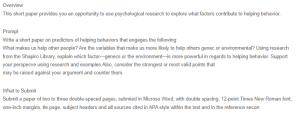
This short paper provides you an opportunity to use psychological research to explore what factors contribute to helping behavior.
Prompt
Write a short paper on predictors of helping behaviors that engages the following:
Environmental Influence as the Strongest Predictor of Helping Behavior
What makes us help other people? Are the variables that make us more likely to help others genec or environmental? Using research from the Shapiro Library, explain which factor—genecs or the environment—is more powerful in regards to helping behavior. Support your perspecve using research and examples.Also, consider the strongest or most valid points that
may be raised against your argument and counter them.
What to Submit
Submit a paper of two to three double-spaced pages, submied in Microso Word, with double spacing, 12-point Times New Roman font, one-inch margins, tle page, subject headers and all sources cited in APA style within the text and in the reference secon
 Complete the order form and upload all of your files, including any instructions, rubrics, or other materials provided by your instructor.
  Complete the order payment after filling in the order form. We’ll receive your order and assign it to a writer.
 The assigned writer will complete your paper and forward it to our Editing Team for review and approval.
 Once approved by the editor, the completed paper will be uploaded to your account for you to download, review and approve.