
Endocrine Hormones
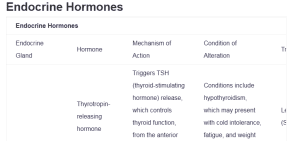
| Endocrine Hormones | ||||
| Endocrine Gland | Hormone | Mechanism of Action | Condition of Alteration | Treatment |
| Hypothalamus | Thyrotropin-releasing hormone | Triggers TSH (thyroid-stimulating hormone) release, which controls thyroid function, from the anterior pituitary (Alvarez-Salas et al., 2022). | Conditions include hypothyroidism, which may present with cold intolerance, fatigue, and weight gain. | Levothyroxine (Synthroid). |
| Corticotropin-releasing hormone | Causes ACTH (anterior pituitary to secrete adrenocorticotropic hormone), which in turn promotes the production of cortisol. | Symptoms of Cushing’s Syndrome include hyperglycemia, moon face, and weight gain. | Ketoconazole, tumor removal if applicable. | |
| Pituitary Gland | Growth hormone (GH) | Promotes tissue development, metabolism, and protein synthesis. | Acromegaly: Enlarged hands/feet, facial bone overgrowth, joint pain. | Octreotide, transsphenoidal surgery. |
| Antidiuretic hormone (ADH) | Maintains fluid balance by controlling the kidneys’ water retention (Cuzzo et al., 2020). | Diabetes Insipidus with presenting manifestations such as excessive thirst, dehydration, and polyuria. | Treatment includes Desmopressin (DDAVP). | |
| Thyroid Gland | Thyroxine | Increases temperature regulation, metabolism, and heart rate | Graves’ Disease (Hyperthyroidism): Tachycardia, weight loss, bulging eyes, and heat intolerance | Methimazole, radioactive iodine, beta-blockers. |
| Calcitonin | Reduces calcium levels in the blood by preventing resorption of bones. | Osteoporosis: Fragile bones, bone pain, and fractures | Vitamin D, calcium, and bisphosphonates. | |
| Parathyroid Gland | Parathyroid hormone | Raises intestinal absorption and promotes bone resorption, which raises calcium levels. | Conditions include Hyperparathyroidism, which manifests through bone pain, kidney stones, fatigue, and hypercalcemia. | Parathyroidectomy, bisphosphonates. |
| Adrenal Gland | Cortisol | Controls stress response, immunological response, and metabolism. | Conditions include primary adrenal insufficiency (Addison’s Disease), which manifests with fatigue, loss of weight, hypotension, and hyperpigmentation. | Treatment involves hydrocortisone and fludrocortisone. |
| Aldosterone | Regulates blood pressure by controlling the balance of potassium and sodium. | Conditions include hyperaldosteronism, which presents with muscle weakness, high blood pressure, and low potassium (K). | Spironolactone
Adrenalectomy, if caused by a tumor. |
|
| Pancreas | Insulin | Reduces levels of blood sugar by facilitating glucose absorption into cells (Rahman, 2021). | Illnesses include Type 1 Diabetes, which manifests as thirst, increased urination, weight loss, and hyperglycemia. | Treatment involves insulin therapy. |
| Glucagon | Causes the liver to break down glycogen, which raises blood sugar levels. | Conditions include hypoglycemia, which manifests sweating, confusion, dizziness, and fainting. | Glucose tablets, IV dextrose. | |
| Ovaries | Estrogen | Controls the menstrual cycle, secondary sex traits, and the female reproductive system. | Conditions include menopause, which can cause mood swings, hot flashes, and an increased risk of osteoporosis. | Treatments include hormone replacement therapy (HRT) and lifestyle modifications. |
| Progesterone | Regulates the menstrual cycle and supports pregnancy. | PCOS (Polycystic Ovary Syndrome): Irregular periods, hirsutism, and infertility | Changes in lifestyle, birth control pills, and metformin. | |
| Testes | Testosterone | Develops tissues in the male reproductive system
Increases bone density and muscle mass. |
Examples of conditions are hypogonadism, which presents with exhaustion/fatigue, muscle loss, decreased libido, and mood changes. | Treatment involves testosterone replacement therapy. |
| Pineal Gland | Melatonin | Controls circadian rhythm and sleep-wake cycles (Savage et al., 2022). | Examples of conditions are insomnia, which presents with sleeping difficulty, daytime fatigue, and irritability. | Comprehensive treatment involves melatonin supplements and cognitive behavioral therapy. |
References
Alvarez-Salas, E., García-Luna, C., Soberanes-Chávez, P., & De Gortari, P. (2022). Role of the thyrotropin-releasing hormone of the limbic system in mood and eating regulation. Journal of Integrative Neuroscience, 21(2), 047. https://doi.org/10.31083/j.jin2102047
Cuzzo, B., Padala, S. A., & Lappin, S. L. (2020). Physiology, vasopressin. PubMed; StatPearls Publishing. https://pubmed.ncbi.nlm.nih.gov/30252325/
Rahman, S. (2021). Role of insulin in health and disease: An update. International Journal of Molecular Sciences, 22(12), 6403. https://doi.org/10.3390/ijms22126403
Savage, R. A., Zafar, N., Yohannan, S., & Miller, J.-M. M. (2022). Melatonin. PubMed; StatPearls Publishing. https://pubmed.ncbi.nlm.nih.gov/30521244/
ORDER A PLAGIARISM-FREE PAPER HERE
We’ll write everything from scratch
Question 
In this assignment you will create a table in Word regarding hormones of the endocrine system. You will use information from biological, physiological sciences. You will translate this evidence into your table and identify physiologic alterations in bodily systems in response to disease processes and associated treatment.
- • Along the top horizontal row you will place the title
- • The next horizontal row will have the following categories
- Endocrine Gland I Hormone I Mechanism of Action I Condition of Alteration I Treatment
- • Complete the content in the vertical columns in your table.
- Gland: Each of the nine endocrine glands must be represented. (9).
- Hormone: You should have 1-2 hormones from each gland for a total of fifteen. (15)
- Mechanism of Action: This means the action and function of the hormone.
- Condition of Alteration: The disorder is named and brief description of symptoms
- Treatment: is the medication or procedures to treat the condition.

Endocrine Hormones
Content may be in short sentences and bullets.
A title page and a reference page is required.
Do not distract your content by overciting each sentence in the blocks.Your instructor will advise you on how the citations should appear in the table.
The table should be usable, orderly and have sufficient content to be substantive but not cluttered or wordy.
Requirements:
- 2 pages
- Use APA 7th edition format
- Use 3 scholarly references
Textbook:
- McCance, K. L. & Huether, S. E. (2019). Pathophysiology: The biologic basis for disease in adults and children (8th ed.). St. Louis
 Complete the order form and upload all of your files, including any instructions, rubrics, or other materials provided by your instructor.
  Complete the order payment after filling in the order form. We’ll receive your order and assign it to a writer.
 The assigned writer will complete your paper and forward it to our Editing Team for review and approval.
 Once approved by the editor, the completed paper will be uploaded to your account for you to download, review and approve.