
Educational e-Learning Program
Purpose of the e-Learning Program
The primary goal of this e-learning initiative is to give supplemental educational support to students who demonstrate below-grade performance or require help reinforcing fundamental concepts. The online delivery of tutoring sessions eliminates the challenges that stem from transport problems, teacher scheduling issues, and time restrictions. Internet access enables students to access targeted tutoring support from qualified professionals anywhere (Alolaywi, 2021). The initiative is a forward-thinking approach to educational fairness rather than a passive remedy.
Benefits of e-Learning to the Educational Institution
Various advantages emerge because of the implementation of an online tutoring system. Online tutoring brings academic improvement together with student participation, resulting in greater learning and improved test results. This system makes personalized educational instruction available to students without increasing the workload of classroom instructors. The program is a tangible proof of strong student care at the school, thus building better relationships with parents and increasing their satisfaction (Alolaywi, 2021). The program gathers data, enabling future academic planning for instructional methods and educational programs.
Philosophy for the Development of e-Learning
The development of this e-learning program relies on constructivist principles to let learners build their comprehension by participating, interacting, and reflecting. The implementation of e-learning should prioritize learner course direction combined with flexibility and support services while offering deep active learning activities instead of content consumption only. The programming design will include various learning methods to support multiple student academic levels and provide suitable educational materials for each student’s competency.
Delivery Modality
A combined approach of real-time learning sessions plus independent work best accommodates the requirements of student families through the program. The National University (2024) indicates that scheduled live tutoring sessions will occur through Kaltura and Zoom or Google Meet during weekday afternoons to provide real-time student-tutor interaction. The learning materials, including instructional videos, practice quizzes, and review assignments, will become accessible through Google Classroom or Canvas platforms. The combined format of organized academic support allows learners without live session access to benefit from an independent learning schedule.
Technology for Implementation
Multiple educational technologies from the program will enable instructional and engagement support. All learning materials and assignments will be found in the main learning management system titled Google Classroom. The tutoring sessions will happen live through Zoom or Google Meet, and students can use Kahoot!, Quizlet Kaltura, and Edpuzzle to practice and get formative assessments, according to the National University (2024). Using Kami instant document collaboration, students and tutors can draw on problems together in real time. The chosen technological solutions demonstrate ease of use and compatibility across multiple devices, making them accessible to all users.
Best Practices for a Positive e-Learning Experience
Multiple best practices will lead to positive experiences for teachers and students in this setup. Representatives of both student and instruction will undergo platform orientation alongside training to develop their familiarity with these applications. Both communication rules and session expectation requirements will be defined before work begins. We will develop a strong community through weekly virtual meetings and enable students to give performance feedback. The tutors will receive support to develop interesting material for students while adjusting their teaching approach to suit the requirements of each learner (Alolaywi, 2021). The program will benefit from continuous program development through ongoing student activity and achievement assessments.
Assessment of Student Learning
Assessment exists as a fundamental feature of the e-learning tutoring program. Students must take evaluation tests before and after the tutoring sessions to demonstrate their educational development throughout the program. The logs and reflections from tutors will function as tracking systems that allow them to determine student advancement and recognize repeat student learning barriers. The sessions include formative assessments that use quizzes, practice problems, and student responses in discussions. The student learning procedure includes self-assessment forms and feedback reports for personal learning evaluation and program satisfaction measures. The evaluation techniques will maintain a results-based approach that dynamically responds to student requirements for the program.
References
Alolaywi, Y. (2021). Teaching online during the COVID-19 pandemic: Teachers’ perspectives. Journal of Language and Linguistic Studies, 17(4), 2022-2045. https://www.jlls.org/index.php/jlls/article/view/3600
National University. (2024, April 17). Kaltura user guide. Graduate Studies Support Center. https://resources.nu.edu/ld.php?content_id=58541906
ORDER A PLAGIARISM-FREE PAPER HERE
We’ll write everything from scratch
Question 
Educational e-Learning Program
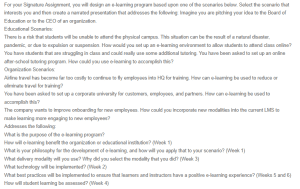
For your Signature Assignment, you will design an e-learning program based upon one of the scenarios below. Select the scenario that interests you and then create a narrated presentation that addresses the following: Imagine you are pitching your idea to the Board of Education or to the CEO of an organization.
Educational e-Learning Program
Educational Scenarios:
There is a risk that students will be unable to attend the physical campus. This situation can be the result of a natural disaster, pandemic, or due to expulsion or suspension. How would you set up an e-learning environment to allow students to attend class online?
You have students that are struggling in class and could really use some additional tutoring. You have been asked to set up an online after-school tutoring program. How could you use e-learning to accomplish this?
Organization Scenarios:
Airline travel has become far too costly to continue to fly employees into HQ for training. How can e-learning be used to reduce or eliminate travel for training?
You have been asked to set up a corporate university for customers, employees, and partners. How can e-learning be used to accomplish this?
The company wants to improve onboarding for new employees. How could you incorporate new modalities into the current LMS to make learning more engaging to new employees?
Addresses the following:
What is the purpose of the e-learning program?
How will e-learning benefit the organization or educational institution? (Week 1)
What is your philosophy for the development of e-learning, and how will you apply that to your scenario? (Week 1)
What delivery modality will you use? Why did you select the modality that you did? (Week 3)
What technology will be implemented? (Week 2)
What best practices will be implemented to ensure that learners and instructors have a positive e-learning experience? (Weeks 5 and 6)
How will student learning be assessed? (Week 4)
Length 2 pages
Resources:
A computer programming hybrid MOOC for Greek secondary education
Koutsakas, P., Karagiannidis, C., Politis, P., & Karasavvidis, I. (2020). A computer programming hybrid MOOC for Greek secondary education. Smart Learning Environments, 7(1).
This paper explores the use of a Massive Open Online Course (MOOC) in secondary education. The purpose of including this paper is to provide a broader view of the use of e-learning technologies in education.
Context-aware mobile learning system: Usability assessment based on a field study
Pensabe-Rodriguez, A., Lopez-Dominguez, E., Hernandez-Velazquez, Y., Dominguez-Isidro, S., & De-la-Calleja, J. (2020). Context-aware mobile learning system: Usability assessment based on a field study. Telematics and Informatics, 48.
This paper evaluates context-aware mobile learning and user acceptance.
Design of eLearning Platform for Adult Learner
Nurhayati, A., & Bandung, Y. (2019). Design of eLearning Platform for Adult Learner. 2019 International Conference of Advanced Informatics: Concepts, Theory and Applications (ICAICTA), Advanced Informatics: Concepts, Theory and Applications (ICAICTA), 2019 International Conference, 1–6.
Nurhayati and Bandung (2019) discussed how e-learning should be tailored to the needs of adult learners using Knowles et al. (1997) theory of andragogy. There is also a discussion on different e-learning platforms that may help guide the selection of an LMS for an organization.
Implementing learning analytics for learning impact: Taking tools to task
Knight, S., Gibson, A., & Shibani, A. (2020). Implementing learning analytics for learning impact: Taking tools to task. The Internet and Higher Education, 45.
This paper discusses the value of learning analytics and how learning analytics can impact student learning.
Online e-learning and cognitive disabilities: A systematic review
Cinquin, P.-A., Guitton, P., & Sauzéon, H. (2019). Online e-learning and cognitive disabilities: A systematic review. Computers & Education, 130, 152–167.
While e-learning is able to bring the classroom to students, the focus tends to be on general education students. This focus on general education students means that ensuring that children that need accommodations are often not considered in the design of e-learning.
Teaching online during the COVID-19 pandemic: Teachers’ perspectives
Alolaywi, Y. (2021). Teaching online during the COVID-19 pandemic: Teachers’ perspectives. Journal of Language & Linguistics Studies, 17(4), 2022–2045.
Kaltura User Guide
National University (2023). Kaltura User Guide. Graduate Studies Support Center.
This resource includes instructions for recording and uploading videos into courses using Kaltura.
 Complete the order form and upload all of your files, including any instructions, rubrics, or other materials provided by your instructor.
  Complete the order payment after filling in the order form. We’ll receive your order and assign it to a writer.
 The assigned writer will complete your paper and forward it to our Editing Team for review and approval.
 Once approved by the editor, the completed paper will be uploaded to your account for you to download, review and approve.