
Early-Stage and Late-Stage Timing Issues in Projects
In my most recent group project for a management class, we experienced an early timing problem when we delayed deciding on our topic at an early stage. We all had varying ideas, but no one volunteered to initiate or organize a discussion. We lost precious time in the planning process. To remedy this, I asked we all have our ideas written down in one place and voted on our top three. I asked that we divide tasks early to work efficiently as soon as we agreed on our topic. Starting an online session and making a timeline worked to bring the group back together. I learned we could avoid disorganization by open communication, making early deadlines, and assigning someone to own it as a coordinator. We corrected our group from lost to in progress by doing all these. Having a plan and someone to guide us turned our delay into an efficient and well-organized effort.
As part of working on an in-class group project for my healthcare management class, we faced an end-of-project timing problem when one member suggested re-designing our overall presentation design three days ahead of the deadline. We had planned on having a slideshow, but he wanted to convert it to a video to increase user participation. While an interesting idea, such an adjustment would have affected our timeliness. I suggested we keep the slideshow but incorporate a short video segment instead of an entirely video-based project. This compromise allowed us to stay on the timeline without compromising on delivery. To avoid procrastination-induced changes in future projects, I recommend including buffer periods in project timelines and setting group policies for controlling modifications. Change is sometimes inescapable, but having a planned framework for evaluating and managing such changes and including final review periods helps stay on track without compromising delivery.
ORDER A PLAGIARISM-FREE PAPER HERE
We’ll write everything from scratch
Question 
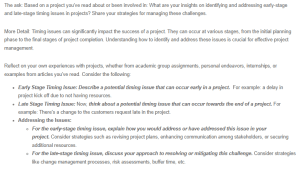
The ask: Based on a project you’ve read about or been involved in: What are your insights on identifying and addressing early-stage and late-stage timing issues in projects? Share your strategies for managing these challenges.
Early-Stage and Late-Stage Timing Issues in Projects
More Detail: Timing issues can significantly impact the success of a project. They can occur at various stages, from the initial planning phase to the final stages of project completion. Understanding how to identify and address these issues is crucial for effective project management.
Reflect on your own experiences with projects, whether from academic group assignments, personal endeavors, internships, or examples from articles you’ve read. Consider the following:
- Early Stage Timing Issue: Describe a potential timing issue that can occur early in a project. For example: a delay in project kick off due to not having resources.
- Late Stage Timing Issue: Now, think about a potential timing issue that can occur towards the end of a project. For example: There’s a change to the customers request late in the project.
- Addressing the Issues:
- For the early-stage timing issue, explain how you would address or have addressed this issue in your project. Consider strategies such as revising project plans, enhancing communication among stakeholders, or securing additional resources.
- For the late-stage timing issue, discuss your approach to resolving or mitigating this challenge. Consider strategies like change management processes, risk assessments, buffer time, etc.
 Complete the order form and upload all of your files, including any instructions, rubrics, or other materials provided by your instructor.
  Complete the order payment after filling in the order form. We’ll receive your order and assign it to a writer.
 The assigned writer will complete your paper and forward it to our Editing Team for review and approval.
 Once approved by the editor, the completed paper will be uploaded to your account for you to download, review and approve.