
Drug Therapy, Anxiety Disorder, Psychotic Major Depression and Insomnia
In 3 or 4 sentences, explain the appropriate drug therapy for a patient who presents with MDD and a history of alcohol abuse. Which drugs are contraindicated, if any, and why? Be specific. What is the timeframe that the patient should see the resolution of symptoms?
In addition to abstinence from alcohol and supportive care, pharmacotherapies and pharmacological measures like antidepressants and serotonin reuptake inhibitors and antidepressants like paroxetine, fluoxetine, escitalopram, sertraline, and citalopram are both regarded as the first-line therapeutic interventions.
Need an unpublished edition on “Drug Therapy” ? Reach out to us.
Corticosteroids, Beta-blockers, Antiparkinson’s medications, Benzodiazepines, Endocrine drugs, Anticonvulsants, Stimulants, H2 Blockers and Proton Pump Inhibitors, Cholesterol-decreasing medications such as Statins, and Anticholinergic medications are the ten medications that are believed to be contraindicated for MDD patients. These medications are regarded as contraindicated because they have the potential to either worsen or contribute to depression in patients who already have substance abuse disorders and depression (Bains & Abdijadid, 2022). These medications are not advised because they either directly or indirectly affect the central nervous system of the patients.
Any antidepressant should typically be taken for a minimum of two to six weeks before results improve. They also mentioned that a patient must go through several trials before discovering the best medication for them. Once the appropriate drug has been identified, it may take several months to determine the optimal dosage and to get the full benefits.
List 4 predictors of late-onset generalized anxiety disorder.
The four main determinants of delayed generalized anxiety disorder are as follows: Compared to men, women are more susceptible. Second is the recent negative life occurrences, including accidents, suicides, or crime-associated circumstances. Third is suffering from persistent physical conditions, including respiratory issues, cardiac arrhythmias and heart failure, hypercholesterolemia, and mental retardation (Stern et al., 2015). I am, lastly, having a history of generalized anxiety disorder, depression, or another mental health problem.
List 4 potential neurobiology causes of psychotic major depression.
The following four neurobiological factors may contribute to major depression in psychosis: Foremost, changes and unbalances in the brain’s neurotransmitters, including serotonin, glutamate, and dopamine. Secondly, there is a decrease in brain networks between the network in default mode (DMN) and the somatic motor or sensory systems, bilaterally insular, and the auditory cortex, with the polar of the right planum showing the most significant spike of decreased connection. This indicates that the functional connection of diminished DMN, which is linked with psychotic depression, and reduced network connections are related to the remission of these conditions. Thirdly, monoamine neurotransmitters such as norepinephrine and serotonin hypothesis (Bains & Abdijadid, 2022). Because different antidepressant medications significantly raise these neurotransmitters’ levels, depressed people are inclined to decrease them. Lastly, one variant in the gene responsible for brain-derived neurotrophic protein is hypothesized to control the interaction between stressors and the serotonergic transporter polymorphisms, leading to severe psychotic depression.
An episode of major depression is defined as a period lasting at least 2 weeks. List at least 5 symptoms required for the episode to occur. Be specific.
The five most frequent signs of major depressive illness include Violence, where the patient exhibits frequent irritability—even over trivial things—angry bouts, worry, restlessness, and agitation. Excessive emotions make the patients isolate themselves because they feel unbearably depressed, crying, hopeless, and empty. Difficulties with appetite where the patient has a decreased appetite and loses excessive amounts of weight, or they may have an enhanced appetite and acquire excessive amounts of weight, nightmares, and other sleep disorders such as insomnia—lastly, Anhedonia and apathy (Bains & Abdijadid, 2022). Apathy refers to the absence of feelings, interest, emotions, or care for the things around the patient. Anhedonia refers to the sensation of lack of interest in pastimes the patient once enjoyed, such as intercourse, leisure, and hobbies.
List 3 classes of drugs, with a corresponding example for each class, that precipitate insomnia. Be specific.
Drug classes that cause insomnia include Benzodiazepines, for example, lorazepam, a class of benzodiazepines with a shorter half-life that controls and relieves insomnia or difficulties falling asleep due to stress or worry. The Dual orexin receptor antagonists, such as Suvorexant, block or antagonize the orexin receptor (Stern et al., 2015). Melatonin receptor agonists, such as Ramelteon, a melatonin receptor agonist that help patients with sleep-onset sleeplessness and those at greater risk of falling sleep better.
References
Bains, N., & Abdijadid, S. (2022). Major depressive disorder. In StatPearls [Internet]. StatPearls Publishing.
Stern, T. A., Fava, M., Wilens, T. E., & Rosenbaum, J. F. (2015). Massachusetts general hospital psychopharmacology and neurotherapeutics. Elsevier Health Sciences.
ORDER A PLAGIARISM-FREE PAPER HERE
We’ll write everything from scratch
Question 
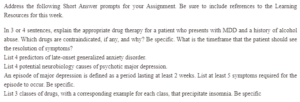
Address the following Short Answer prompts for your Assignment. Be sure to include references to the Learning Resources for this week.
Drug Therapy, Anxiety Disorder, Psychotic Major Depression and Insomnia
In 3 or 4 sentences, explain the appropriate drug therapy for a patient who presents with MDD and a history of alcohol abuse. Which drugs are contraindicated, if any, and why? Be specific. What is the timeframe that the patient should see the resolution of symptoms?
List 4 predictors of late-onset generalized anxiety disorder.
List 4 potential neurobiology causes of psychotic major depression.
An episode of major depression is defined as a period lasting at least 2 weeks. List at least 5 symptoms required for the episode to occur. Be specific.
List 3 classes of drugs, with a corresponding example for each class, that precipitate insomnia. Be specific
 Complete the order form and upload all of your files, including any instructions, rubrics, or other materials provided by your instructor.
 Complete the order payment after filling in the order form. We’ll receive your order and assign it to a writer.
 The assigned writer will complete your paper and forward it to our Editing Team for review and approval.
 Once approved by the editor, the completed paper will be uploaded to your account for you to download, review and approve.