
Discussion: Suicide Risk in Farmers
The reviewed article, Farmer Suicides among States Reporting Violent Deaths, 2003–2017, by Norrod et al. (2023), aimed to generate farmer-specific suicide rates, distinguish farmers from other agricultural workers, and analyze temporal trends from 2003 to 2017. The study overcame previous methodological weaknesses in which a variety of farming occupations were combined, and could provide inaccurate estimates of suicide. Farmers were defined as the people who made daily operational and managerial farm decisions (Norrod et al., 2023). This more specific definition allowed for a more specific epidemiologic characterization of suicide risk in this distinctive occupational group. The general goal was to explain the patterns of farmer suicide and guide selective prevention interventions.
The National Violent Death Reporting System (NVDRS) in 36 states and the U.S. Census of Agriculture were used as data sources. Occupational classification was further improved with the use of expert panel reviews based on standard definitions. The demographics of eligible decedents were compared, and suicide rates were age-adjusted to the age of the U.S. male population. The rate change over time was evaluated using joinpoint regression. A total of 1,652 farmer suicide decedents were identified, most of whom were older white men, with the age-specific rate highest among patients aged 65 years or older (22.0 per 100,000). The rate of suicide in male farmers was between 8.81 and 19.37 per 100,000 and increased annually by 2.44 percent significantly (Norrod et al., 2023). These results indicate a high and growing burden of suicide in the farming population.
Among the strengths were precise occupational classification, multi-year multi-state data, and strong statistical modeling. The weaknesses included possible underreporting due to stigma, the inability to test the effect of off-farm work, and a low proportion of proper samples from minorities and women. To PMHNPs, these findings highlight the significance of occupational-sensitive and culturally-competent suicide assessment and intervention. The identification of significant risk factors, including old age, social isolation, and financial problems, may guide the implementation of preventive solutions. This can be improved by incorporating community-based programs and telepsychiatry in rural locations (Agley et al., 2022). This evidence emphasizes the contribution of the PMHNP in early detection, intervention, and advocacy in mitigating the rate of suicide in vulnerable farmer groups.
References
Agley, J., Barnes, P., Tidd, D., Todd, A., Friedman, K., Gordon, S., Richardson, J., & Delong, J. (2022). Integrating telepsychiatry into rural primary care for upstream prevention: Feasibility case study of the Faith Net Program. INQUIRY: The Journal of Health Care Organization Provision and Financing, 59. https://doi.org/10.1177/00469580221097428
Norrod, P. E., Sanderson, W. T., Abner, E. L., Seals, J., & Browning, S. (2023). Farmer suicides among states reporting violent deaths, 2003–2017. Journal of Rural Mental Health, 47(3), 139–151. https://doi.org/10.1037/rmh0000232
ORDER A PLAGIARISM-FREE PAPER HERE
We’ll write everything from scratch
Question 
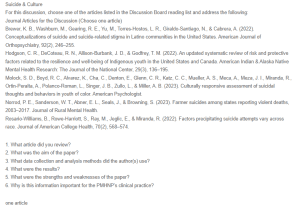
Suicide & Culture
For this discussion, choose one of the articles listed in the Discussion Board reading list and address the following:
Journal Articles for the Discussion (Choose one article)
Suicide Risk in Farmers
Brewer, K. B., Washburn, M., Gearing, R. E., Yu, M., Torres-Hostos, L. R., Giraldo-Santiago, N., & Cabrera, A. (2022). Conceptualizations of suicide and suicide-related stigma in Latino communities in the United States. American Journal of Orthopsychiatry, 92(2), 246–255.
Hodgson, C. R., DeCoteau, R. N., Allison-Burbank, J. D., & Godfrey, T. M. (2022). An updated systematic review of risk and protective factors related to the resilience and well-being of Indigenous youth in the United States and Canada. American Indian & Alaska Native Mental Health Research: The Journal of the National Center, 29(3), 136–195.
Molock, S. D., Boyd, R. C., Alvarez, K., Cha, C., Denton, E., Glenn, C. R., Katz, C. C., Mueller, A. S., Meca, A., Meza, J. I., Miranda, R., Ortin-Peralta, A., Polanco-Roman, L., Singer, J. B., Zullo, L., & Miller, A. B. (2023). Culturally responsive assessment of suicidal thoughts and behaviors in youth of color. American Psychologist.
Norrod, P. E., Sanderson, W. T., Abner, E. L., Seals, J., & Browning, S. (2023). Farmer suicides among states reporting violent deaths, 2003–2017. Journal of Rural Mental Health.
Rosario-Williams, B., Rowe-Harriott, S., Ray, M., Jeglic, E., & Miranda, R. (2022). Factors precipitating suicide attempts vary across race. Journal of American College Health, 70(2), 568–574.
1. What article did you review?
2. What was the aim of the paper?
3. What data collection and analysis methods did the author(s) use?
4. What were the results?
5. What were the strengths and weaknesses of the paper?
6. Why is this information important for the PMHNP’s clinical practice?
one article
 Complete the order form and upload all of your files, including any instructions, rubrics, or other materials provided by your instructor.
  Complete the order payment after filling in the order form. We’ll receive your order and assign it to a writer.
 The assigned writer will complete your paper and forward it to our Editing Team for review and approval.
 Once approved by the editor, the completed paper will be uploaded to your account for you to download, review and approve.