
Discussion: Suicide and Stigma
Hello and welcome. My name is Mamada Abdi, and in today’s session, I will be discussing my opinion about suicide and stigma. The subject of suicide can be extraordinarily sensitive and extremely complex, and it is one I have come across in practice and personal life. I have had experiences of attending to patients with suicidal thoughts, and I have seen how fear of being judged or ridiculed discourages such patients from speaking out freely. Regrettably, this reluctance may cause a delay in intervention and aggravate the results, as noted by Harmer et al. (2024).
Stigma often takes many forms—social, cultural, and even systemic. I have witnessed families who would not like to discuss suicide because they felt ashamed and dishonored their family name. This silence leaves the person at a risk more hopeless and lonelier. In the sphere of public life, a famous individual engaging in suicide is a topic of news coverage that is not always sympathetic and can lead to the reinforcement of harmful stereotypes (Heard et al., 2022). The result is that people suffering in silence may feel less inclined to seek the help they urgently need.
Addressing stigma starts with education and empathy. We need to normalize conversations about mental health in schools, workplaces, and healthcare settings. Non-judgmental language, active listening, and the incorporation of culturally sensitive care delivery are among the aspects that healthcare providers can adopt in leading the process. Campaigns on suicide that involve testimonies of people who have survived suicide, as well as their relatives, may help humanize this issue and address the stigma as a barrier to support. Systemically, training every professional in the healthcare field in suicide risk assessment and prevention can eliminate the fear and prejudice that steers people to seek treatment sooner. Collectively, we can improve the situation by opening up the conversation, dismantling stereotypes, and providing loving support to make our world a safer place where asking for help is normal and not a sign of weakness, as noted by Antoine et al. (2023). Thank you for watching.
References
Antoine, D. G., Manogue, S., Blue, J., Irvin, R., & Irvin, N. (2023). Addressing stigma by increasing empathy toward vulnerable populations in preprofessional trainees: Impacts of the Generation Tomorrow Summer Health Disparities Scholars Program. Journal of Acquired Immune Deficiency Syndromes (1999), 94(2S), S47–S52. https://doi.org/10.1097/QAI.0000000000003262
Harmer, B., Lee, S., Rizvi, A., & Saadabadi, A. (2024, April 20). Suicidal ideation. StatPearls – NCBI Bookshelf. https://www.ncbi.nlm.nih.gov/books/NBK565877/
Heard, T. R., McGill, K., Skehan, J., & Rose, B. (2022). The ripple effect, silence and powerlessness: Hidden barriers to discussing suicide in Australian Aboriginal communities. BMC Psychology, 10, 1–14. https://doi.org/10.1186/s40359-022-00724-9
ORDER A PLAGIARISM-FREE PAPER HERE
We’ll write everything from scratch
Question 
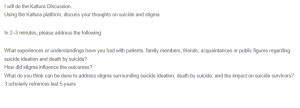
I will do the Kaltura Discussion.
Using the Kaltura platform, discuss your thoughts on suicide and stigma.
Discussion – Suicide and Stigma
In 2–3 minutes, please address the following:
What experiences or understandings have you had with patients, family members, friends, acquaintances or public figures regarding suicide ideation and death by suicide?
How did stigma influence the outcomes?
What do you think can be done to address stigma surrounding suicide ideation, death by suicide, and the impact on suicide survivors?
3 scholarly refrences last 5 years
 Complete the order form and upload all of your files, including any instructions, rubrics, or other materials provided by your instructor.
  Complete the order payment after filling in the order form. We’ll receive your order and assign it to a writer.
 The assigned writer will complete your paper and forward it to our Editing Team for review and approval.
 Once approved by the editor, the completed paper will be uploaded to your account for you to download, review and approve.