
Discussion: Space Travel in Interstellar
The film Interstellar, directed by Nolan (2014), explores the possibility of interstellar travel as humanity searches for a new home beyond Earth. In the film, the astronauts passed a wormhole situated at Saturn and arrived in the planets that were distant from Earth and located in a black hole named Gargantua, which is huge.
This space-travelling scenario is based on the General Theory of Relativity described by Albert Einstein and describes how space time is distorted by massive bodies such as black holes. Wormholes are posed as shortcuts over long distances (Mündlein, 2024). General Relativity predicts that wormholes are a possibility, but at the same time, they are purely speculative, as there is still no trace which would demonstrate they are stable and traversable.
The issue of time dilation around the strong gravitational fields is also well depicted in Interstellar. On the planet to which Miller belongs, near Gargantua, time goes much more slowly than on Earth gravity-time dilation clock effect.
Space travel in Interstellar is not achievable, despite its scientific basis. Assuming that wormholes actually exist, they would need exotic matter to be open, a material that has not been found or yet been exploited by scientists (Genta, 2024). In addition to this, flying close to a black hole would subject space ships to intense tidal forces and intense radiation, which is a big danger. As Fraknoi et al. (2022) explain, even the nearest stars are light-years away, making Interstellar travel impossible with current science.
In conclusion, whereas the movie Interstellar has portrayed a realistic situation of space travel based on accurate scientific theories, the voyages are not yet within the limits of humanity. The documentary is mostly science fiction, which allows the audience to dream of something that may be possible in the future, even though it is not possible to travel at present.
References
Fraknoi, A., Morrison, D., & Wolff, S. (2022). Astronomy 2e. OpenStax. https://openstax.org/books/astronomy-2e/pages/24-5-black-holes
Genta, G. (2024). Interstellar exploration: From science fiction to actual technology. Acta Astronautica, 222, 655–660. https://doi.org/10.1016/j.actaastro.2024.06.049
Mündlein, J. (2024). Bodies in space and time: Time travel in Interstellar (Christopher Nolan, US/UK 2014). Journal for Religion, Film and Media (JRFM), 10(2). 27–40. http://dx.doi.org/10.25969/mediarep/23507
Nolan, C. (Director). (2014). Interstellar. Paramount Pictures. https://www.imdb.com/title/tt0816692/
ORDER A PLAGIARISM-FREE PAPER HERE
We’ll write everything from scratch
Question 
Discussion: Space Travel in Interstellar
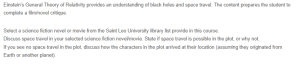
Einstein’s General Theory of Relativity provides an understanding of black holes and space travel. The content prepares the student to complete a film/novel critique.
Discussion – Space Travel in Interstellar
Select a science fiction novel or movie from the Saint Leo University library list provide in this course.
Discuss space travel in your selected science fiction novel/movie. State if space travel is possible in the plot, or why not.
If you see no space travel in the plot, discuss how the characters in the plot arrived at their location (assuming they originated from Earth or another planet).
 Complete the order form and upload all of your files, including any instructions, rubrics, or other materials provided by your instructor.
  Complete the order payment after filling in the order form. We’ll receive your order and assign it to a writer.
 The assigned writer will complete your paper and forward it to our Editing Team for review and approval.
 Once approved by the editor, the completed paper will be uploaded to your account for you to download, review and approve.