
Discussion – Social Media Presidential Campaigns
According to Liberini et al. (2025), social media networking platforms such as YouTube, Twitter, and Facebook have become crucial in contemporary presidential campaigns in the recent past. Such campaigns micro-target specific voting demographics such as young people, urban dwellers, and college-educated adults, among others. Despite the growing usage of social media campaigning by major political parties in the US, there has been widespread debate on whether they influence voting decisions. Trump’s 2016 presidential campaign showed that micro-targeting on social media does influence voting behavior.
One way political parties that present presidential candidates use social media is to encourage voters, especially young ones, to turn up to vote. Targeting young voters through social media is informed by the fact that most social media and technology users are young. A common message passed when encouraging voters to turn up is that if they are dissatisfied with the current regime, the failure to turn up means that they are supporting such regimes. Considering that young people rarely attend town hall meetings or watch mainstream television, using social media has played a vital role in getting voters out to vote.
Additionally, presidential campaigns leverage social media campaigns to explain policy to the masses. Social media tools offer candidates the opportunity to explain their policies without awkward questioning by journalists in traditional broadcast media (Greenberg & Page, 2020). This is because major broadcast media networks in the US exhibit open bias in presidential elections. For instance, Trump personally leveraged Twitter to explain his policy, avoiding being filtered by news media and his campaign team (Greenberg & Page, 2020). Likewise, Obama’s 2008 campaign used social media to avoid being filtered by mainstream media.
Social media has been a successful presidential campaigning tool, considering its impact on voting behavior in the past elections since 2008. Presidential campaign teams have successfully influenced a higher voter turnout, especially among young voters, through social media messaging. Besides, the platform enables presidential candidates to communicate their policy intentions without being filtered by traditional news media, thus influencing voters attracted to hardline political stances to support their preferred presidential candidate.
References
Greenberg, E. S., & Page, B. I. (2020). Struggle for democracy: 2018 elections and update edition (12th ed.). Pearson.
Liberini, F., Redoano, M., Russo, A., Cuevas, A., & Cuevas, R. (2025). Politics in the Facebook era. Evidence from the 2016 US presidential elections. European Journal of Political Economy, 87, 102641. https://doi.org/10.1016/j.ejpoleco.2025.102641
ORDER A PLAGIARISM-FREE PAPER HERE
We’ll write everything from scratch
Question 
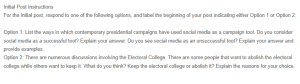
Initial Post Instructions
For the initial post, respond to one of the following options, and label the beginning of your post indicating either Option 1 or Option 2:
Social Media Presidential Campaigns
Option 1: List the ways in which contemporary presidential campaigns have used social media as a campaign tool. Do you consider social media as a successful tool? Explain your answer. Do you see social media as an unsuccessful tool? Explain your answer and provide examples.
Option 2: There are numerous discussions involving the Electoral College. There are some people that want to abolish the electoral college while others want to keep it. What do you think? Keep the electoral college or abolish it? Explain the reasons for your choice.
 Complete the order form and upload all of your files, including any instructions, rubrics, or other materials provided by your instructor.
  Complete the order payment after filling in the order form. We’ll receive your order and assign it to a writer.
 The assigned writer will complete your paper and forward it to our Editing Team for review and approval.
 Once approved by the editor, the completed paper will be uploaded to your account for you to download, review and approve.