
Discussion Responses: Empowerment Theory
Responding to KR
Hello,
Thank you for sharing your thoughtful post. Your clear definition of the ideas of the empowerment theory and how they directly relate to the ethical standard 1.02 – Self-Determination of the NASW Code of Ethics is commendable. Such theories as empowerment theory play a critical role in the development of the social work competencies in general and in the interactions with diversity and difference in particular. The empowerment theory also facilitates the awareness and honor of cultural or racial diversity, gender, and socioeconomic diversity, by asking the clients to recognize their strong points and breaking down the walls that enslave them due to systems of oppression (Rachmad, 2022). Your use of empowerment theory also shows how social workers can become change facilitators rather than directors of a client’s journey. This supports the social work competencies of ethical practice, cultural humility, and a devotion to the promotion of equity on the micro and macro levels. Great work.
Reference
Rachmad, Y. E. (2022). Empowerment theory. Cáceres Conquistadores Publicaciones Internacionales, Edición Especial 2022. https://doi.org/10.17605/osf.io/wymnz
Responding to TY
Hello,
Thank you for your post. Your post offers a logical and convincing presentation of the empowerment theory in the case of your client. Your attitude towards helping the client to regain confidence and to find long-term goals shows how this theory makes an individual strong to change their past and take control over the future. Theories such as empowerment theory play essential roles in guiding social work competence since they focus on respect for individual and cultural environments. Also, theories assist social workers to work with differences and diversity effectively in the promotion of self-determination to solve unique problems that clients experience by treating them as realistic (Caffrey & Browne, 2022). In addition, the theory of empowerment promotes human rights, social, economic, and environmental justice by trying to overcome existing barriers to it, by promoting equity, and promoting client advocacy against oppressive systems. In general, your post demonstrates that there is a close relationship between the empowerment theory and ethical, client-centered social work practice. Great work.
Reference
Caffrey, L., & Browne, F. (2022). Understanding the social worker–family relationship through self‐determination theory: A realist synthesis of signs of safety. Child & Family Social Work, 27(3), 513–525. https://doi.org/10.1111/cfs.12903
ORDER A PLAGIARISM-FREE PAPER HERE
We’ll write everything from scratch
Question 
Discussion Responses: Empowerment Theory
Respond to these two discussion posts.
Respond to two colleagues:
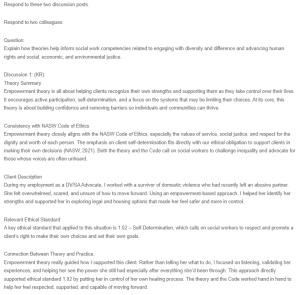
Discussion Responses – Empowerment Theory
Question:
Explain how theories help inform social work competencies related to engaging with diversity and difference and advancing human rights and social, economic, and environmental justice.
Discussion 1: (KR):
Theory Summary
Empowerment theory is all about helping clients recognize their own strengths and supporting them as they take control over their lives. It encourages active participation, self-determination, and a focus on the systems that may be limiting their choices. At its core, this theory is about building confidence and removing barriers so individuals and communities can thrive.
Consistency with NASW Code of Ethics
Empowerment theory closely aligns with the NASW Code of Ethics, especially the values of service, social justice, and respect for the dignity and worth of each person. The emphasis on client self-determination fits directly with our ethical obligation to support clients in making their own decisions (NASW, 2021). Both the theory and the Code call on social workers to challenge inequality and advocate for those whose voices are often unheard.
Client Description
During my employment as a DV/SA Advocate, I worked with a survivor of domestic violence who had recently left an abusive partner. She felt overwhelmed, scared, and unsure of how to move forward. Using an empowerment-based approach, I helped her identify her strengths and supported her in exploring legal and housing options that made her feel safer and more in control.
Relevant Ethical Standard
A key ethical standard that applied to this situation is 1.02 – Self-Determination, which calls on social workers to respect and promote a client’s right to make their own choices and set their own goals.
Connection Between Theory and Practice
Empowerment theory really guided how I supported this client. Rather than telling her what to do, I focused on listening, validating her experiences, and helping her see the power she still had especially after everything she’d been through. This approach directly supported ethical standard 1.02 by putting her in control of her own healing process. The theory and the Code worked hand in hand to help her feel respected, supported, and capable of moving forward.
References
Franklin, C., & Jordan, C. (Eds.). (2024). Turner’s social work treatment: Interlocking theoretical approaches (7th ed.). Oxford University Press.
Joseph, R. (2020). The theory of empowerment: A critical analysis with the theory evaluation scale. Journal of Human Behavior in the Social Environment, 30(2), 138–157. https://doi.org/10.1080/10911359.2019.1660294Links to an external site.
National Association of Social Workers. (2021). Code of ethics of the National Association of Social Workers. https://www.socialworkers.org/About/Ethics/Code-of-Ethics/Code-of-Ethics-EnglishLinks to an external site.
Discussion II (TY)
Summary of Empowerment Theory:
Empowerment theory focuses on helping individuals gain control over their lives by fostering self-efficacy, access to resources, and critical awareness of power structures. It emphasizes collaboration, strength-based practice, and the capacity of people to influence their own circumstances. This theory supports clients in identifying their own goals and mobilizing personal and environmental resources to achieve them (Perkins & Zimmerman, 1995).
Alignment with NASW Code of Ethics:
Empowerment theory aligns closely with the NASW Code of Ethics, particularly in its commitment to the dignity and worth of the person, social justice, and the importance of human relationships (National Association of Social Workers [NASW], 2021). Both the theory and the Code emphasize client self-determination and the need to challenge systemic oppression. The theory’s focus on client strengths and collaboration supports the ethical standard of respecting clients’ rights to make their own choices.
Client Description and Presenting Problem:
My client is a 57-year-old male who has been on probation for the past two years due to methamphetamine and marijuana possession. He expressed feelings of shame and helplessness related to his criminal record and is struggling to find stable employment. Using empowerment theory, interventions focused on building his confidence, identifying community supports, and developing a plan to achieve long-term goals.
Relevant NASW Ethical Standard:
Standard 1.02 – Self-Determination: “Social workers respect and promote the right of clients to self-determination and assist clients in their efforts to identify and clarify their goals” (NASW, 2021).
Consistency Between Theory, Practice, and Ethics:
Empowerment theory is consistent with Standard 1.02 because it centers the client’s voice in setting recovery and reintegration goals, rather than imposing predetermined outcomes. In practice, this theory supported the client’s autonomy by encouraging him to define success on his own terms and pursue resources aligned with his values. The collaborative, strengths-based nature of the work reflected both the ethical obligation to respect self-determination and the core tenets of empowerment theory (Gutierrez, 1994; NASW, 2021).
References
Gutierrez, L. M. (1994). Beyond coping: An empowerment perspective on stressful life events. Journal of Sociology & Social Welfare, 21(3), 201–219.
National Association of Social Workers. (2021). Code of Ethics of the National Association of Social Workers. https://www.socialworkers.org/About/Ethics/Code-of-Ethics/Code-of-Ethics-English
Perkins, D. D., & Zimmerman, M. A. (1995). Empowerment theory, research, and application. American Journal of Community Psychology, 23(5), 569–579. https://doi.org/10.1007/BF02506982
 Complete the order form and upload all of your files, including any instructions, rubrics, or other materials provided by your instructor.
  Complete the order payment after filling in the order form. We’ll receive your order and assign it to a writer.
 The assigned writer will complete your paper and forward it to our Editing Team for review and approval.
 Once approved by the editor, the completed paper will be uploaded to your account for you to download, review and approve.