
Discussion Responses
Responding to BW
Hello,
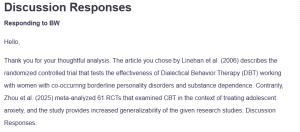
Thank you for your thoughtful analysis. The article you chose by Linehan et al. (2006) describes the randomized controlled trial that tests the effectiveness of Dialectical Behavior Therapy (DBT) working with women with co-occurring borderline personality disorders and substance dependence. Contrarily, Zhou et al. (2025) meta-analyzed 61 RCTs that examined CBT in the context of treating adolescent anxiety, and the study provides increased generalizability of the given research studies: Discussion Responses.
DBT focuses more on emotion regulation and interpersonal effectiveness, which is perfect in the case of Paula due to her chronic dysregulation. CBT works with the maladaptive thoughts and is hence more appropriate to adolescents with trauma and anxiety (Stemerding et al., 2025).
The comparison of the articles allowed me to feel more confident in my choice to employ CBT in the case of Ella, as research suggests its use among young people and in the presence of trauma-related symptoms. However, using DBT is more suitable with adult clients who have several diagnoses and unstable relationships.
References
Linehan, M. M., Schmidt, H., Dimeff, L. A., Craft, J. C., Kanter, J., & Comtois, K. A. (2006). Dialectical behavior therapy for patients with borderline personality disorder and drug dependence. The American Journal on Drug and Alcohol Abuse, 25(4), 691–712. https://doi.org/10.1080/00952990600974916
Stemerding, L. E., de Beurs, D., Arntz, A., & Kindt, M. (2025). Mapping emotional memories in depression: An exploratory analysis. Cognitive Therapy and Research, 1-12. https://doi.org/10.1007/s10608-025-10617-x
Zhou, S., Creswell, C., Košir, U., & Reardon, T. (2025). Moderators of cognitive and behaviour therapies for prevention and treatment of anxiety disorders in children and adolescents: A Systematic review and meta-analysis. Clinical Psychology Review, 116, 102548. https://doi.org/10.1016/j.cpr.2025.102548
Responding to JH
Hello,
Thank you for sharing your post. While you chose Dialectical Behavioral Therapy (DBT) as the treatment of choice in the case of Helen, my case centered around the Cognitive Behavioral Therapy (CBT) for Ella. According to Moglia (2024), DBT is a kind of treatment that moves in stages systematically: it teaches patients to regulate emotions, accept themselves, and achieve goals, and is therefore highly applicable to Helen and her existential crisis in relationships.
The meta-analysis conducted by Zhou et al. (2025) confirms the effectiveness of CBT in eliminating the symptoms of anxiety among adolescents using cognitive restructuring and coping skills. DBT has many applications in treating adults with complex emotional and behavioral needs, whereas CBT works more often with younger clients (Lancastle et al., 2024).
Your study helped me remember the value of DBT to an emotionally overwhelmed patient similar to Helen, and it confirmed that CBT was a suitable option in the case of Ella, who needed structured cognitive intervention because she is going through a developmental period and experienced trauma.
References
Lancastle, D., Davies, N. H., Gait, S., Gray, A., John, B., Jones, A., Kunorubwe, T., Molina, J., Roderique-Davies, G., & Tyson, P. (2024). A systematic review of interventions aimed at improving emotional regulation in children, adolescents, and adults. Journal of Behavioral and Cognitive Therapy, 34(3), 100505. https://doi.org/10.1016/j.jbct.2024.100505
Moglia, P., PhD. (2024). Dialectical behavioral therapy (DBT). Salem Press Encyclopedia of Health.
Zhou, S., Creswell, C., Košir, U., & Reardon, T. (2025). Moderators of cognitive and behaviour therapies for prevention and treatment of anxiety disorders in children and adolescents: A systematic review and meta-analysis. Clinical Psychology Review, 116, 102548. https://doi.org/10.1016/j.cpr.2025.102548
ORDER A PLAGIARISM-FREE PAPER HERE
We’ll write everything from scratch
Question 
Discussion response
Question: Respond to two colleagues who selected a case study different from yours:
- *Compare and contrast the article you selected with your colleague’s article in terms of how they might inform appropriateness for use with the identified client.
- *Explain how reviewing the different studies presented in this Discussion influenced your decision about whether you would use the therapy, given various evidence for the different treatment modalities.
Textbook:
- Turner’s Social Work Treatment: Interlocking Theoretical Approaches
Discussion 1 (BW)
Selected Therapy: Dialectical Behavior Therapy
I selected Dialectical Behavior Therapy (DBT) for Paula Cortez, a 43-year-old Hispanic woman diagnosed with bipolar disorder and living with chronic pain, a history of substance use, and unresolved trauma. DBT is designed for individuals with complex emotional regulation issues, self-harming behaviors, and interpersonal difficulties, making it an appropriate therapeutic fit for Paula.
Methodology Summary:
Linehan et al. (2006) conducted a randomized controlled trial evaluating DBT’s effectiveness in women with co-occurring borderline personality disorder and substance dependence. Participants were randomly assigned to either receive DBT or treatment-as-usual (TAU), and data were collected using structured interviews and validated self-report instruments that measured drug use, parasuicidal behaviors, and treatment retention. The study found that the DBT group demonstrated significantly lower levels of drug use and self-injurious behaviors, as well as greater adherence to treatment.
Applicability to Paula Cortez:
Paula shares several characteristics with the study population, including fluctuation of emotions, a history of trauma, substance use, difficulty managing interpersonal relationships, and treatment noncompliance. DBT’s structured modules, emotion regulation, distress tolerance, mindfulness, and interpersonal effectiveness, which target the exact areas in which Paula struggles.
DBT’s validation strategies can help build trust and increase Paula’s engagement in both mental health and medical care. These findings support DBT as a clinically appropriate intervention that can enhance Paula’s overall functioning and quality of life.
Use of DBT with Paula Cortez:
I would recommend using DBT with Paula Cortez. The therapy is culturally adaptable, offering space to honor Paula’s bilingual identity and her lived experiences as a Latina woman with a history of marginalization and trauma. DBT aligns with social work values of self-determination, empowerment, and evidence-based practice.
It provides a respectful, nonjudgmental framework that supports client autonomy while encouraging meaningful change. Given Paula’s chronic mental health and medical conditions, DBT offers a structured and compassionate approach that supports recovery and sustainable caregiving.
References:
Linehan, M. M., Schmidt, H., Dimeff, L. A., Craft, J. C., Kanter, J., & Comtois, K. A. (2006). Dialectical behavior therapy for patients with borderline personality disorder and drug dependence. The American Journal on Drug and Alcohol Abuse, 25(4), 691–712. https://doi.org/10.1080/00952990600974916
Franklin, C., & Jordan, C. (Eds.). (2024). Dialectical behavior therapy in clinical social work practice. In Turner’s social work treatment: Interlocking theoretical approaches (7th ed.). Oxford University Press.
Discussion Responses
Discussion 2: (JH)
Provide the reference for the study you found using APA guidelines. Be sure to provide a link to the article.
Moglia, P., PhD. (2024). Dialectical behavioral therapy (DBT). Salem Press Encyclopedia of Health.
Identify the therapy that you chose.
Dialectical Behavioral Therapy (DBT)
Briefly paraphrase, in 2–3 sentences, the methodological context (i.e., research method, how data was collected, and the instruments used) of the study and the findings.
Dialectical Behavioral Therapy (DBT) steams from Cognitive Behavior Therapy. According to Moglia (2024), DBT incorporates dialectic thinking and goes through four levels of treatment including achieving control and reducing self-harming behavior, addressing their emotions and traumatic events, developing self-respect and personal goals, finally, reaching some fulfillment. DBT is delivered through individual therapy, group therapy, phone coaching, and ongoing therapist consultation team (Moglia, 2024).
Explain how the findings are applicable or appropriate for the client in your case study.
Helen’s feelings of being inadequate as a wife and feeling like a burden, using Dialectical Behavior Therapy encourages Helen to become more self-aware shifting her thinking to acceptance. Helen also is dealing with being burnt out with her roles as wife, mother, and caregiver. DBT teaches Helen how to manage her crisis without worsening it.
Determine whether you would use or not use the therapy you selected for the client in your selected case study (consider how culturally relevant it is, how aligned it is with social work ethics, etc.) and explain why.
Yes, I would utilize dialectical behavioral therapy while working with Helen to help her regulate her emotions, deal with her distress, and with her interpersonal relationships. Using DBT Helen would identify and manage her feelings better, develop coping strategies during crisis and burnout, and she would develop boundaries, communicate better, and reduce her feeling of guilt.
Reference
Moglia, P., PhD. (2024). Dialectical behavioral therapy (DBT). Salem Press Encyclopedia of Health.
 Complete the order form and upload all of your files, including any instructions, rubrics, or other materials provided by your instructor.
  Complete the order payment after filling in the order form. We’ll receive your order and assign it to a writer.
 The assigned writer will complete your paper and forward it to our Editing Team for review and approval.
 Once approved by the editor, the completed paper will be uploaded to your account for you to download, review and approve.