
Discussion – Population Health Informatics
Population health informatics is the application of information science, public health, and data analytics for the improvement of the health of the population in general (Jen et al., 2023). This includes acquiring, synthesizing, and applying available health information to manage key health problems, particularly those impacting populations with limited healthcare access. Electronic health records, health information exchange and geographic information systems are some of the tools that can be used, and they provide a means of determining health outcomes and access across diverse populations. This evidence-based approach helps public health professionals design equitable intervening health measures and policies.
Utilizing Informatics to Identify and Mitigate Health Disparities
Applying informatics tools and technologies is pivotal in developing a strategy for identifying and reducing health inequality in communities. Using geographic information systems, one can easily identify geographical areas lacking adequate healthcare, transport or accessibility of good nutrition, thus raising awareness of geographical disparities (Chandran & Roy, 2024). Moreover, big data mining assists in revealing disparities in the health care services received based on the status, race, age, or insurance the individuals possess (Yang et al., 2020). Predictive analytics can be valuable because the information provided helps the authorities detect health risks and take necessary measures in the regions where these risks are high. These technologies also allow for the development of targeted intervention programs for particular populations of interest. Therefore, informatics provides the knowledge necessary to identify the causes of these disparities and to guide improvement in health status for various populations.
Role of Cultural Competency in Population Health Informatics
Culture plays a significant role in incorporating aspects such as informatics for use in populations by ensuring the tools and systems are acceptable among the targeted populations. Cultural competence recognizes various languages, cultural practices, and health behaviors in diverse groups, enhancing their participation confidence. Introducing multilingual features in the system and using culturally sensitive means of information representation increases the chances of communication and participation by minority groups. According to Joo and Liu (2020), engaging the community also ensures that health interventions are appropriate and can be easily adopted within the targeted community. In conclusion, cultural competency promotes health equity because all the population groups are provided the best chance of getting quality, equitable health services.
References
Chandran, A., & Roy, P. (2024). Applications of geographical information system and spatial analysis in Indian health research: A systematic review. BMC Health Services Research, 24(1). https://doi.org/10.1186/s12913-024-11837-9
Jen, M. Y., Mechanic, O. J., & Teoli, D. (2023, September 4). Informatics. StatPearls – NCBI Bookshelf. https://www.ncbi.nlm.nih.gov/books/NBK470564/
Joo, J. Y., & Liu, M. F. (2020). Culturally tailored interventions for ethnic minorities: A scoping review. Nursing Open, 8(5), 2078–2090. https://doi.org/10.1002/nop2.733
Yang, J., Li, Y., Liu, Q., Li, L., Feng, A., Wang, T., Zheng, S., Xu, A., & Lyu, J. (2020). Brief introduction of medical database and data mining technology in big data era. Journal of Evidence-Based Medicine, 13(1), 57–69. https://doi.org/10.1111/jebm.12373
ORDER A PLAGIARISM-FREE PAPER HERE
We’ll write everything from scratch
Question 
Discussion – Population Health Informatics
Discussion Board Question:
Population health informatics aims to address health disparities and promote health equity among diverse populations. How can informatics tools and technologies be utilized to identify and mitigate health disparities within communities? What role does cultural competency play in designing and implementing population health informatics solutions?
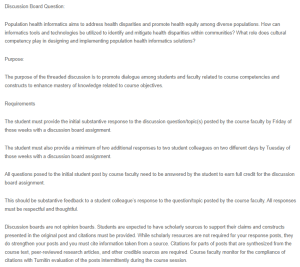
Discussion – Population Health Informatics
Purpose:
The purpose of the threaded discussion is to promote dialogue among students and faculty related to course competencies and constructs to enhance mastery of knowledge related to course objectives.
Requirements
The student must provide the initial substantive response to the discussion question/topic(s) posted by the course faculty by Friday of those weeks with a discussion board assignment.
The student must also provide a minimum of two additional responses to two student colleagues on two different days by Tuesday of those weeks with a discussion board assignment.
All questions posed to the initial student post by course faculty need to be answered by the student to earn full credit for the discussion board assignment.
This should be substantive feedback to a student colleague’s response to the question/topic posted by the course faculty. All responses must be respectful and thoughtful.
Discussion boards are not opinion boards. Students are expected to have scholarly sources to support their claims and constructs presented in the original post and citations must be provided. While scholarly resources are not required for your response posts, they do strengthen your posts and you must cite information taken from a source. Citations for parts of posts that are synthesized from the course text, peer-reviewed research articles, and other credible sources are required. Course faculty monitor for the compliance of citations with Turnitin evaluation of the posts intermittently during the course session.
 Complete the order form and upload all of your files, including any instructions, rubrics, or other materials provided by your instructor.
  Complete the order payment after filling in the order form. We’ll receive your order and assign it to a writer.
 The assigned writer will complete your paper and forward it to our Editing Team for review and approval.
 Once approved by the editor, the completed paper will be uploaded to your account for you to download, review and approve.