
Discussion: Existential Questions and Post-Traumatic Growth
My field placement experience at IHSS in San Joaquin County involved working with a middle-aged client who had a history of years spent being subjected to domestic abuse and thus was permanently physically disabled and emotionally scarred. Regardless of her plight, she demonstrated strength to carry on in living a self-sufficient life and supporting her adult child with intellectual disability. Her hardiness and firmness evoked an existential question, which I quietly wrestled with: Why do people who try so hard to live good lives often endure so much pain?
The client has the potential to forge her new sense of identity through her trauma, where she identifies her power in overcoming abuse and maintaining her caregiving role. With trauma-informed care, she might be able to reorient her self-worth away from the perspective of a victim, but as an ambitious and strong woman. The client’s healing can also be assisted by mindfulness-based practices that enable her to remain in the present instead of being consumed by fear of the past (Franklin & Jordan, 2024). As she processes her trauma, she can learn to understand better empathy, patience, and appreciation of small winnings.
Listening to the client’s story as a social worker is a challenging task that has made me confront assumptions about justice, safety, and suffering. By being a witness to her trauma, I was able to grow in emotional capacity and become a more vigorous advocate of trauma-informed practice. Spiritual meaning was also found in the discovery that healing is a non-linear process and that post-traumatic growth can be discovered in places one least expects (Vis & Marie Boynton, 2008).
I may experience challenges when a client attributes their trauma to divine punishment, while I believe suffering is not always spiritually caused. This characteristic difference may cause conflict as I attempt to legitimize their meaning without trying to enforce mine. Cultural humility will be required to balance the values and beliefs that hold respect for their values and my own beliefs.
References
Franklin, C., & Jordan, C. (Eds.). (2024). Turner’s social work treatment: Interlocking theoretical approaches (7th ed.). Oxford University Press. https://mbsdirect.vitalsource.com/books/9780197678046
Vis, J., & Boynton, H. M. (2008). Spirituality and transcendent meaning making: Possibilities for enhancing posttraumatic growth. Journal of Religion & Spirituality in Social Work Social Thought, 27(1–2), 69–86. https://doi.org/10.1080/15426430802113814
ORDER A PLAGIARISM-FREE PAPER HERE
We’ll write everything from scratch
Question 
Discussion: Existential Questions and Post-Traumatic Growth
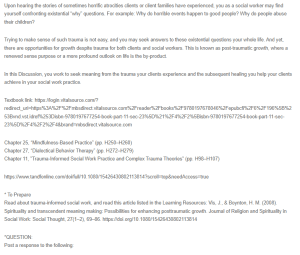
Upon hearing the stories of sometimes horrific atrocities clients or client families have experienced, you as a social worker may find yourself confronting existential “why” questions. For example: Why do horrible events happen to good people? Why do people abuse their children?
Discussion – Existential Questions and Post-Traumatic Growth
Trying to make sense of such trauma is not easy, and you may seek answers to these existential questions your whole life. And yet, there are opportunities for growth despite trauma for both clients and social workers. This is known as post-traumatic growth, where a renewed sense purpose or a more profound outlook on life is the by-product.
In this Discussion, you work to seek meaning from the trauma your clients experience and the subsequent healing you help your clients achieve in your social work practice.
Textbook link: https://login.vitalsource.com/?redirect_uri=https%3A%2F%2Fmbsdirect.vitalsource.com%2Freader%2Fbooks%2F9780197678046%2Fepubcfi%2F6%2F196%5B%253Bvnd.vst.idref%253Disbn-9780197677254-book-part-11-sec-23%5D%21%2F4%2F2%5Bisbn-9780197677254-book-part-11-sec-23%5D%2F4%2F2%2F4&brand=mbsdirect.vitalsource.com
Chapter 25, “Mindfulness-Based Practice” (pp. H250–H260)
Chapter 27, “Dialectical Behavior Therapy” (pp. H272–H279)
Chapter 11, “Trauma-Informed Social Work Practice and Complex Trauma Theories” (pp. H98–H107)
https://www.tandfonline.com/doi/full/10.1080/15426430802113814?scroll=top&needAccess=true
* To Prepare
Read about trauma-informed social work, and read this article listed in the Learning Resources: Vis, J., & Boynton, H. M. (2008). Spirituality and transcendent meaning making: Possibilities for enhancing posttraumatic growth. Journal of Religion and Spirituality in Social Work: Social Thought, 27(1–2), 69–86. https://doi.org/10.1080/15426430802113814
*QUESTION:
Post a response to the following:
In 1 sentence, identify an existential question with which you have grappled in relation to a client who has been traumatized.
Reflect on your fieldwork, or perhaps identify an existential question that might arise in working with the client in the case study you have selected throughout the course.
In 3–4 brief sentences, describe where there is potential for growth for the client as a result of the trauma.
In 3–4 brief sentences, explain where there is potential for growth for you, the social worker, as a result of listening to the client’s stories and bearing witness to their trauma.
Describe any challenges you may experience between the meaning you hold based on your personal beliefs and working within the client’s potentially different belief framework.
 Complete the order form and upload all of your files, including any instructions, rubrics, or other materials provided by your instructor.
  Complete the order payment after filling in the order form. We’ll receive your order and assign it to a writer.
 The assigned writer will complete your paper and forward it to our Editing Team for review and approval.
 Once approved by the editor, the completed paper will be uploaded to your account for you to download, review and approve.