
Discussion: Employee Performance Evaluation
The essential element of human resource management is performance evaluation. Notably, this is because it can affect the motivation of the employees, the pay, the career growth, and the organization’s success (Alsafadi & Altahat, 2021). Performance evaluations are a litigious arena in which it is hard to create and administer without the careful balancing act of legal compliance, ethical integrity, and the subjectivity of human response to feedback. Companies need to establish performance management mechanisms that are not only legal in employment as set out by laws but also lead to trust, fairness, and openness. This paper discusses the legal regulations that managers need to take into consideration during performance appraisal, steps to avoid discrimination, ethics to follow in rewarding performance, and the methods to overcome employee dissatisfaction with their evaluation.
What laws should be considered when conducting a performance evaluation?
Civil Rights Act of 1964 (Title VII)
This act forbids discrimination in employment due to race, color, religion, sex, or national origin. Managers must ensure that performance appraisals are objective and consistent, without discrimination.
Age Discrimination in Employment Act (ADEA)
Under this act, employees who are 40 years and above should not be discriminated against based on their age. Managers should not be prejudiced in thinking that older workers are less adaptable to technological changes or less innovative than younger workers.
Equal Pay Act (EPA)
Assessment should not be impacted by assumptions based on gender that may contribute to a lack of fairness in wages or promotion. Performance review is also critical in justifying the compensation differences, and in fact, biased performance evaluations may lead to an EPA violation.
Fair Labor Standards Act (FLSA)
The FLSA plays an important role in the form of fair treatment of wages and hours. It also focuses on the compensation practices. The performance appraisals associated with the pay-for-performance systems should be open and in line with wage policies.
International Standards
Global organizations should not overlook worldwide standards. Such a regulation is, for example, the European Union General Data Protection Regulation (GDPR), regulating the collection, storage, and distribution of employee data (including performance records). Employers must adopt transparency and data privacy within the performance evaluation operating procedures.
When conducting performance evaluations, what can managers do to prevent discrimination?
Discrimination can happen even when laws are in place, since it is based on assumptions and poor managerial skills. As such, managers have an important role to play in ensuring fairness.
Application of Objective Criteria
Evaluations should be made based on objective and job-related performance measures, such as the completion of project deadlines, sales targets, or quality standards. Subjective measures are linked with the inclination to subjective judgments.
Manager Training
Managers should be trained to identify and combat unconscious bias. For example, managers tend to evaluate employees who are more like them at an above-average level without realizing it (Hartley, 2025). These tendencies can be avoided or prevented with the help of training
Standardized Evaluation Forms
This approach involves using structured forms and rating scales to check consistency among employees. Having a common framework or language among all managers will limit subjectivity and make performance evaluations more objective and thus fair.
Regular Performance Conversations
Performing the evaluation only once a year is more prone to bias following recent events. On the other hand, ongoing performance discussions all year allow managers to give feedback as it happens and eliminate “recency bias.”
Documentation
Managers ought to write down the performance-related behaviors and performance outcomes. By writing down the evidence, one avoids being biased and relying on memory or impressions, which can be biased.
What ethical principles should be considered when rewarding employee performance?
Rewarding employee performance requires more ethical considerations than being able to satisfy the legal aspects of such a reward. Employees tend to remain active when they feel that the reward system is just and in line with the organizational needs. Fairness and equity should always be maintained. Ethical management of performance requires that rewards not be given out based on favoritism but on merit. There should be fairness regarding recognition and the rewards offered to employees who perform the same work. Another ethical principle to consider is communication, as employees must know how they will be evaluated and how measurement equates to rewards (Elsafty & Oraby, 2022). Notably, mistrust and unfair treatment may result from a lack of transparency. Lastly, there should be recognition above and beyond money. There is a need for reward systems that recognize employees in terms of their career development and flexible work arrangements.
As a manager, what would you do if an employee disagreed with their performance review?
There is always the possibility that the notions of some employees may differ from their appraisal. How managers deal with these situations may significantly influence morale and engagement levels. As a manager, I would give the employees a platform to voice their points of view. With an open and respectful dialogue, the employees will feel heard even when the rating is unaffected. Further, managers should provide documented evidence to support their evaluations and prove objectivity. Lastly, the manager can focus on development opportunities for employees. Essentially, this can offer the employee a chance to improve their performance.
Conclusion
Performance evaluation is one of the most important tools in employee development and fair pay decisions, and is inevitable for organizational success. It must be done with great sensitivity to being lawful, ethical, and human responsive. By considering legal, ethical, and human factors, the organizations can regulate the performance management systems in a way that is fair, motivating, and effective in generating long-term value.
References
Alsafadi, Y., & Altahat, S. (2021). Human Resource management practices and employee performance: The role of job satisfaction. Journal of Asian Finance Economics and Business, 8(1), 519–529. https://doi.org/10.13106/jafeb.2021.vol8.no1.519
Elsafty, A., & Oraby, M. (2022). The impact of training on employee retention: An empirical research on the private sector in Egypt. International Journal of Business and Management, 17(5), 58. https://doi.org/10.5539/ijbm.v17n5p58
Hartley, J. (2025). Public aspects of public manager training, education and development. Public Money & Management, 45(2), 111–118. https://doi.org/10.1080/09540962.2024.2398132
ORDER A PLAGIARISM-FREE PAPER HERE
We’ll write everything from scratch
Question 
Description
Assignment Details
There is a delicate balance between legal requirements, ethical responsibilities, and human reactions’ effect on employee evaluation and feedback. Organizations need to design performance systems that are both legally compliant and perceived as fair by employees. By ensuring fair and ethical employee evaluations, the performance management system can effectively motivate employees and support performance throughout the organization. A fair and ethical performance management system provides managers with a good foundation for performance discussions with employees.
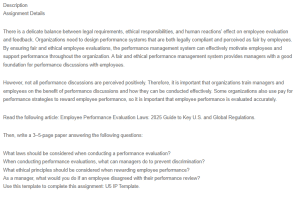
Discussion – Employee Performance Evaluation
However, not all performance discussions are perceived positively. Therefore, it is important that organizations train managers and employees on the benefit of performance discussions and how they can be conducted effectively. Some organizations also use pay for performance strategies to reward employee performance, so it is important that employee performance is evaluated accurately.
Read the following article: Employee Performance Evaluation Laws: 2025 Guide to Key U.S. and Global Regulations.
Then, write a 3–5-page paper answering the following questions:
What laws should be considered when conducting a performance evaluation?
When conducting performance evaluations, what can managers do to prevent discrimination?
What ethical principles should be considered when rewarding employee performance?
As a manager, what would you do if an employee disagreed with their performance review?
Use this template to complete this assignment: U5 IP Template.
 Complete the order form and upload all of your files, including any instructions, rubrics, or other materials provided by your instructor.
  Complete the order payment after filling in the order form. We’ll receive your order and assign it to a writer.
 The assigned writer will complete your paper and forward it to our Editing Team for review and approval.
 Once approved by the editor, the completed paper will be uploaded to your account for you to download, review and approve.