
Discussion – Economic Systems and Global Interdependence
Question 1: State Ownership vs. Private Ownership
State-owned economies differ significantly from privately owned economies, where governments control the industry, as opposed to individuals or other organizations owning the businesses (Pevehouse & Goldstein, 2021). State ownership still exists in Cuba and North Korea, as well as in countries with mixed economies that balance private ownership with state ownership. Consistently, Eastern Europe, following the collapse of the Soviet Union, serves as an example of transitional economies where the state does not exert complete control and has since shifted to privatized systems.
Subsequently, while State ownership guarantees basic services and stability, reducing disparity, this type of ownership has some cons, including the costs of inefficiency, over-regulation, and the misallocation of resources. On the other hand, private ownership is advantageous as it fosters innovation, encourages economic growth, and promotes efficiency alongside increased industry competition. Nonetheless, it can lead to unequal wealth distribution, social unrest, and a business that favors consumer profits over its services.
Question 2: Interdependence in World Trade
Interdependence in world trade refers to the mutual reliance between countries on products, services, and technologies (Pevehouse & Goldstein, 2021). The use of comparative benefits by other countries helps improve economic productivity and growth. For example, Taiwan and South Korea provide the world with microchips, which are essential for running the technology industry. Similarly, interdependence in trade is evident in Russia’s supply of energy to Europe and North America’s supply of grains to the Middle East. It is important to note that institutions like the World Trade Organization (WTO) play a significant role in the regulation of trade relationships and ensuring inequalities within the interconnected global system are addressed.
Undeniably, the disadvantages associated with these interdependent trade practices are often overlooked. For example, a sudden supply chain failure or political unrest in a region can undermine a country’s well-being. Additionally, the world’s interconnectedness may widen the gap between the developed and developing countries, as wealthy and developed nations may exploit the labor or resources of poorer developing nations. However, trust among nations opens up opportunities for the international business world. To optimally utilize resources worldwide, establishing a sustainable global agenda is crucial. Balanced global trading can be facilitated through fortified supply chains, fairer legal frameworks, and the willingness of states.
References
Pevehouse, J. C. W., & Goldstein, J. S. (2021). International relations, Brief edition (8th ed.). Pearson.
ORDER A PLAGIARISM-FREE PAPER HERE
We’ll write everything from scratch
Question 
Discussion – Economic Systems and Global Interdependence
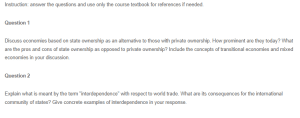
Instruction: answer the questions and use only the course textbook for references if needed.
Question 1
Economic Systems and Global Interdependence
Discuss economies based on state ownership as an alternative to those with private ownership. How prominent are they today? What are the pros and cons of state ownership as opposed to private ownership? Include the concepts of transitional economies and mixed economies in your discussion.
Question 2
Explain what is meant by the term “interdependence” with respect to world trade. What are its consequences for the international community of states? Give concrete examples of interdependence in your response.
 Complete the order form and upload all of your files, including any instructions, rubrics, or other materials provided by your instructor.
  Complete the order payment after filling in the order form. We’ll receive your order and assign it to a writer.
 The assigned writer will complete your paper and forward it to our Editing Team for review and approval.
 Once approved by the editor, the completed paper will be uploaded to your account for you to download, review and approve.