
Discussion: Developing Leader Innovation Skills
The “Leading Yourself” Competency and Self-Care Activity
Leading oneself is one of the leadership competencies since it guarantees that leaders are grounded, balanced, and resilient as they lead others. Weberg and Davidson (2021) assert that “leading yourself” entails developing energy, reflection, and renewal to prevent burnout and maintain effectiveness. My process for addressing this competency will start with regular self-reflection through journaling and feedback to align professional duties with strengths, values, and goals. Additionally, I will integrate mindfulness interventions such as meditation and deep breathing to foster self-awareness and self-regulation (Schuman-Olivier et al., 2020).
My small, manageable self-care goal for the next seven weeks is to practice conscious breathing exercises for ten minutes every morning. Practicing this daily will allow me to start each day with tranquility, improve my focus, and enhance my ability to prioritize well-being and lead effectively.
My Role as a Visionary Leader
In my upcoming career as a nurse leader, I will make a point to demonstrate the seven characteristics of visionary leadership outlined by Nzinga et al. (2021). In order to practice boundary spanning, I will participate in cross-functional workshops that facilitate interaction beyond nursing. Risk-taking will be demonstrated by encouraging staff to pilot evidence-based initiatives toward improved patient outcomes. Through visioning, I will impart a compelling departmental mission to capture the alignment of organizational goals. I will learn to seize opportunities by leveraging nurse-led innovations such as workflow enhancements that maximize efficiency. Adaptation will entail promoting a growth mindset culture where challenges are seen as opportunities for learning. For information flow coordination, I will promote a culture of transparency through shared decision-making and open communication. Lastly, I will practice facilitation by promoting creativity and teamwork, making employees feel valued to assist with problem-solving as well as innovation (Ellison, 2025).
Leadership Laboratory
Mackoff’s (2023) boundary clarity example story, in which a manager refused to give out personal phone numbers to employees, resonates with me as it emphasizes the necessity of keeping the personal and professional lives separate. Creating these boundaries protects against overdependence and helps to train staff to become more self-sufficient in solving problems. My lesson is that great leaders have to demonstrate the culture of values, time, and excellence, not just the time of leaders, but also the time in their teams. I will encourage accountability, balance, and healthier workplaces in my leadership by maintaining professional boundaries in building trustful relationships.
References
Ellison, R. (2025). Umiker’s management skills for the new health care supervisor (8th ed.). Jones and Bartlett.
Mackoff, B. (2023). Leadership laboratory for nurse leaders. Cognella.
Nzinga, J., Boga, M., Kagwanja, N., Waithaka, D., Barasa, E., Tsofa, B., Gilson, L., & Molyneux, S. (2021). An innovative leadership development initiative to support building everyday resilience in health systems. Health Policy and Planning, 36(7), 1023–1035. https://doi.org/10.1093/heapol/czab056
Schuman-Olivier, Z., Trombka, M., Lovas, D. A., Brewer, J. A., Vago, D. R., Gawande, R., Dunne, J. P., Lazar, S. W., Loucks, E. B., & Fulwiler, C. (2020). Mindfulness and behavior change. Harvard Review of Psychiatry, 28(6), 371–394. https://doi.org/10.1097/HRP.0000000000000277
Weberg, D., & Davidson, S. (2021). Leadership for evidence-based innovation in nursing and health professions (2nd ed.). Jones and Bartlett.
ORDER A PLAGIARISM-FREE PAPER HERE
We’ll write everything from scratch
Question 
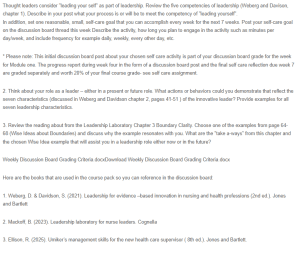
Thought leaders consider “leading your self” as part of leadership. Review the five competencies of leadership (Weberg and Davison, chapter 1). Describe in your post what your process is or will be to meet the competency of “leading yourself”.
In addition, set one reasonable, small, self-care goal that you can accomplish every week for the next 7 weeks. Post your self-care goal on the discussion board thread this week Describe the activity, how long you plan to engage in the activity such as minutes per day/week, and include frequency for example daily, weekly, every other day, etc.
Discussion – Developing Leader Innovation Skills
* Please note: This initial discussion board post about your chosen self care activity is part of your discussion board grade for the week for Module one. The progress report during week four in the form of a discussion board post and the final self care reflection due week 7 are graded separately and worth 20% of your final course grade- see self care assignment.
2. Think about your role as a leader – either in a present or future role. What actions or behaviors could you demonstrate that reflect the seven characteristics (discussed in Weberg and Davidson chapter 2, pages 41-51 ) of the innovative leader? Provide examples for all seven leadership characteristics.
3. Review the reading about from the Leadership Laboratory Chapter 3 Boundary Clarity. Choose one of the examples from page 64- 68 (Wise Ideas about Boundaries) and discuss why the example resonates with you. What are the “take a-ways” from this chapter and the chosen Wise Idea example that will assist you in a leadership role either now or in the future?
Weekly Discussion Board Grading Criteria.docxDownload Weekly Discussion Board Grading Criteria.docx
Here are the books that are used in the course pack so you can reference in the discussion board:
1. Weberg, D. & Davidson, S. (2021). Leadership for evidence –based innovation in nursing and health professions (2nd ed.). Jones and Bartlett
2. Mackoff, B. (2023). Leadership laboratory for nurse leaders. Cognella
3. Ellison, R. (2025). Umiker’s management skills for the new health care supervisor ( 8th ed.). Jones and Bartlett.
 Complete the order form and upload all of your files, including any instructions, rubrics, or other materials provided by your instructor.
  Complete the order payment after filling in the order form. We’ll receive your order and assign it to a writer.
 The assigned writer will complete your paper and forward it to our Editing Team for review and approval.
 Once approved by the editor, the completed paper will be uploaded to your account for you to download, review and approve.