
Discussion and Response: Native American Songs
Question 1 Discussion
Native American songs emphasize non-isometric rhythms, aligning with natural speech or ceremonial flow rather than strict meter, and feature repetitive melodic phrases with vocables to convey emotion or mimic nature. Storytelling is central, preserving history, moral lessons, and spiritual traditions through oral transmission (Connect4Education, 2018). Traditional tribal music is intrinsically tied to specific communities, using distinct languages, instruments, and ceremonial contexts. For example, Hopi Kachina songs for agricultural rituals employ tribe-specific vocables and percussion, reinforcing cultural identity and ancestral continuity (Connect4Education, 2018). In contrast, inter-tribal music adapts accessible elements like Plains-style drumming and group call-response singing to foster pan-Indigenous unity. Genres like the Round Dance simplify structures to enable cross-tribal participation while respecting diverse identities.
Reference
Connect4Education. (2018). OnMusic of the world (3rd ed.). Connect For Education, Inc. https://store.connect4education.com/product/onmusic-of-the-world-3rd-edition/
Peer Responses
Reply to Person 1
Hello,
Great work with your post. You have successfully pointed out the non-isometric nature of rhythms and the storytelling nature of Native American songs. I agree that repetition aids oral transmission, as seen in Navajo “Enemyway” healing chants, where cyclical phrases reinforce ceremonial narratives. Your difference between tribal and inter- tribal music is evident. Recent research shows that inter-tribal genres such as the Round Dance are specifically designed to simplify melodic patterns to increase access among various populations (Connect4Education, 2018). This strategic transformation helps make the argument about mutual involvement without harming the essential cultural roles. These innovations show the relevance of musical evolution in meeting the modern needs of Indigenous communities without destroying the traditional foundations.
Reference
Connect4Education. (2018). OnMusic of the world (3rd ed.). Connect For Education, Inc. https://store.connect4education.com/product/onmusic-of-the-world-3rd-edition/
Reply to Person 2
Hello,
This is a great post. Your focus on the rhythmical intricacy of Northwest Coast customs is interesting. The deliberate replacement of tempo between singers and drums produces elaborate polyrhythms of ceremonial purposefulness. I agree that traditional music is the foundation of culture, as it is evident in Hopi kachina songs, which have a certain relationship to agricultural rituals. As far as inter-tribal music is concerned, modern research proves that the use of such instruments as water drums is a symbol of pan-Indigenous unity. The contemporary powwows are a good example of such an integration of local components into group activities; plains-style drumming circles accompany intertribal dances, and different communities can celebrate their common heritage and represent individual identities. Such a musical conversation enhances cultural resilience (Connect4Education, 2018).
Reference
Connect4Education. (2018). OnMusic of the world (3rd ed.). Connect For Education, Inc. https://store.connect4education.com/product/onmusic-of-the-world-3rd-edition/
ORDER A PLAGIARISM-FREE PAPER HERE
We’ll write everything from scratch
Question 
Discussion and Response: Native American Songs
Question 1
- What are the characteristics of Native American songs in terms of meter, phrasing, story-telling, etc.?
- What are the main differences between traditional tribal music and inter-tribal music?
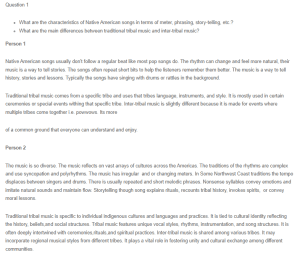
Discussion and Response – Native American Songs
Person 1
Native American songs usually don’t follow a regular beat like most pop songs do. The rhythm can change and feel more natural, their music is a way to tell stories. The songs often repeat short bits to help the listeners remember them better. The music is a way to tell history, stories and lessons. Typically the songs have singing with drums or rattles in the background.
Traditional tribal music comes from a specific tribe and uses that tribes language, instruments, and style. It is mostly used in certain ceremonies or special events withing that specific tribe. Inter-tribal music is slightly different because it is made for events where multiple tribes come together i.e. powwows. Its more
of a common ground that everyone can understand and enjoy.
Person 2
The music is so diverse. The music reflects on vast arrays of cultures across the Americas. The traditions of the rhythms are complex and use syncopation and polyrhythms. The music has irregular and or changing meters. In Some Northwest Coast traditions the tempo displaces between singers and drums. There is usually repeated and short melodic phrases. Nonsense syllables convey emotions and imitate natural sounds and maintain flow. Storytelling though song explains rituals, recounts tribal history, invokes spirits, or convey moral lessons.
Traditional tribal music is specific to individual indigenous cultures and languages and practices. It is tied to cultural identity reflecting the history, beliefs,and social structures. Tribal music features unique vocal styles, rhythms, instrumentation, and song structures. It is often deeply intertwined with ceremonies,rituals,and spiritual practices. Inter-tribal music is shared among various tribes. It may incorporate regional musical styles from different tribes. It plays a vital role in fostering unity and cultural exchange among different communities.
 Complete the order form and upload all of your files, including any instructions, rubrics, or other materials provided by your instructor.
  Complete the order payment after filling in the order form. We’ll receive your order and assign it to a writer.
 The assigned writer will complete your paper and forward it to our Editing Team for review and approval.
 Once approved by the editor, the completed paper will be uploaded to your account for you to download, review and approve.