
Disaster Recovery Plan
Hello, and welcome to this disaster recovery presentation. I hope you will learn about my disaster recovery plan. This presentation will develop a disaster recovery plan for the provided Vila Health community to reduce health disparities and elevate access to care.
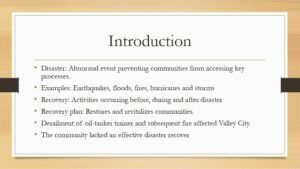
A disaster is any regular activity that prevents individuals from accessing key processes. Recovery is a set of activities that happen before, during, and after the disaster. Disaster commonly co-occurs with emergency response activities. The disaster recovery plan aims to restore and revitalize communities impacted by a disaster (Finucane et al., 2020). Natural disasters include hurricanes, storms, lightning, air crashes, floods, fires, and earthquakes. One community affected by a disaster is the Villa Health community, which was affected by a derailed oil tanker trained. The community did not have the necessary measures to respond to such a disaster. After conversing with community and hospital officials, their disaster recovery plan should be updated.
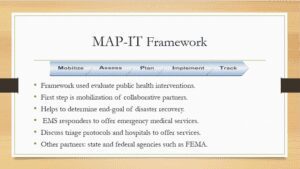
Map-IT framework from the Healthy People 2020 is a framework that can be used in the planning and evaluation of public health programs, including disaster recovery. The first step in this framework is mobilizing collaborative partners (Buns et al., 2017). This step helps to determine the end objective of the recovery plan. In the case of Valley City, a derailed oil tanker caused an explosion and fire. The first step should be collaborating with local EMS responders to formulate a plan to reach and offer emergency services to individuals affected by the fire and those needing medical attention. This collaborative process should discuss triage protocols and the hospitals to receive critical patients. Furthermore, a search and rescue team should be in place to look for individuals who cannot be traced. Other partners will be state and federal government agencies, such as FEMA, who can offer additional help.

The second step is to assess community needs and resources. This will help determine real needs and give a reality check on what can be achieved (Buns et al., 2017). This will address individuals affected by the disaster, available resources, and resources needed. The collaborative partners will work to set priorities and allocate resources to meet these priorities. Community leaders include EMS supervisors, senior hospital management, utility company leaders, and elected officials. The Villa Health community is diverse with unique needs. There is a high number of older adults living in nursing homes. These persons will require medicines for their chronic conditions. The community also has a higher number of low-income uninsured individuals. Many homeless individuals will also require shelter in case of a disaster as fire erupts.

The third step is the planning phase. This will involve developing an action plan with definitive steps and plans (Buns et al., 2017). In this phase, the vision of the recovery plan and clear goals will be set to help achieve the plan. The objectives should be specific to the needs of the Villa Health community and address the recovery plan’s goal. This will include what is required to achieve the goals and ways of measuring progress to determine if the goal has been achieved. The action plan will include action steps such as EMS responding in case of an explosion and how to triage. All members of the rescue team will be assigned responsibility. In addition, it will show how to collect information and a feasible timeline for the recovery plan. The objectives will be clear and realistic. A target should also be set. The action plan should indicate individuals responsible for each step with defined roles. A command center will be developed, and it will have EMS responders. The command center will be responsible for mobilizing first-time responders. Vulnerable areas such as nursing homes will have first-time responders. Proper triage training should be done, and hospitals should be on standby to receive fire victims.

The fourth step is implementing strategies and steps identified in the action plan by the coalition team (Buns et al., 2017). The coalition team should collaborate to complete their assigned tasks in the determined timeline. It is also vital to monitor and routinely track the action plan events. There should be weekly reports on the number of patients treated for burns and monitoring to see if this has been achieved. Appropriate indicators for the monitoring stage should be identified. New partners and team members should be looked for, bringing in new energy and fresh ideas. Regular partners should also be periodically checked to see their progress. Effective communication is critical in the implementation stage. This step should also involve publicizing the recovery plan by organizing community meetings to update on progress.
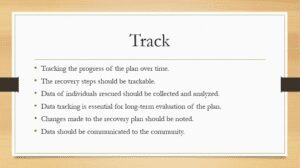
The final step in the MAP-IT framework is to track the plan’s progress over time (Buns et al., 2017). In a fire situation, the recovery steps must be organized and be trackable. The search and rescue teams should be in groups to look for any survivors. The data of individuals rescued should be analyzed and reported. The extent of how the plan was followed and any changes made to the recovery plan should also be noted. Data tracking is essential in evaluating the long-term success of the recovery plan. Data collection efforts should be regularly made. The data should be shared with the community.
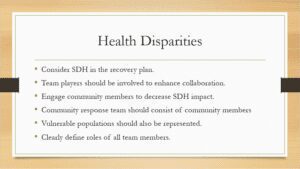
During the assessment step, the collaborative team must consider the social determinants that impact the recovery process. Social determinants of health must be recognized to ensure a quality healthcare service (Islam, 2019). The collaborative team must thus consider the social determinants to ensure no disparities during the recovery plan. This will involve collaborating with informational resources and social services. All the team players should be in the same room to facilitate effective communication. This will enhance collaboration and the pooling of ideas to implement an effective recovery plan (Whittington et al., 2020). Engaging community members will decrease the impact of social inequalities. A community response team composed of the residents of the Villa Health community will be formed. To ensure the effective collaboration of community members, the training courses on disaster response will be affordable and accessible to all. The training center will be central and accessed by people with disabilities. Translators will also be available, and training time will accommodate everyone. Finally, a representative of a member of the vulnerable persons will also be part of the recovery team. Another way of ensuring collaboration is by clearly defining roles to ensure all team members feel like part of the team.
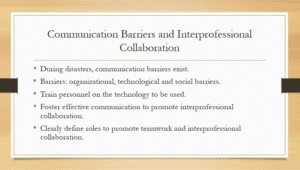
During disasters such as fire, communication barriers exist. It is essential to overcome these barriers. Information should be distributed promptly to prevent panic. There may be three types of communication barriers during a disaster. Social barriers result from differences in perceptions among individuals in the crisis response. The second barriers are technological barriers that result from technology use during disaster management. The final barriers are organization barriers, which may arise from disagreements between the different organizations in crisis management. Technology is critical in disaster management since it promotes effective communication. This barrier can be overcome by training the personnel on the technology used. In addition to this, backup non-technological tools such as radios should be used. Effective communication should also be fostered to promote teamwork among the different players (Whittington et al., 2020). Team members should also have defined roles to foster interprofessional collaboration.
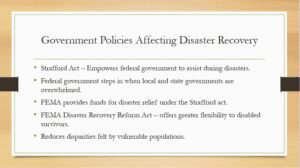
Health and government can affect disaster recovery plans significantly. One such policy is the Strafford Act, which empowers the federal government to assist states during significant emergencies and disasters (Katz et al., 2017). The assistance under this act is provided when combined local and state responses cannot mitigate the disaster. Federal Emergency Management Agency (FEMA) coordinates disaster relief resources. It avails billions of funds after the president has declared an emergency under this act. These funds help individuals with immediate financial assistance and disaster-related needs (Katz et al., 2017). Another policy is the FEMA Disaster Recovery Reform Act, which offers greater flexibility to disabled disaster survivors. This helps minimize disparities felt by vulnerable populations (Schroeder, 2019). This act increases the funds availed to individuals and families affected by disasters.
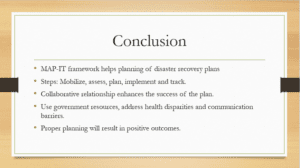
In conclusion, the MAP-IT framework should be used to plan disaster recovery plans effectively. This framework involves coordinating partners, assessing community needs, planning, implementing, and tracking the plan’s progress. A collaborative relationship between the Villa Health community and the collaborative team can help improve the achievement of the plan. A good recovery plan uses government resources and addresses community resources, communication barriers, and health disparities. Proper planning will result in positive results.
Buns, M. T., Pettitt, C., & Blanton, J. (2017). Using the MAP-IT framework for implementing a homeschool physical education program at a University campus. International Journal of Sports and Physical Education, 3(2). https://doi.org/10.20431/2454-6380.0302003
Finucane, M. L., Acosta, J., Wicker, A., & Whipkey, K. (2020). Short-term solutions to a long-term challenge: Rethinking disaster recovery planning to reduce vulnerabilities and inequities. International Journal of Environmental Research and Public Health, 17(2), 482. https://doi.org/10.3390/ijerph17020482
Islam, M. M. (2019). Social determinants of health and related inequalities: Confusion and implications. Frontiers in Public Health, 7. https://doi.org/10.3389/fpubh.2019.00011
Katz, R., Attal-Juncqua, A., & Fischer, J. E. (2017). Funding public health emergency preparedness in the United States. American Journal of Public Health, 107(S2), S148-S152. https://doi.org/10.2105/ajph.2017.303956
Schroeder, S. C. (2019). Does America’s new disaster relief law provide the relief America needs? | Published in Houston Law Review. Houston Law Review. https://houstonlawreview.org/article/10023-does-america-s-new-disaster-relief-law-provide-the-relief-america-needs
Whittington, K. D., Walker, J., & Hirsch, B. (2020). Promoting interdisciplinary communication as a vital function of effective teamwork to positively impact patient outcomes, satisfaction, and employee engagement. Journal of Medical Imaging and Radiation Sciences, 51(4), S107-S111. https://doi.org/10.1016/j.jmir.2020.07.002
ORDER A PLAGIARISM-FREE PAPER HERE
We’ll write everything from scratch
Question 
Develop a disaster recovery plan to lessen health disparities and improve access to community services after a disaster. Then, develop and record a 10-12 slide presentation (please refer to the PowerPoint tutorial) of the plan with audio and speaker notes for the Vila Health system, city officials, and the disaster relief team.
Disaster Recovery Plan
As you prepare this assessment, you are encouraged to complete the Disaster Preparedness and Management activity. The information gained from completing this activity will help you succeed with the assessment as you consider critical disaster preparedness and management issues in the community or workplace. Completing activities is also a way to demonstrate engagement.
Professional Context
Nurses perform a variety of roles, and their responsibilities as healthcare providers extend to the community. The daily decisions and crises often involve balancing human rights with medical necessities, equitable access to services, legal and ethical mandates, and financial constraints. In the event of a major accident or natural disaster, many issues can complicate decisions concerning the needs of an individual or group, including understanding and upholding rights and desires, mediating conflict, and applying established ethical and legal standards of nursing care. As a nurse, you must be knowledgeable about disaster preparedness and recovery to safeguard those in your care. As an advocate, you are accountable for promoting equitable services and quality care for the diverse community.
Nurses work alongside first responders, other professionals, volunteers, and the health department to safeguard the community. Some concerns during a disaster and recovery period include the possibility of death and infectious disease due to debris and contamination of the water, air, food supply, or environment. Various degrees of injury may also occur during disasters, terrorism, and violent conflicts.
First responders must use a triage system to assign victims according to their condition/prognosis severity to maximize survival, allocatee equitable resource,s, and provide treatment. During infectious disease outbreaks, triage does not replace routine clinical triage.
Trace mapping becomes essential in interrupting the spread of infectious diseases to prevent or curtail morbidity and mortality in the community. A vital step in trace-mapping is identifying the infectious individual or group and isolating or quarantining them. During the trace-mapping process, these individuals are interviewed to identify those who have had close contact with them. Contacts are notified of their potential exposure, testing referrals become paramount, and individuals are connected with appropriate services they might need during self-quarantine (CDC, 2020).
An example of such a disaster is the COVID-19 pandemic of 2020. People who had contact with someone who was in contact with the COVID-19 virus were encouraged to stay home and maintain social distance (at least 6 feet) from others until 14 days after their last exposure to a person with COVID-19. Contacts were required to monitor themselves by checking their temperature twice daily and watching for symptoms of COVID-19 (CDC, 2020). Local, state, and health department guidelines were essential in establishing the recovery phase. Triage Standard Operating Procedure (SOP) in the case of COVID-19 focused on inpatient and outpatient healthcare facilities that would receive or prepare to receive suspected or confirmed COVID-19 victims. Controlling droplet transmission through hand washing, social distancing, self-quarantine, PPE, installing barriers, education, and standardized triage algorithms/questionnaires became essential to the triage system (CDC, 2020; WHO, 2020).
This assessment allows you to apply the concepts of emergency preparedness, public health assessment, triage, management, and surveillance after a disaster. Based on the disaster scenario provided, you will also focus on evacuation, extended displacement periods, and contact tracing.
Demonstration of Proficiency
By completing this assessment, you will demonstrate your proficiency in the following course competencies and assessment criteria:
Competency 1: Analyze health risks and health care needs among distinct populations.
Describe the determinants of health and the cultural, social, and economic barriers that impact a community’s safety, health, and disaster recovery efforts.
Competency 2: Propose health promotion strategies to improve the health of populations.
Present specific, evidence-based strategies to overcome communication barriers and enhance interprofessional collaboration to improve disaster recovery efforts.
Competency 3: Evaluate health policies based on their ability to achieve desired outcomes.
Explain how health and governmental policy affect disaster recovery efforts.
Competency 4: Integrate principles of social justice in community health interventions.
Explain how a proposed disaster recovery plan will lessen health disparities and improve access to community services.
Competency 5: Apply professional, scholarly communication strategies to lead health promotion and improve population health.
Organize content with clear purpose/goals and relevant and evidence-based sources (published within five years).
Slides are easy to read and error-free. Detailed audio and speaker notes are provided. The audio is clear, organized, and professionally presented.
Note: Complete the assessments in this course in the order in which they are presented.
Preparation
When disaster strikes, community members must be protected. A comprehensive recovery plan, guided by the MAP-IT (Mobilize, Assess, Plan, Implement, Track) framework, is essential to help ensure everyone’s safety. The unique needs of residents must be assessed to lessen health disparities and improve access to equitable services after a disaster. Recovery efforts depend on the appropriateness of the plan, the extent to which key stakeholders have been prepared, the quality of the trace mapping, and the allocation of available resources. In a time of cost containment, when personnel and resources may be limited, the needs of residents must be weighed carefully against available resources.
In this assessment, you are a community task force member responsible for developing a disaster recovery plan for the Vila Health community using MAP-IT and trace mapping, which you will present to city officials and the disaster relief team.
Complete the Vila Health: Disaster Recovery Scenario simulation to prepare for the assessment.
In addition, you are encouraged to complete the Disaster Preparedness and Management activity. The information gained from completing this activity will help you succeed with the assessment as you consider critical disaster preparedness and management issues in the community or workplace. Completing activities is also a way to demonstrate engagement.
Begin thinking about:
Community needs.
Resources, personnel, budget, and community makeup.
People are accountable for the implementation of the disaster recovery plan.
Healthy People 2020 goals and 2030 objectives.
A timeline for the recovery effort.
You may also wish to:
Review the MAP-IT (Mobilize, Assess, Plan, Implement, Track) framework, which you will use to guide the development of your plan:
Mobilize collaborative partners.
Assess community needs.
Plan to lessen health disparities and improve access to services.
Implement a plan to reach Healthy People 2020 goals or 2030 objectives.
Track community progress.
Review the assessment instructions and scoring guide to ensure that you understand the work you will be asked to complete.
Note: Remember that you can submit all or a portion of your draft recovery plan to Smarthinking Tutoring for feedback before you submit the final version of this assessment. If you plan on using this free service, be mindful of the 24-48 hours turnaround time for receiving feedback.
Note: If you require assistive technology or alternative communication methods to participate in this activity, please get in touch with [email protected] to request accommodations.
Instructions
Every ten years, The U.S. Department of Health and Human Services and the Office of Disease Prevention and Health Promotion release information on health indicators, public health issues, and current trends. At the end of 2020, Healthy People 2030 was released to provide information for the next ten years. Healthy People 2030 provides the most updated content for prioritizing public health issues; however, some historical content offers a better understanding of some topics. Disaster preparedness is addressed in Healthy People 2030, but a more robust understanding of MAP-IT, triage, and recovery efforts is found in Healthy People 2020. For this reason, you will find references to Healthy People 2020 and Healthy People 2030 in this course.
Complete the following:
Develop a disaster recovery plan for the Vila Health community to lessen health disparities and improve access to services after a disaster. Refer to the Vila Health: Disaster Recovery Scenario to understand the community.
Assess community needs.
Consider resources, personnel, budget, and community makeup.
Identify the people accountable for implementing the plan and describe their roles.
Focus on specific Healthy People 2020 goals and 2030 objectives.
Include a timeline for the recovery effort.
Apply the MAP-IT (Mobilize, Assess, Plan, Implement, Track) framework to guide the development of your plan:
Mobilize collaborative partners.
Assess community needs.
Use the demographic data and specifics related to the disaster to identify the community’s needs and develop a recovery plan. Consider the entire community’s physical, emotional, cultural, and financial needs.
Include in your plan the equitable allocation of services for the diverse community.
Apply the triage classification to provide a rationale for those who may have been injured during the train derailment. Provide support for your position.
Include in your plan contact tracing of the homeless, disabled, displaced community members, migrant workers, and those who have hearing impairment or English as a second language in the event of severe tornadoes.
Plan to lessen health disparities and improve access to services.
Implement a plan to reach Healthy People 2020 goals and 2030 objectives.
Track and trace-map community progress.
Use the CDC’s Contract Tracing Resources for Health Departments as a template to create your contact tracing.
Describe the plan for contact tracing during the disaster and recovery phase.
Develop a slide presentation of your disaster recovery plan with an audio recording of your Vila Health: Disaster Recovery Scenario assessment for city officials and the disaster relief team. Be sure also to include speaker notes.
Presentation Format and Length
You may use Microsoft PowerPoint (preferred) or other suitable presentation software to create your slides and add your voice-over and speaker notes. If you elect to use an application other than PowerPoint, check with your instructor to avoid potential file compatibility issues.
Be sure that your slide deck includes the following slides:
Title slide.
Recovery plan title.
Your name.
Date.
Course number and title.
References (at the end of your presentation).
Your slide deck should contain 10-12 content slides, title, and reference slides. Use the speaker’s notes section of each slide to develop your talking points and cite your sources as appropriate. Be sure also to include a transcript that matches your recorded voice-over. The transcript can be submitted on a separate Word document. Make sure to review the Microsoft PowerPoint tutorial for directions.
The following resources will help you create and deliver an effective presentation:
Record a Slide Show With Narration and Slide Timings.
This Microsoft article provides steps for recording slide shows in different versions of PowerPoint, including steps for Windows, Mac, and online.
Microsoft Office Software.
This Campus page includes tip sheets and tutorials for Microsoft PowerPoint.
PowerPoint Presentations Library Guide.
This library guide provides links to PowerPoint and other presentation software resources.
SoNHS Professional Presentation Guidelines [PPTX].
This presentation, designed especially for the School of Nursing and Health Sciences, offers valuable tips and links. It is a PowerPoint template that can be used to create a presentation.
Supporting Evidence
Cite at least three credible sources from peer-reviewed journals or professional industry publications within the past five years to support your plan.
Graded Requirements
The requirements outlined below correspond to the grading criteria in the scoring guide, so be sure to address each point:
Describe the determinants of health and the cultural, social, and economic barriers that impact the community’s safety, health, and recovery efforts.
Consider the interrelationships among these factors.
Explain how your proposed disaster recovery plan will lessen health disparities and improve access to community services.
Consider principles of social justice and cultural sensitivity concerning ensuring health equity for individuals, families, and aggregates within the community.
Explain how health and governmental policy impact disaster recovery efforts.
Consider the implications for individuals, families, and aggregates within the community of legislation that includes, but is not limited to, the Americans with Disabilities Act (ADA), the Robert T. Stafford Disaster Relief and Emergency Assistance Act, and the Disaster Recovery Reform Act (DRRA).
Present specific, evidence-based strategies to overcome communication barriers and enhance interprofessional collaboration to improve the disaster recovery effort.
Consider how your proposed strategies will affect disaster relief team members, individuals, families, and aggregates within the community.
Include evidence to support your strategies.
Organize content with clear purpose/goals and relevant and evidence-based sources (published within five years).
Slides are easy to read and error-free. Detailed audio and speaker notes are provided. The audio is clear, organized, and professionally presented.
Develop your presentation with a specific purpose and audience in mind.
Adhere to scholarly and disciplinary writing standards and APA formatting requirements.
 Complete the order form and upload all of your files, including any instructions, rubrics, or other materials provided by your instructor.
  Complete the order payment after filling in the order form. We’ll receive your order and assign it to a writer.
 The assigned writer will complete your paper and forward it to our Editing Team for review and approval.
 Once approved by the editor, the completed paper will be uploaded to your account for you to download, review and approve.