
Developing a Task Group to Address Mental Health Barriers in Downtown Stockton, CA: A Reflection
Dealing with Barriers to Mental Health through Task Group
Creating a task group is an effective way to bring professionals and community stakeholders together to address patient social concerns. Using the needs assessment conducted in Stockton, CA, the main issue centers on the barriers that people experiencing homelessness and poverty face when seeking mental health services. A Community Mental Health Access Task Group (CMHATG) will be formed to address this issue.
Types of Task Groups
Once the task group is formed, its primary role will be to bring together professionals and, most importantly, act as a community-based interagency collaboration group. This group will primarily develop strategies to expand access to essential mental health services and identify the specific barriers that prevent homeless individuals from receiving mental health support (Park et al., 2019). The solution will include having a short-term crisis intervention strategy and implementing long-term policy recommendations.
Recruitment
The recruitment process will involve outreach. In other words, the strategy will be characterized by targeting professionals and organizations currently offering mental health services, community advocacy, and homeless interventions. This team will comprise representatives from San Joaquin County Health and Human Services, the Stockton Medical Center, faith-based organizations, local universities, homeless shelters, and community mental health experts. The recruitment process will involve collaborative meetings and formal invitations (Davidson et al., 2022). Working events can also be used as a recruitment process. The task group can also seek out community members who have experienced homelessness to join the team. This group can give first-hand information on the challenges they face. To motivate participants to participate in the initiative, the recruitment effort will highlight the benefits of their collaboration.
Composition of the Task Group and Scope
The task group will comprise professionals who work directly with low-income populations and homeless individuals. Experts, including mental health practitioners, healthcare professionals, policy advocates, social workers, and nonprofit leaders, should also be part of the task group (Davidson et al., 2022). The group will focus primarily on the needs of the locals in downtown Stockton. By focusing on the local community, the task group will be able to tailor interventions that are specifically designed for the community in this area, with a primary focus on the homeless population (Park et al., 2019). This team will work in collaboration with local service providers to ensure better access to healthcare.
Purpose and Addressed Needs
The core objective of this team is to minimize barriers to healthcare access among homeless and low-income individuals. The primary barriers the group will focus on are stigma, a lack of immediate care, and a lack of transportation. The team may also consider streamlining healthcare services to ensure availability is a reality. They will ensure long-term mental health support. Additionally, this group is expected to reduce bureaucracy and lengthy intake processes.
Desired Outcomes
The desired outcomes will include increased access to healthcare services, enhanced public awareness, and increased collaboration. Other outcomes are policy advocacy, continuous community involvement and crisis intervention. The team will also collect and evaluate the data. They will also ensure the client’s long-term stability.
Therefore, if CMHATG improves cross-sector collaboration and enhances community engagement, they will have made efforts to make health services more accessible. Their primary role will be to advocate for structural transformation to ensure inclusivity in mental health systems.
References
Davidson, K. W., Mangione, C. M., Barry, M. J., Nicholson, W. K., Cabana, M. D., Caughey, A. B., Davis, E. M., Donahue, K. E., Doubeni, C. A., Kubik, M., Li, L., Ogedegbe, G., Pbert, L., Silverstein, M., Stevermer, J., Tseng, C., & Wong, J. B. (2022). Collaboration and shared decision-making between patients and clinicians in preventive health care decisions and US Preventive Services Task Force recommendations. JAMA, 327(12), 1171. https://doi.org/10.1001/jama.2022.3267
Park, A. L., Boustani, M. M., Saifan, D., Gellatly, R., Letamendi, A., Stanick, C., Regan, J., Perez, G., Manners, D., Reding, M. E. J., & Chorpita, B. F. (2019). Community mental health professionals’ perceptions about engaging underserved populations. Administration and Policy in Mental Health and Mental Health Services Research, 47(3), 366–379. https://doi.org/10.1007/s10488-019-00994-3
ORDER A PLAGIARISM-FREE PAPER HERE
We’ll write everything from scratch
Question 
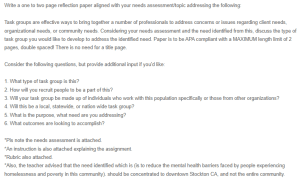
Write a one to two page reflection paper aligned with your needs assessment/topic addressing the following:
Task groups are effective ways to bring together a number of professionals to address concerns or issues regarding client needs, organizational needs, or community needs. Considering your needs assessment and the need identified from this, discuss the type of task group you would like to develop to address the identified need. Paper is to be APA compliant with a MAXIMUM length limit of 2 pages, double spaced! There is no need for a title page.
Developing a Task Group to Address Mental Health Barriers
Consider the following questions, but provide additional input if you’d like:
1. What type of task group is this?
2. How will you recruit people to be a part of this?
3. Will your task group be made up of individuals who work with this population specifically or those from other organizations?
4. Will this be a local, statewide, or nation wide task group?
5. What is the purpose, what need are you addressing?
6. What outcomes are looking to accomplish?
*Pls note the needs assessment is attached.
*An instruction is also attached explaining the assignment.
*Rubric also attached.
*Also, the teacher advised that the need identified which is (is to reduce the mental health barriers faced by people experiencing homelessness and poverty in this community). should be concentrated to downtown Stockton CA, and not the entire community.
 Complete the order form and upload all of your files, including any instructions, rubrics, or other materials provided by your instructor.
  Complete the order payment after filling in the order form. We’ll receive your order and assign it to a writer.
 The assigned writer will complete your paper and forward it to our Editing Team for review and approval.
 Once approved by the editor, the completed paper will be uploaded to your account for you to download, review and approve.