
Determining the Resources of Evidence and Resources – Sepsis
Evidence-based practice (EBP) is critical for determining the best and most appropriate practice in rendering care to patients within the current healthcare setting. Sepsis is a severe, potentially fatal illness caused by an infection that affects various organs in the body and poses plenty of problems to the caretakers, given its abrupt onset and steep mortality index. The use of evidence-based practices in sepsis treatment means that everything done is in line with the best practices as sourced from current research, which has been proven to increase the patients’ outcomes. Baccalaureate-prepared registered nurses, therefore, have a pivotal role to play in the application of this evidence in practice (Mohamed et al., 2024). It is a common requirement for nurses to base their decisions on local and international evidence for the improvement of patient care and safety. This paper seeks to establish the factors that make sources such as journal articles and websites credible, as well as the role of models when handling sepsis cautiously.
Describe the Chosen Diagnosis
Sepsis: A Diagnosis in Need of Evidence-Based Intervention
Sepsis is an inflammatory response of the body’s organs and tissues to the presence of infection that leads to a reduction in organ functions. As noted by Gauer et al. (2020), sepsis is one of the main reasons for patients’ hospitalization and a leading cause of death globally. Screening, early detection, and early treatment play a vital role in decreasing mortality and increasing the survival of the patients. If not addressed, sepsis could turn into septic shock, multiple organ dysfunction, and, in some cases, death. The use of evidence-based practice is crucial in sepsis management, predominantly due to the ability to integrate the most recent information and data available for practice (Abdalhafith et al., 2025). Because early assessment and management are so essential, these guidelines must be integrated into interventions rated by nurses.
Criteria for Determining the Credibility of Resources
Appreciating the various resources available helps ascertain which journal articles or websites are credible enough to be applied in practice. It will be essential to consider the following aspects when assessing these resources:
Authority
Resources need to be from credible sources, those being peer-reviewed journals, established medical organizations, or government health agencies. For instance, the Guidelines of the Surviving Sepsis Campaign (SSC), which are very well accepted by critical care organizations, represent high-quality evidence for sepsis management (Rello et al., 2020).
Currency
The evidence should be as current as possible, especially in areas such as sepsis, where changes occur frequently in terms of guidelines and management. For instance, the current SSC guidelines are revised from time to time in accordance with the emerging literature and research advancements in sepsis treatment (Santacroce et al., 2024).
Accuracy
It is required that the information presented holds factual information and is grounded in empirical research. In general, if an article has undergone a rigorous peer review process, for example, articles published in PubMed or the Cochrane Library, etc, are usually deemed to be accurate and reliable.
Relevance
The information should be so directly applicable to the clinical context where it will be used that it would be safer either to develop it yourself or to obtain it in other ways. Nurses specifically dealing with sepsis cases in hospitals need evidence-based protocols for sepsis management, for instance.
Purpose
A resource should be intended to be educational or informational, as opposed to promotional. For example, clinical guidelines of the World Health Organization (WHO) or the CDC are utilized to enhance healthcare delivery and are not driven by commercial interests.
With respect to these criteria, authority, currency, and accuracy in the care of sepsis, resources such as the Surviving Sepsis Campaign guidelines and studies from PubMed are highly credible (Evans et al., 2021).
Analyze the Credibility and Relevance of Evidence
Thus, in evaluating credibility and relevance in order to identify diverse resources related to sepsis, a closer look is taken at specific sources.
Surviving Sepsis Campaign Guidelines
These guidelines present best practice interventions in the identification, fluid therapy, and use of antimicrobial agents in sepsis cases. It is also important to note that SSC is a reputable source, which has been approved by such global organizations as the World Health Organization and is revised in accordance with the available evidence on a regular basis (Critical Care Medicine, 2021). They are helpful for sepsis care because some of the highlights reflect the most vulnerable areas that need to be handled keenly when sepsis is being managed, for instance, time to first evaluation for intensive care, initial resuscitation, and early management of sepsis.
PubMed and CINAHL
These databases give access to the full text of peer-reviewed journal articles, clinical trials, and systematic reviews, and they contain a wide-ranging set of evidence-based research. These repositories of materials may encompass research on the multiple effectiveness of various sepsis interventions, such as early goal-directed protocol. The information provided in such resources is as credible, up-to-date, and relevant to clinical practice in sepsis management as any found elsewhere.
Cochrane Library
This resource focuses on the identification of systematic reviews and meta-analyses, making it an excellent source of the best quality and most relevant evidence on the efficacy of treatments. The Cochrane Library provides a meta-analysis of treatment options such as fluid and use of antimicrobial agents that are directly relevant to the clinical management of sepsis.
Thus, with the help of these sources, the most relevant evidence that may help nurses and other healthcare givers to manage sepsis optimally can be singled out.
Identify an Evidence-Based Practice Model
Among the models that can be applied in a clinical setting, the Iowa Model of Evidence-Based Practice helps very much in handling sepsis. Iowa Model refers to a systematic method of handling a problem in a systematic manner where one initially searches for information on the issue before embarking on gathering more evidence about the cause, implementing what has been learned, and determining the effects. The identified model promotes the application of the current research of evidence, integrating it into clinical practice for the improvement of the patient’s care, as noted by Duff et al. (2020). For the clinical practices to be well grounded on adequate evidence gathered from the current database, it is necessary to incorporate credible evidence in the Iowa Model. For instance, the application of Surviving Sepsis Campaign guidelines within the Iowa Model enables healthcare practitioners to adhere to the best practices, such as giving fluids and antibiotics combined within specific time constraints, which have actually been proven to enhance patient outcomes. With the use of this model, nurses can make the right decisions regarding the health of their patients with the ultimate goal of delivering high-quality care to their patients and reducing risks to their lives.
Conclusion
Using evidence findings in clinical practice forms part of the principles of modern healthcare, especially when dealing with complicated illnesses such as sepsis. Hence, healthcare providers should assess the credibility of resources like Surviving Sepsis Campaign guidelines, PubMed, and the Cochrane Library so that the most accurate results can be achieved. The direct application of the Iowa Model of Evidence-Based Practice takes the evidence to the next level. It implements it directly into the practice arena to ensure that the interventions being utilized clinically are founded on current research. As more and more nurses adopt EBP, patients will experience better outcomes, and the delivery of care will prove to be enhanced.
References
Abdalhafith, O., Rababa, M., Hayajneh, A. A., Alharbi, T. A. F., Alhumaidi, B., & Alharbi, M. N. (2025). Critical care nurses’ knowledge, confidence, and clinical reasoning in sepsis management: A systematic review. BMC Nursing, 24(1). https://doi.org/10.1186/s12912-025-02986-1
Critical Care Medicine. (2021, October 4). Surviving Sepsis Campaign Guidelines 2021. Society of Critical Care Medicine (SCCM). https://www.sccm.org/Clinical-Resources/Guidelines/Guidelines/Surviving-Sepsis-Guidelines-2021
Duff, J., Cullen, L., Hanrahan, K., & Steelman, V. (2020). Determinants of an evidence-based practice environment: an interpretive description. Implementation Science Communications, 1(1). https://doi.org/10.1186/s43058-020-00070-0
Evans, L., Rhodes, A., Alhazzani, W., Antonelli, M., Coopersmith, C. M., French, C., Machado, F. R., Mcintyre, L., Ostermann, M., Prescott, H. C., Schorr, C., Simpson, S., Wiersinga, W. J., Alshamsi, F., Angus, D. C., Arabi, Y., Azevedo, L., Beale, R., Beilman, G., & Belley-Cote, E. (2021). Surviving sepsis campaign: International Guidelines for Management of Sepsis and Septic Shock 2021. Intensive Care Medicine, 47(11), 1181–1247. https://doi.org/10.1007/s00134-021-06506-y
Gauer, R., Forbes, D., & Boyer, N. (2020). Sepsis: Diagnosis and management. American Family Physician, 101(7), 409–418. https://pubmed.ncbi.nlm.nih.gov/32227831/
Mohamed, R. A., Alhujaily, M., Ahmed, F. A., Nouh, W. G., & Almowafy, A. A. (2024). Nurses’ experiences and perspectives regarding evidence‐based practice implementation in healthcare context: A qualitative study. Nursing Open, 11(1), e2080. https://doi.org/10.1002/nop2.2080
Rello, J., Tejada, S., Xu, E., Solé-Lleonart, C., Campogiani, L., Koulenti, D., Ferreira-Coimbra, J., & Lipman, J. (2020). Quality of evidence supporting surviving sepsis campaign recommendations. Anaesthesia Critical Care & Pain Medicine, 39(4), 497–502. https://doi.org/10.1016/j.accpm.2020.06.015
Santacroce, E., D’Angerio, M., Ciobanu, A. L., Masini, L., Lo Tartaro, D., Coloretti, I., Busani, S., Rubio, I., Meschiari, M., Franceschini, E., Mussini, C., Girardis, M., Gibellini, L., Cossarizza, A., & De Biasi, S. (2024). Advances and challenges in sepsis management: Modern tools and future directions. Cells, 13(5), 439. https://doi.org/10.3390/cells13050439
ORDER A PLAGIARISM-FREE PAPER HERE
We’ll write everything from scratch
Question 
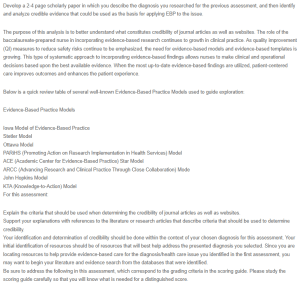
Develop a 2-4 page scholarly paper in which you describe the diagnosis you researched for the previous assessment, and then identify and analyze credible evidence that could be used as the basis for applying EBP to the issue.
Determining the Resources of Evidence and Resources
The purpose of this analysis is to better understand what constitutes credibility of journal articles as well as websites. The role of the baccalaureate-prepared nurse in incorporating evidence-based research continues to growth in clinical practice. As quality improvement (QI) measures to reduce safety risks continue to be emphasized, the need for evidence-based models and evidence-based templates is growing. This type of systematic approach to incorporating evidence-based findings allows nurses to make clinical and operational decisions based upon the best available evidence. When the most up-to-date evidence-based findings are utilized, patient-centered care improves outcomes and enhances the patient experience.
Below is a quick review table of several well-known Evidence-Based Practice Models used to guide exploration:
Evidence-Based Practice Models
Iowa Model of Evidence-Based Practice
Stetler Model
Ottawa Model
PARiHS (Promoting Action on Research Implementation in Health Services) Model
ACE (Academic Center for Evidence-Based Practice) Star Model
ARCC (Advancing Research and Clinical Practice Through Close Collaboration) Mode
John Hopkins Model
KTA (Knowledge-to-Action) Model
For this assessment:
Explain the criteria that should be used when determining the credibility of journal articles as well as websites.
Support your explanations with references to the literature or research articles that describe criteria that should be used to determine credibility.
Your identification and determination of credibility should be done within the context of your chosen diagnosis for this assessment. Your initial identification of resources should be of resources that will best help address the presented diagnosis you selected. Since you are locating resources to help provide evidence-based care for the diagnosis/health care issue you identified in the first assessment, you may want to begin your literature and evidence search from the databases that were identified.
Be sure to address the following in this assessment, which correspond to the grading criteria in the scoring guide. Please study the scoring guide carefully so that you will know what is needed for a distinguished score.
Describe a chosen diagnosis that could benefit from an evidence-based approach.
Explain criteria that should be considered when determining credibility of resources such as journal articles and websites.
Analyze the credibility and relevance of evidence and resources within the context of a chosen diagnosis.
This is where you are selecting the specific resources to help address the diagnosis you selected for the first assessment.
Identify the Evidence-Based Practice model and explain the importance of incorporating credible evidence into the EBP model used to address a chosen diagnosis. Review the literature below and choose the appropriate model for your diagnosis.
Selecting a model for evidence-based practice changes. [PDF] and Evidence-Based Practice Models help explain the various evidence-based nursing models.
Communicate using writing that is clear, logical, and professional with correct grammar and spelling using current APA style.
Your assessment should meet the following requirements:
Length of submission: 2-4-page scholarly paper, this does not include the APA-formatted title page and reference list.
Number of references: Cite 3-5 sources of scholarly or professional evidence that support your findings and considerations. Resources should be no more than five years old.
APA formatting: References and citations are formatted according to current APA style.
 Complete the order form and upload all of your files, including any instructions, rubrics, or other materials provided by your instructor.
  Complete the order payment after filling in the order form. We’ll receive your order and assign it to a writer.
 The assigned writer will complete your paper and forward it to our Editing Team for review and approval.
 Once approved by the editor, the completed paper will be uploaded to your account for you to download, review and approve.