
Determining the Credibility of Evidence and Resources for Chronic Kidney Disease (CKD) Management
Evidence-based practice (EBP) is the foundation of modern nursing and promotes balanced clinical decision-making between the latest external evidence, clinician skills, and patient values. Credible, timely information is paramount in managing complex conditions such as CKD to offer patient-centered care, improve outcomes, and reduce healthcare risk. As more nurses take up the leadership role in healthcare reform, it is imperative to understand how to evaluate the credibility of evidence. The paper will explain the criteria for assessing the credibility of journal articles and websites, assess critically selected sources relevant to CKD management, and use an effective EBP model to facilitate the implementation of viable evidence into practice.
Description of CKD and the Value of an Evidence-Based Approach
Chronic kidney disease is a progressive kidney disease with loss of kidney function over months or years. An estimated 37 million Americans have chronic kidney disease (CKD). Approximately 90% do not know about their condition due to low awareness of the importance of CKD testing and diagnosis among practitioners and people at risk for CKD (Alfego et al., 2021). If untreated, CKD can progress to end-stage renal disease (ESRD), requiring dialysis or transplant. Given that CKD treatment involves medication adherence, dietary modification, lifestyle adjustment, and referral to specialists, EBP is crucial to direct such multifaceted interventions. Applying EBP in the care of advanced CKD patients facilitates consistency in treatment and improves adherence to clinical guidelines, especially when nurses and physicians are actively engaged in the process. As emphasized, “We need to communicate more with each other, so that we all row in the same direction and apply the same approach” (Pintado-Outumuro et al., 2024, p. 10).
Criteria for Determining Credibility of Evidence
The CRAAP test is a widely recognized tool for evaluating sources based on currency, relevance, authority, accuracy, and purpose (Kampen, 2023). Each criterion is critical in assessing whether an article or website suits evidence-based clinical practice.
Currency
Currency refers to the timeliness of information. For CKD, where new pharmacological therapies and treatment algorithms are rapidly emerging, sources must be published within the last five years to remain relevant. Databases like PubMed and Cochrane Library update frequently and provide filters for the most recent studies.
Relevance
Relevance ensures the information applies to the clinical question and patient context. Resources focusing on dialysis management, nutritional interventions, and CKD-related cardiovascular risks are highly applicable to nursing practice. Resources should align with nursing roles and patient education needs.
Authority
Authority assesses the qualifications of the authors and publishers. Credible sources include government health agencies, peer-reviewed journals, and professional organizations like the National Kidney Foundation. Authorship credentials and institutional affiliations must be verifiable.
Accuracy
Accuracy pertains to the reliability and validity of the content. Sources should be supported by scientific evidence, cite referenced studies, and present balanced, error-free information. Meta-analyses and randomized controlled trials are especially valuable for guiding clinical decisions.
Purpose
Purpose examines the intent behind the content. Resources intended for education, research, or clinical application are preferred over those with promotional or commercial bias. For example, Cochrane Library articles are free of advertising and provide unbiased, evidence-based conclusions.
Analysis of Credible Resources for CKD Management
PubMed
The U.S. National Library of Medicine maintains PubMed and offers access to over 38 million citations from biomedical literature (PubMed, 2025). It is especially effective for locating current, peer-reviewed articles relevant to CKD, including studies on dialysis modalities, pharmacologic interventions, comorbidity management, and health outcomes. PubMed’s powerful search engine and Medical Subject Headings (MeSH) enhance the precision of literature retrieval, allowing nurses to tailor evidence queries to CKD-specific patient care issues. For example, nurses can access randomized controlled trials or systematic reviews for the efficacy of ACE inhibitors in slowing CKD progression.
CINAHL (Cumulative Index to Nursing and Allied Health Literature)
CINAHL is maintained by EBSCO and offers access to authoritative nursing and allied health literature. The database indexes top nursing journals and publications from reputable organizations such as the National League for Nursing and the American Nurses Association. Its comprehensive coverage includes nursing, biomedicine, health sciences librarianship, alternative/complementary medicine, consumer health, and 17 allied health disciplines (EBSCO, 2025). For nurses managing CKD, CINAHL is an essential resource for locating high-quality, discipline-specific evidence to support clinical decision-making.
The Cochrane Library
Cochrane maintains the Cochrane Library and offers access to systematically reviewed and rigorously synthesized healthcare evidence. The Cochrane Library’s peer-reviewed content is developed using strict editorial standards to minimize bias and enhance reliability (Cochrane Library, 2022). Its reviews include meta-analyses on the effectiveness of dialysis techniques, interventions for slowing CKD progression, and pharmacologic treatment comparisons. For nurses managing CKD, the Cochrane Library is an essential resource for locating high-level, evidence-based guidance to support clinical decision-making and to recommend policy or procedural updates for nephrology care.
National Kidney Foundation (NKF)
NKF provides authoritative, up-to-date clinical practice guidelines and patient education resources. NKF, being a specialty society, has publications such as the Kidney Disease Outcomes Quality Initiative (KDOQI) guidelines developed by expert panels from peer-reviewed evidence. NKF is revolutionizing the fight to save lives by eliminating preventable kidney disease, accelerating innovation for the dignity of the patient experience, and dismantling structural inequities in kidney care, dialysis, and transplantation (National Kidney Foundation, 2024). The site’s utilities are helpful in making conflicting evidence comprehensible for patient education and clinical settings. Therefore, they are a necessary resource for nurses who plan long-term care for CKD patients.
Hospital Policy Portal (Intranet Access)
The hospital intranet provides access to institution-specific guidelines and clinical pathways. While not peer-reviewed, these documents ensure alignment with regulatory standards and standardized care. For CKD, this may include hemodialysis checklists, potassium management algorithms, and discharge instructions. These protocols translate research into practical, policy-driven care delivery.
Evidence-Based Practice Model
The Iowa Model of Evidence-Based Practice is widely used for translating evidence into practice decision-making. According to Brunt and Morris (2023), the ARCC model promotes evidence-based practice by utilizing EBP mentors and cognitive behavioral strategies to foster sustainable system-wide changes in nursing care practices. The model most directly applies to CKD care, where interprofessionality between nephrology, pharmacy, and nursing is essential.
Using the Iowa Model, a nurse who finds phosphate control to be suboptimal among patients with CKD would assemble a team to examine NKF and Cochrane guidelines, pilot a revised dietary education protocol, and examine lab trends postintervention. This systematic approach ensures that sound evidence exists and is tested, implemented, and sustained within practice. Ongoing feedback and system-level inclusion offered by the Iowa Model are amenable to CKD’s long-term management needs.
Conclusion
Accurate evidence forms the basis of quality care, particularly in chronic conditions such as CKD. As demonstrated in this paper, evaluation of evidence using measures like the CRAAP test and application of proven models of EBP ensures relevance, insight, and efficacy of clinical judgments. Tools such as databases PubMed, CINAHL, and Cochrane and institutions like the NKF provide accurate sources to inform care. Using the Iowa Model, nurses can courageously incorporate evidence into practice to foster improved outcomes, reduce complications, and enhance professional standards in CKD care.
References
Alfego, D., Ennis, J., Gillespie, B. E., Lewis, M. E., Montgomery, E. A., Ferrè, S., Vassalotti, J. A., & Letovsky, S. (2021). Chronic kidney disease testing among at-risk adults in the U.S. remains low: Real-world evidence from a National Laboratory Database. Diabetes Care, 44(9), 2025–2032. https://doi.org/10.2337/dc21-0723
Brunt, B., & Morris, M. (2023, March 4). Nursing professional development evidence-based practice. National Library of Medicine. https://www.ncbi.nlm.nih.gov/books/NBK589676/
Cochrane Library. (2022). About the Cochrane Library. Cochrane Library. https://www.cochranelibrary.com/about/about-cochrane-library
EBSCO. (2025). CINAHL Database. EBSCO. https://www.ebsco.com/products/research-databases/cinahl-database
Kampen, K. V. (2023). Library guides: Evaluating resources and misinformation: CRAAP test. UChicago Library. https://guides.lib.uchicago.edu/c.php?g=1241077&p=9082343
National Kidney Foundation. (2024, December 13). Advancing kidney health equity: NKF’s 2024 advocacy wins. National Kidney Foundation. https://www.kidney.org/news-stories/advancing-kidney-health-equity-nkf-s-2024-advocacy-wins
PubMed. (2025). PubMed Overview. PubMed; National Library of Medicine. https://pubmed.ncbi.nlm.nih.gov/about/
ORDER A PLAGIARISM-FREE PAPER HERE
We’ll write everything from scratch
Question 
Determining the Credibility of Evidence and Resources for Chronic Kidney Disease (CKD) Management
Develop a 2-4 page scholarly paper in which you describe the diagnosis you researched for the previous assessment, and then identify and analyze credible evidence that could be used as the basis for applying EBP to the issue.
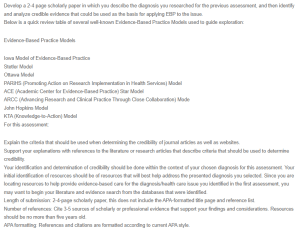
Below is a quick review table of several well-known Evidence-Based Practice Models used to guide exploration:
Determining the Credibility of Evidence and Resources
Evidence-Based Practice Models
Iowa Model of Evidence-Based Practice
Stetler Model
Ottawa Model
PARiHS (Promoting Action on Research Implementation in Health Services) Model
ACE (Academic Center for Evidence-Based Practice) Star Model
ARCC (Advancing Research and Clinical Practice Through Close Collaboration) Mode
John Hopkins Model
KTA (Knowledge-to-Action) Model
For this assessment:
Explain the criteria that should be used when determining the credibility of journal articles as well as websites.
Support your explanations with references to the literature or research articles that describe criteria that should be used to determine credibility.
Your identification and determination of credibility should be done within the context of your chosen diagnosis for this assessment. Your initial identification of resources should be of resources that will best help address the presented diagnosis you selected. Since you are locating resources to help provide evidence-based care for the diagnosis/health care issue you identified in the first assessment, you may want to begin your literature and evidence search from the databases that were identified.
Length of submission: 2-4-page scholarly paper, this does not include the APA-formatted title page and reference list.
Number of references: Cite 3-5 sources of scholarly or professional evidence that support your findings and considerations. Resources should be no more than five years old.
APA formatting: References and citations are formatted according to current APA style.
 Complete the order form and upload all of your files, including any instructions, rubrics, or other materials provided by your instructor.
  Complete the order payment after filling in the order form. We’ll receive your order and assign it to a writer.
 The assigned writer will complete your paper and forward it to our Editing Team for review and approval.
 Once approved by the editor, the completed paper will be uploaded to your account for you to download, review and approve.