
Determining the Credibility of Evidence and Resources
As care approaches tend towards patient-centeredness and the pursuit of quality and safe healthcare heightens, evidence-based practice remains central to these advances. These approaches utilize the best available evidence in the literature and incorporate them into care processes. Evidence-based practice (EBP) models provide a systematic framework for the rapid and appropriate integration of new research into current practice. This paper details the criteria for ascertaining the credibility of resources utilizable in managing long-term complications of diabetes and the relevance of these resources in diabetic care. It will also outline the importance of incorporating evidence using EBP models.
Description of the Chosen Clinical Diagnosis
Long-term complications of diabetes are one of the key disturbing healthcare issues of diabetes management. These complications have been implicated in human suffering, deterioration in the quality of life of diabetic patients, and escalated costs of managing the disease. Current approaches in managing long-term complications target prevention through aggressive diabetic control and early detection of these complications to minimize their effects on individuals (Liu et al., 2022). Evidence-based approaches in diabetes management inform effective management strategies that improve clinical outcomes for patients with the disease. These approaches may considerably lower the incidence of diabetic complications and, therefore, prolong these patients’ lives (Valencia & Dols, 2021). Various resources on comprehensive diabetic care outline interventions for managing these complications, reinforcing their significance in care processes.
Criteria Considered when Determining Credibility of Resources
The CRAAP model provides a valuable evaluation tool for determining the credibility of resources such as journal articles and websites. The criteria outlined in this model are currency, relevancy, authority, accuracy, and purpose. Currency details the timelines of the information presented in the article. For a source to meet the credibility criteria, it must have been produced recently to inform the most current best practices in healthcare. Relevancy, conversely, defines the significance of the information found in various sources to the field of study. Next, authority defines the source of information. This provision distinguishes high-quality sources from sources whose standards are not ascertainable. Accuracy is another criterion that defines how truthful or correct the information in articles or other sources is, while purpose is why the information exists. Whereas accuracy points to the validity of the information and interrogates who may have come up with the information, purpose interrogates their intentions for availing it. The purpose will point at the need for that information in healthcare practice. Accordingly, all these criteria should be met before including a source for EBP.
Analyzing the Credibility and Relevance of Evidence and Resources Within the Context of Diabetes
The CRAAP model maintains significance in evaluating evidence and resources applicable to diabetic care. The credibility of a source utilized in this regard should meet the criteria for currency, relevance, authority, accuracy, and purpose. Several resources on comprehensive management of diabetes detail best practices in preventing and managing long-term complications of diabetes. Karthik et al. (2020) and Negash & Yismaw (2020) outline best practices in the comprehensive management of diabetes. These resources meet the credibility criteria outlined by the CRAAP model. The resource “Self-care practices among type II diabetics in a rural area of Kancheepuram district, Tamil Nadu”, outlines self-care practices among type 2 diabetics. This article meets the credibility criteria of currency as it was published in 2020 and is relevant as it outlines self-care as a best practice in diabetes care and its significance in lowering diabetic complications. It is also accurate as it is backed by scientific evidence. This article also meets the authority and purpose criteria as it is peer-reviewed and is targeted at influencing aspects of diabetes management to favour self-care as a best practice in preventing long-term complications.
The article “Management Practice and Contributing Risk Factors for Chronic Complications Among Type 2 Diabetes Mellitus Adult Patients in Follow-Up at a Tertiary Care Teaching Hospital” also meets the credibility criteria. It is current as it was established in 2020, relevant as it outlines management practices in type 2 diabetes. The article is authoritative as it is peer-reviewed, accurate, and backed by scientific evidence. This article also meets the criteria of purpose as it outlines diabetes management practices that prolong the life of diabetics, improve their quality of life, and lower their likelihood of developing diabetic complications.
Evidence-Based Practice Model and the Importance of Incorporating Credible Evidence into the EBP Model
Evidence-Based Practice Models are theoretical frameworks that allow for fast implementation of evidence and sources. The Johns Hopkins Nursing Evidence-Based (JHNEB) model is an example of an EBP model that can guide the implementation of pieces of evidence. This model emphasizes individual use rather than a system approach. It outlines a three-phased approach to implementing evidence. These are identifying the EBP question, the appraisal, rating, and description of the quality of evidence that adequately answers the EBP, and the translation phase (Liza Anicoche & Kaiser, 2021). This three-thronged approach offers a simplistic mechanism for incorporating changes in care processes.
Incorporating credible evidence into an EBP model is important as these models guide the integration of this evidence to create best care practices. These models also assure complete implementation of the provisions of these credible pieces of evidence or sources. This, in turn, optimizes healthcare providers’ utilization of organizational resources and time. By providing a systematic way of implementing changes, these model eliminates confusion during these processes that may reduce their effectiveness in practice (Speroni et al., 2020). In diabetic care, the JHNEB model can guide the implementation of specific changes in healthcare, such as the adoption of healthcare information technologies and glucose monitoring devices in patient monitoring, which are integral in comprehensive diabetes management.
Conclusion
Long-term diabetic complication remains a concerning healthcare issue that contributes significantly to suffering and death. New approaches in diabetic care targeted at minimizing these complications and improving their management may be valuable in lessening the health impacts of this problem. The CRAAP model of ascertaining the credibility of articles can be vital in evaluating research on diabetic care. Credible evidence can be integrated into practice using EBP models like the JHNEB. These models provide a systematic approach to implementing changes in healthcare, highlighting their significance.
References
Karthik, R. C., Radhakrishnan, A., Vikram, A., Arumugam, B., & Jagadeesh, S. (2020). Self-care practices among type II diabetics in a rural area of Kancheepuram District, Tamil Nadu. Journal of Family Medicine and Primary Care, 9(6), 2912. https://doi.org/10.4103/jfmpc.jfmpc_356_20
Liu, Y., Ning, X., Zhang, L., Long, J., Liang, R., Peng, S., Wang, H., Li, Y., Chen, W., & Xiao, H. (2022). Prevalence of long-term complications in inpatients with diabetes mellitus in China: A nationwide Tertiary Hospital-based study. BMJ Open Diabetes Research & Care, 10(3). https://doi.org/10.1136/bmjdrc-2021-002720.
Liza Anicoche, P. I., & Kaiser, C.-I. L. (2021). The Johns Hopkins Evidence-based practice (EBP) model: Weinberg perianesthesia interventions for a healing environment. Journal of PeriAnesthesia Nursing, 36(4). https://doi.org/10.1016/j.jopan.2021.06.064.
Negash, Z., & Yismaw, M. (2020). Management practice and contributing risk factors for chronic complications among type 2 diabetes mellitus adult patients in follow-up at a tertiary care teaching hospital. Diabetes, Metabolic Syndrome and Obesity: Targets and Therapy, Volume 13, 3969–3976. https://doi.org/10.2147/dmso.s275677
Speroni, K. G., McLaughlin, M. K., & Friesen, M. A. (2020). Use of evidence‐based practice models and research findings in magnet‐designated hospitals across the United States: National survey results. Worldviews on Evidence-Based Nursing, 17(2), 98–107. https://doi.org/10.1111/wvn.12428.
Valencia, Y., & Dols, J. D. (2021). Facilitating adherence to evidence-based practices for adults with type 2 diabetes mellitus. The Journal for Nurse Practitioners, 17(6), 744–748. https://doi.org/10.1016/j.nurpra.2020.12.027
ORDER A PLAGIARISM-FREE PAPER HERE
We’ll write everything from scratch
Question 
Develop a 2-4 page scholarly paper in which you describe a quality or safety issue or a chosen diagnosis, and then identify and analyze credible evidence that could be used as the basis for applying EBP to the issue.
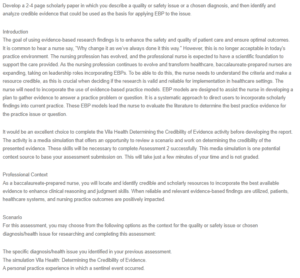
Determining the Credibility of Evidence and Resources
Introduction
The goal of using evidence-based research findings is to enhance the safety and quality of patient care and ensure optimal outcomes. It is common to hear a nurse say, “Why change it as we’ve always done it this way.” However, this is no longer acceptable in today’s practice environment. Nursing has evolved, and the professional nurse is expected to have a scientific foundation to support the care provided. As the nursing profession continues to evolve and transform healthcare, baccalaureate-prepared nurses are expanding, taking on leadership roles incorporating EBPs. To be able to do this, the nurse needs to understand the criteria and make a resource credible, as this is crucial when deciding if the research is valid and reliable for implementation in healthcare settings. The nurse will need to incorporate the use of evidence-based practice models. EBP models are designed to assist the nurse in developing a plan to gather evidence to answer a practice problem or question. It is a systematic approach to direct users to incorporate scholarly findings into current practice. These EBP models lead the nurse to evaluate the literature to determine the best practice evidence for the practice issue or question.
It would be an excellent choice to complete the Vila Health Determining the Credibility of Evidence activity before developing the report. The activity is a media simulation that offers an opportunity to review a scenario and work on determining the credibility of the presented evidence. These skills will be necessary to complete Assessment 2 successfully. This media simulation is one potential context source to base your assessment submission on. This will take just a few minutes of your time and is not graded.
Professional Context
As a baccalaureate-prepared nurse, you will locate and identify credible and scholarly resources to incorporate the best available evidence to enhance clinical reasoning and judgment skills. When reliable and relevant evidence-based findings are utilized, patients, healthcare systems, and nursing practice outcomes are positively impacted.
Scenario
For this assessment, you may choose from the following options as the context for the quality or safety issue or chosen diagnosis/health issue for researching and completing this assessment:
The specific diagnosis/health issue you identified in your previous assessment.
The simulation Vila Health: Determining the Credibility of Evidence.
A personal practice experience in which a sentinel event occurred.
Instructions
This analysis aims to understand better what constitutes the credibility of journal articles and websites. The role of the baccalaureate-prepared nurse in incorporating evidence-based research continues to grow in clinical practice. As quality improvement (QI) measures to reduce safety risks continue to be emphasized, the need for evidence-based models and templates is growing. This systemic approach to incorporating evidence-based findings allows nurses to make clinical and operational decisions based on the best available evidence. When the most up-to-date evidence-based findings are utilized, patient-centered care improves outcomes and enhances the patient experience.
Below is a quick review table of several well-known Evidence-Based Practice Models used to guide exploration:
Evidence-Based Practice Models
Iowa Model of Evidence-Based Practice
Stetler Model
Ottawa Model
PARiHS (Promoting Action on Research Implementation in Health Services) Model
ACE (Academic Center for Evidence-Based Practice) Star Model
ARCC (Advancing Research and Clinical Practice Through Close Collaboration) Mode
John Hopkins Model
KTA (Knowledge-to-Action) Model
For this assessment:
Explain the criteria that should be used when determining the credibility of journal articles and websites.
Support your explanations with references to the literature or research articles that describe criteria that should be used to determine credibility.
Your identification and determination of credibility should be done within the context of your chosen scenario for this assessment. For example, if you choose to use the provided Vila Health scenario, your initial identification of resources should be of resources that will best help address the presented issue. However, suppose you are locating resources to help provide evidence-based care for the diagnosis/health care issue you identified in the first assessment. In that case, you may want to begin your literature and evidence search from the identified databases. Any of the three scenario options are acceptable. So, pick the one that most interests you.
Be sure to address the following in this assessment, corresponding to the grading criteria in the scoring guide. Please study the scoring guide carefully to know what is needed for a distinguished score.
Describe a quality or safety issue or a chosen diagnosis that could benefit from an evidence-based approach.
Explain criteria when determining the credibility of resources such as journal articles and websites.
Analyze the credibility and relevance of evidence and resources within a quality or safety issue or a chosen diagnosis.
You select the specific resources to help address the issue in your chosen scenario.
Identify the Evidence-Based Practice model and explain the importance of incorporating credible evidence into the EBP model to address a quality or safety issue or a chosen diagnosis/health care issue. Review the literature below and choose the appropriate model for your diagnosis/health care issue.
Selecting a model for evidence-based practice changes. [PDF] and Evidence-Based Practice Models help explain the various evidence-based nursing models.
Communicate using clear, logical, and professional writing with correct grammar and spelling using the current APA style.
 Complete the order form and upload all of your files, including any instructions, rubrics, or other materials provided by your instructor.
 Complete the order payment after filling in the order form. We’ll receive your order and assign it to a writer.
 The assigned writer will complete your paper and forward it to our Editing Team for review and approval.
 Once approved by the editor, the completed paper will be uploaded to your account for you to download, review and approve.